
 Share
Share 


Alberta is now the second province in Canada with a regulated online gambling market. And just days after launch, the Better Business Bureau is warning Albertans about a wave of fraudulent gambling ads and fake betting websites already plaguing the market.
According to Mary O’Sullivan-Andersen, the CEO of BBB serving Alberta and East Kootenay, the launch of new iGaming markets always draws in predators, and the launch of Alberta online casinos and sportsbooks is no exception.
“Scammers are the ultimate opportunists and the launch of legal online gambling in the province provides scammers an opportunity to try and confuse consumers and have them go to unregulated gambling sites or to straight-ahead fake sites,” said O’Sullivan-Andersen.
10,000 Complaints, a $402 Billion Black Market: The Numbers Behind the Warning
The consumer organization noted that between 2022 and mid-2025, it received over 10,000 complaints related to online gambling, with most starting from fake ads found online.
More interesting is that one of the BBB reports reveals that the value of the US regulated online gaming market sits at around $103 billion. The illegal online gambling market, on the other hand, is roughly four times that size, at an estimated $402 billion.
Here’s why that matters for Alberta right now: officials say more than half of the province’s online gambling activity was already happening before legalization, just through unregulated sites with zero oversight, zero fraud protection, and zero guarantee the platform was even real.
The goal of legalization isn’t creating new gamblers. It’s trying to drag existing ones out of the shadows. And the timing couldn’t be more ripe for scammers. Nearly 50 companies paid $200,000 each to register for Alberta’s launch, with 20+ live and fighting for customers on launch day.
That’s dozens of new, similarly-branded platforms flooding Albertans’ feeds all at once. The exact kind of chaos fraudsters thrive in, betting that one confused click lands on their site instead of a licensed one.
How to Tell a Real Gambling Ad From a Fake One
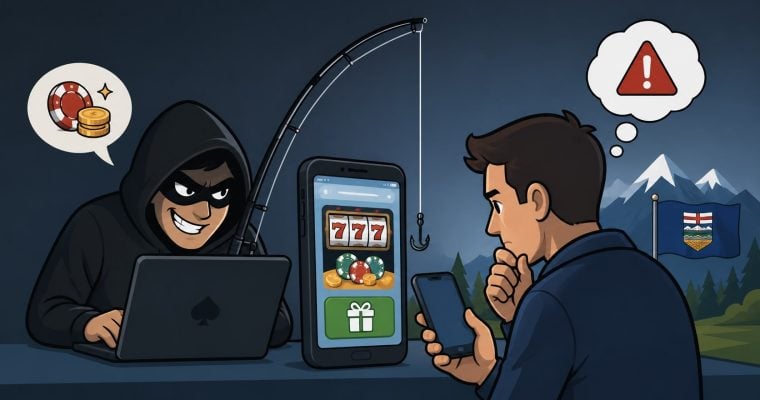
Not every casino ad you scroll past is exactly what it looks like. That’s the warning the Better Business Bureau is sounding, and Wes Lafortune, speaking for the BBB serving Alberta and East Kootenay, says the goal is simple: make people aware these fake ads exist in the first place.
Here’s how he put it:
“These (fake gambling advertisements) often pop up in social media feeds. You’ll see an ad for a casino, and often it’s either an illegal site operating overseas or an actual fake fraud site.”
So, how do you make sure you’re choosing a legit gambling website?
A Celebrity in the Ad Doesn’t Mean the Site Is Real
Social media feeds are the easiest place for a fake gambling ad to hide in plain sight. Sandwiched between posts from friends and brands you already trust, fraudsters hope that trust from such posts transfer over, even if the ad itself is all fake promises.
The BBB even said some of these ads have reportedly featured sports celebrities, such as NHL star Connor McDavid. But big names attached to a gambling ad don’t mean the site behind it is real. In fact, if the ad messaging is not about responsible gaming and it features a celebrity or public figure, it’s against the AGLC’s rules for advertising. So, before tapping through, pause and question the operator behind that link.
Check AiGC Registration Before You Do Anything Else
Checking for the site’s approval from the Alberta Gaming, Liquor, and Cannabis (AGLC) and the Alberta iGaming Corporation (AiGC) takes less time than it does to sign up for an account. In fact, it’s the single most reliable way to know a platform is real.
Every operator legally permitted to take bets or deposits and issue cashouts to Albertans has completed registration with the province. They also hold an active agreement with the AiGC, evidenced by an AiGC logo on the operator’s website and app.
What’s more, Albertans can find the full list of official legal and regulated operators in the province online at abigaming.ca. If a site or app isn’t on that list, it isn’t authorized to operate in Alberta, no matter how convincing the branding looks.
HTTPS Is a Start, Not Proof
Although not 100% foolproof, checking for ‘https’ when evaluating website addresses goes a long way in ensuring you’re accessing a secure website. That added ‘s’ means the site is encrypted, meaning your data isn’t traveling in plain, readable text as it moves between your browser and the server.
It’s a low bar, though, as scammers can buy an SSL certificate just as easily as any legitimate operator. So a padlock icon alone doesn’t prove a site is real. Treat it as one small check among several, useful for catching the laziest fakes, but no substitute for actually confirming a platform’s AiGC registration before you commit any real money.
Typos and Clunky Copy Are Worth a Second Look
Legitimate gambling operators spend real money on their websites by hiring copywriters, editors, legal review, the works. Fraud sites, by contrast, are usually built fast and cheap, often translated or copy-pasted in a hurry, and it shows. A misspelled word in the footer, an oddly phrased terms-and-conditions page, or a headline that reads like it went through a translator twice are all small tells that something isn’t right.
None of these mistakes alone proves a site is fake. After all, plenty of real businesses let a typo slip through. But sloppiness that shows up repeatedly, especially on pages handling money or personal information, is worth treating as a warning sign rather than a coincidence. If the writing feels rushed or slightly off, it’s reasonable to assume the security behind it might be too.
Crypto-Only Payouts Are a Warning Sign, Not a Convenience
Alberta’s gambling laws require licensed operators to run on standard, traceable payment rails. These include the likes of Interac e-Transfer, debit/credit cards, PayPal, and sometimes Apple Pay — all processed in Canadian dollars.
Unfortunately, cryptocurrencies don’t carry any built-in protections a credit/debit card gives you if something goes wrong. While designed to be fast and irreversible, the lack of traceability of these digital currencies works against the accountability the AGLC and AiGC require.
So, if a “casino/sportsbook” is asking Albertans to fund an account or pay out winnings in crypto as the only option, that alone is a strong sign that it’s operating outside the AGLC’s regulated framework.
Before You Deposit: The 60-Second Check
If you’re 18+ and in Alberta, the BBB’s advice is simple: verify an operator through the AiGC’s official portal before you sign up or deposit any money, not after.
Alberta’s new open iGaming market gives players more legitimate options than ever. But that same growth is exactly what scammers are counting on to slip past unnoticed. A few seconds spent checking a license or the AiGC logo, confirming the payment methods on offer, and reading a site’s fine print can save you from plenty.
The tools to verify are already public and free, so there’s no real reason not to use them before your first deposit lands.