
 Share
Share 


As Alberta moves toward a regulated iGaming market, private operators will be required to pay a 20% tax on gross gaming revenue (GGR), marking a significant step in the province’s effort to better capture value from online gambling.
This fixed levy is part of Bill 48, the iGaming Alberta Act, which establishes the legal framework for a government-regulated market supported by private operators.
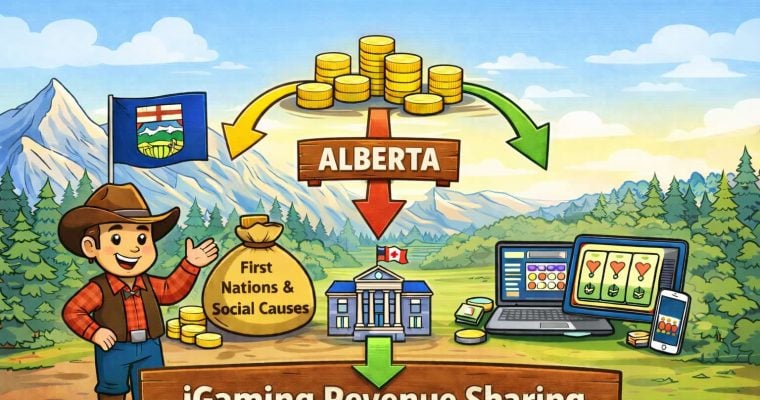
Under Alberta’s new revenue model, 3% of GGR is allocated upfront to First Nations initiatives and social responsibility programs. The remaining revenue is then split, with 80% going to Alberta online casino and sports betting site operators and 20% retained by the government. This structured approach signals a major shift in how iGaming revenue is distributed in the province.
Here’s what to expect from Alberta’s new revenue distribution policy for new iGaming sites.
Alberta’s New Revenue Allocation Formula for iGaming Operators
With private operators entering the market, the Alberta iGaming Corporation (AiGC) has established a commercial framework that outlines how revenue will be shared across licensed platforms.
Detailed in the government’s official document, Alberta’s iGaming Strategy, the model introduces a transparent structure for handling iGaming revenue—something the province has not previously implemented.
Historically, all net gaming revenue from Alberta’s only regulated platform, PlayAlberta, was directed to the province’s General Revenue Fund. The new system replaces that approach with a multi-tiered allocation model that distributes funds more broadly.
Alberta’s Commitment to Community Funding
A key feature of Alberta’s strategy is the 3% “top skim” applied to all gross gaming revenue before any other distribution occurs.
The allocation includes a 2% allocation to the First Nations Development Fund, which was initially funded by a portion of the proceeds from land-based casinos based in Alberta’s 48 First Nations. This ensures that First Nations communities continue to benefit from gaming revenue, even as activity shifts from land-based casinos to online platforms.
The other 1% is allocated to social responsibility initiatives, including responsible gambling programs and treatment services for problem gambling. These funds are distributed by the province to relevant organizations and public health bodies.
Together, these allocations highlight Alberta’s intent to balance revenue generation with community support and player protection.
iGaming Revenue Split with Providers
After the 3% allocation is deducted, the remaining revenue is split between operators and the province at an 80-20 ratio.
Operators retain 80%, which is used to cover operational costs such as platform maintenance, marketing, and customer acquisition. The remaining 20% goes to the Government of Alberta and is treated as general tax revenue, contributing to the provincial budget without specific spending restrictions.
Overall, Alberta’s model closely aligns with the structure used by Ontario online casinos and sportsbooks, where operators and the government also follow an 80-20 revenue split. The main difference is Alberta’s 3% top skim. Despite some minor differences in how each province manages its share, operators familiar with Ontario’s market should find Alberta’s system easy to navigate.