
 Share
Share 


There’s plenty of excitement around the launch of Alberta’s privatized iGaming market. But the truth is that not everyone is elated about it.
Alberta daily fantasy sports (DFS) and poker players have dreaded the launch of the open online gambling market. Why? Because the go-live date marks the start of swimming in much smaller ponds.
In late March 2026, a letter to iGaming stakeholders revealed that Alberta online casinos and sportsbooks would debut on July 13, 2026. That date also marks the last day that companies without AGLC licensing and local operating agreements must cease offering their gambling products within the province legally. Among these will be DFS betting platforms as well as online poker sites where Alberta residents compete in peer-to-peer games with global pools.
Once Alberta’s iGaming market makes its debut, such gaming ecosystems will be confined to within provincial borders.
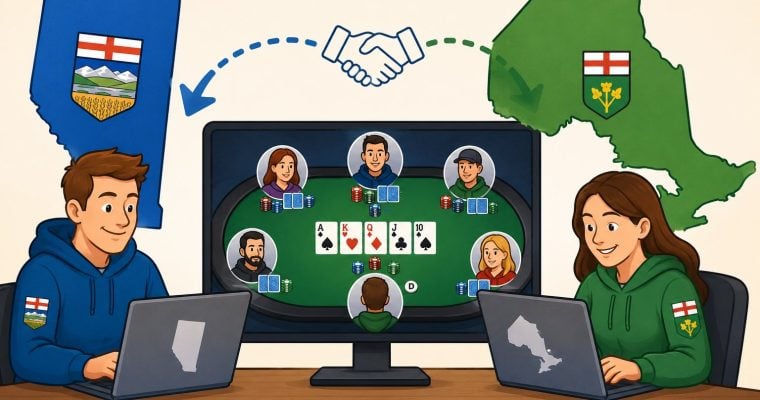
However, new Alberta iGaming Corporation (AiGC) Chief Dan Keene recently disclosed that a memorandum of understanding (MOU) between Alberta and Ontario is currently in the works.
Speaking with gambling industry expert Martin Lycka, Keene said:
“We’re currently working on a memorandum of understanding with Ontario about interprovincial liquidity. We’ll try and get that done as quickly as we can with our friends in Ontario. We are in favour of that … From a business and commercial perspective, it makes a lot of sense.”
What Interprovincial Liquidity Could Mean for Alberta and Ontario Residents
Keene’s remarks confirm what his counterpart at iGaming Ontario, Joseph Hiller, told the Canadian Gaming Summit back in December 2025: “Ontario and Alberta are ready to share player pooling to whatever extent possible.”
But here’s the problem: “to whatever extent possible” falls far short of what players are actually losing.
Albertans, as of June 2026, are participating in large, global pools on offshore-licensed platforms. PokerStars, for example, hosts tens of thousands of players online simultaneously across North America and Europe.
When Alberta’s regulated market launches on July 13, fans of online poker and DFS will be confined to a provincial, or at best, interprovincial, ecosystem. Even with Ontario’s 14.5 million residents combined with Alberta’s 4.6 million, the player pool will shrink by a factor of 10 to 20 compared to the global offshore sites Canadians are accustomed to.
This represents a genuine loss. Fewer players means smaller tournament guarantees and longer waits to find games at your skill level. It also implies less profitable action for professionals and semipros who’ve built their income around larger, more competitive tables. Casual players will find fewer opponents, especially during off-peak hours.
The interprovincial MOU is Alberta’s and Ontario’s attempt to soften the blow. Larger combined interprovincial player pools will help sustain more diverse game offerings while keeping operators competitive. But let’s be clear: This is mere damage control. It’s not a long-term solution, but it is the best they’re likely to get.
Ontario Exposed Canada’s Liquidity Problem
The same thing happened when Ontario launched its open iGaming market in April 2022. For operators like PokerStars and BetMGM, securing AGCO approval meant accepting a harsh trade-off: They could operate in Ontario, but only within Ontario-specific player pools.
What happened next revealed the fundamental flaw: Without access to larger player bases, Ontario’s poker and DFS markets struggled to sustain the action and liquidity players expected. Operators found themselves caught between regulatory compliance and market viability.
The result? Ontario’s regulated poker and DFS markets have remained relatively thin compared to what players experienced previously on international platforms. Games fill slower. Tournament fields are smaller, and the variety of stakes and formats is limited. This is one of the main reasons why players simply haven’t abandoned their international accounts completely despite active efforts from regulators.
And this is precisely why Alberta and Ontario are now pursuing interprovincial liquidity. A combined pool offers the scale and player depth that can compete with international poker rooms. Something that neither province could achieve alone.
The MOU represents an acknowledgment of what Ontario learned the hard way. Canadian players won’t accept smaller ponds if they have the option to keep swimming in larger ones.
International Liquidity is Still on the Table
While Alberta and Ontario look into the potential of interprovincial liquidity for their peer-to-peer gaming market, there’s the issue of international liquidity currently before the Canadian Supreme Court.
In late 2024, Ontario’s government filed a reference question at the Court of Appeal for Ontario. It sought clarification whether legal online gaming would remain “lawful” under Canada’s Criminal Code if the province allowed its residents to participate in betting and games involving players outside Canada.
In November 2025, the Court’s majority ruled 4-1 in favor of Ontario, allowing its players to play peer-to-peer games and place bets against other players outside Canada. However, that win was short-lived.
Several members of the Canadian Gaming Coalition filed an appeal in the Supreme Court. These include the Atlantic Lottery Corporation, British Columbia Lottery Corporation, and the Manitoba Liquor and Lotteries. The Mohawk Council of Kahnawake had also jumped into the fight, but recently backed down.
The Coalition’s primary concern centers on regulatory oversight. They argue that allowing Ontario players to compete against international opponents creates jurisdictional complications. If portions of the game exist outside Ontario’s borders, the province’s ability to enforce player protections and monitor activity becomes murky.
Ontario’s government, alongside Alberta’s, counters that provincial regulation of the Ontario-side operations is sufficient. The Ontario court sided with this interpretation, but the Coalition remains unconvinced, arguing the ruling sets a dangerous precedent for fragmented regulation across Canada’s gambling landscape.
As of June 2026, the case remains pending before the Supreme Court of Canada, with no hearing date scheduled.
Does Liquidity Only Affect Peer-to-Peer Poker and DFS betting?
While the Ontario court ruling and subsequent interprovincial discussions have focused heavily on poker and DFS, the conversation doesn’t necessarily end there.
Joseph Hillier, iGaming Ontario’s chief, has hinted that the potential scope extends beyond skill-based peer-to-peer games. In discussions about cross-border liquidity with Canadian Gaming Business, he has mentioned possibilities like progressive jackpot casino games that could theoretically benefit from shared player pools across provinces. The infrastructure being developed now for poker and DFS could eventually support other gaming formats.
“I think the opportunities could be significant,” said Hillier. “There’s definitely an eagerness to move things along as quickly as possible. But at the same time, it’s understanding where the true opportunities are. Peer-to-peer poker is something that people have spoken about, daily fantasy, maybe even super progressive jackpots on the casino side.”
The real question is whether regulators will maintain the flexibility to expand. Hillier himself has suggested that the framework should be designed with future possibilities in mind, remaining adaptable as the market matures. What opportunities might emerge in two or three years? Could shared progressive jackpots work across provinces? Could other casino-style products eventually qualify for interprovincial pooling?
For now, Alberta and Ontario are focused on getting poker and DFS right. But the liquidity infrastructure they’re building may ultimately prove to be the first step toward a more integrated Canadian gaming market. Whether that expansion happens depends on regulatory appetite, court decisions, and how quickly the interprovincial model proves itself viable.