
 Share
Share 


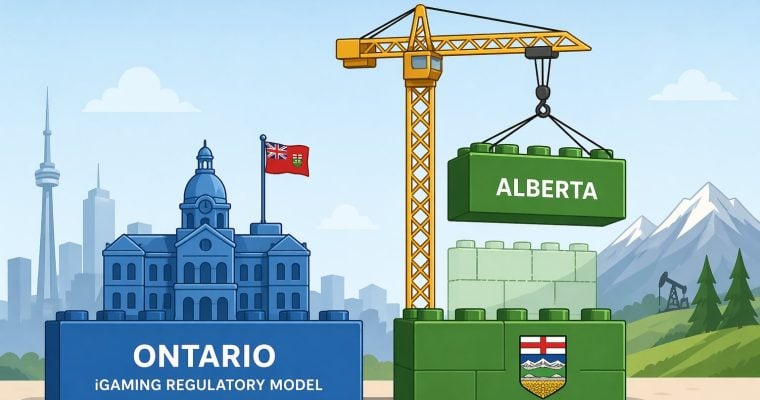
Ontario and Alberta are the only two Canadian provinces to break from the traditional model of provincially run gambling monopolies. And with Alberta building its private iGaming framework directly from Ontario’s blueprint, many operators might assume the two markets will function identically.
A closer examination of Alberta’s Standards and Requirements for Internet Gaming (SRIG) against Ontario’s equivalent framework tells a different story. The differences are significant, and understanding them is the first step for any Alberta online casinos and sportsbooks preparing to enter the market.
Wagering on Political Events: Alberta vs. Ontario
When comparing Ontario online gambling rules and those in Alberta, perhaps the most obvious difference is the status of political event wagering. The Alcohol and Gaming Commission of Ontario (AGCO) stipulates that licensed online sportsbooks can offer “novelty event” bets.
The market regulator defines such bets as “any bet placed on a non-sporting event where real-world factual occurrences are the contingency on which an outcome is determined.”
This definition comfortably covers wagers on political events, although specific markets are subject to the AGCO’s approval. Under AGCO’s iGaming framework, any sports or novelty event bet offered by a licensed Ontario operator must:
- Be verifiable, meaning any event being wagered on must produce a result that can be independently documented and confirmed.
- Observe integrity safeguards. Operators should demonstrate sufficient protections exist against match-fixing, cheating, and any other illicit activity that could influence the outcome of a bet.
- Ensure results come from a reliable, independent process, not in a way that’s not open to manipulation or outside interference.
- Guarantee that betting doesn’t influence the outcome in any way, especially when it comes to political markets, where large-scale betting has been shown to move public sentiment as much as reflect it.
What’s more, the AGCO standards state that bets cannot be “reasonably objective.” This is defined as any bet that is “unethical, derives entertainment from human suffering or death, or involves non-consensual violence or injury.” Together, these criteria give the AGCO considerable discretion over which political and novelty betting markets make it onto Ontario’s licensed platforms and which ones don’t.
In Alberta, the story is quite different. Bets on all kinds of political events are illegal. In March, the Alberta Gaming, Liquor and Cannabis (AGLC) released a bulletin announcing to prospective iGaming operators the new rule that bans political wagers. The bulletin comes following an amendment to Section 4.6 ‘Sports and Event Betting’ of the SRIG, which now states:
“Bets on political events (e.g., elections, by-elections, leadership contests) are prohibited.”
This deviation is a clear example of the Western Canadian province beating its own path in iGaming.
Operator Application and Licensing Fees
The numbers behind registration applications and licensing fees in Alberta and Ontario are also vastly different.
Within Ontario’s iGaming market, iGaming operators are required to pay a $100,000 registration fee per year, without any one-time application fees. In Alberta, on the other hand, iGaming websites are required to pay $150,000 per site every year, alongside a one-time application fee of $50,000.
Platform providers pay the same amount in licensing fees in both provinces: $15,000 per year with no one-time application fee. The same applies to critical gaming system suppliers, which include e-wallet payment providers, accredited testing labs, sports data providers, and even independent integrity monitoring organizations, who pay a yearly $3,000, also without a one-time application fee.
Alberta Allocates First Nation Revenue Sharing Model, Ontario Doesn’t
One important note: Alberta and Ontario don’t have the same iGaming tax rate. While Ontario boasts 20%, one of the lowest in the world, Alberta will retain 20% of the net iGaming revenue, on top of a 2% set aside for funding First Nation communities and another 1% for social responsibility initiatives.
For Alberta, the decision to formalize First Nations revenue sharing from the outset reflects both the political reality of the province and the lessons drawn from watching Ontario build its market without that provision in place. Alberta has the second-largest Indigenous population in Canada, and the inclusion of a dedicated revenue stream signals that the province intends for iGaming growth to benefit communities beyond the provincial treasury.
Worth mentioning is that Ontario’s iGaming framework carries no equivalent obligation. When the province launched its regulated market in April 2022, First Nations revenue sharing was not embedded into the commercial iGaming structure in the same way, leaving that relationship largely outside the regulated online gambling framework.
A Province-Wide Self-Exclusion Program
As a way of implementing robust player protections in a regulated market, both Ontario and Alberta market regulators require licensed operators to offer above-average self-exclusion tools. But how each province delivers on that commitment tells a very different story.
In Ontario, self-exclusion is operator-by-operator. A player who excludes themselves from one licensed platform is not automatically blocked from the rest. It is a fragmented system with real gaps — but Ontario still anticipates establishing a co-ordinated centralized self-exclusion tool. Four years into one of the world’s most closely watched regulated iGaming markets and the program is still arriving, perhaps by mid-2026.
As for Canada’s western province, a province-wide centralized self-exclusion system is a hard requirement in Alberta’s iGaming framework. According to SRIG, licensed operators must be fully integrated with this program before they can go live on July 13.
And unlike Ontario’s patchwork approach, Alberta’s system extends beyond online platforms to cover land-based casinos and racing entertainment centres across the province. One exclusion tool for every platform right from day one.
More Prescriptive Rules on Gambling Ads in Alberta
Anyone who has watched a sports broadcast within Canada in the past few years knows what an unregulated gambling advertising landscape looks like. The volume, the celebrity endorsements, the aggressive bonus offers — Ontario’s launch in 2022 opened the floodgates, and public criticism followed almost immediately.
Alberta is launching into that context with a sharper set of rules designed to avoid repeating the same mistakes. Here, the iGaming advertising environment is tighter, more player-focused, and more accountable than what we see in Ontario.
A good example is how the Strong and Free province handles bonus ads. While both provinces restrict the use of retired or active celebrities in marketing materials, online casinos and online sportsbooks in Alberta must provide players with a clear opt-in process before that advertising is directed at them. Also, they must provide an easy and accessible way to withdraw that consent at any time.
Likewise, offers cannot be described as “risk-free” if the player stands to lose their own money in the process. All material terms and conditions must be disclosed upfront, not buried in fine print, a click away. Alberta also places explicit restrictions on advertising directed at individuals the operator knows to be at high risk of gambling harm. Ontario’s framework focuses primarily on protecting minors; Alberta extends that duty of care to vulnerable adults as well.
Perhaps most distinct is that Alberta holds licensed operators directly accountable for the conduct of their third-party advertising partners. If an affiliate or marketing partner runs a non-compliant campaign on an operator’s behalf, the operator wears the consequences — up to and including loss of license. Ontario’s framework is less explicit on this point, leaving more room for operators to distance themselves from third-party conduct.
Golden Rule: Know the Rules Before Participating in the Market
By now, it’s clear Ontario licensed operators subscribe to a different set of operational rules compared to those who will go live in Alberta come July 13, 2026. This is crucial to keep in mind before applying for an AGLC or AGCO license or placing a bet under either of the regulated iGaming frameworks.
Alberta has taken four years of Ontario’s trial and error and used it to build a framework that is stricter in some areas, more structured in others, and purpose-built for a province with its own political landscape, Indigenous communities, and commercial priorities. The First Nations revenue-sharing model, the hard launch requirement for centralized self-exclusion, the tighter grip on bonus advertising, and the outright ban on political event wagering are fundamental design choices that will shape how the Alberta market operates day to day.
For operators already active in Ontario, the instinct may be to treat Alberta as a straightforward geographic expansion. That instinct could be costly as the compliance obligations are different, the advertising rules carry sharper teeth, and the revenue split does not work the same way. Prospective operators who take the time to understand where the two frameworks diverge, rather than assuming alignment, will be far better positioned when the Alberta iGaming market goes live.