
 Share
Share 


Alberta’s regulated iGaming market is still weeks away from launch, but the province’s first wave of supplier approvals is already revealing how regulators intend the market to function behind the scenes.
More than 35 gaming system providers have now received approval from the Alberta Gaming, Liquor & Cannabis Commission (AGLC), and the composition of that list is telling. While major game studios like Evolution, Play’n GO, and Games Global are included, the bulk of approvals have gone to platform, infrastructure, and compliance technology providers such as EveryMatrix, Continent 8, Bede Gaming, and Soft2Bet.
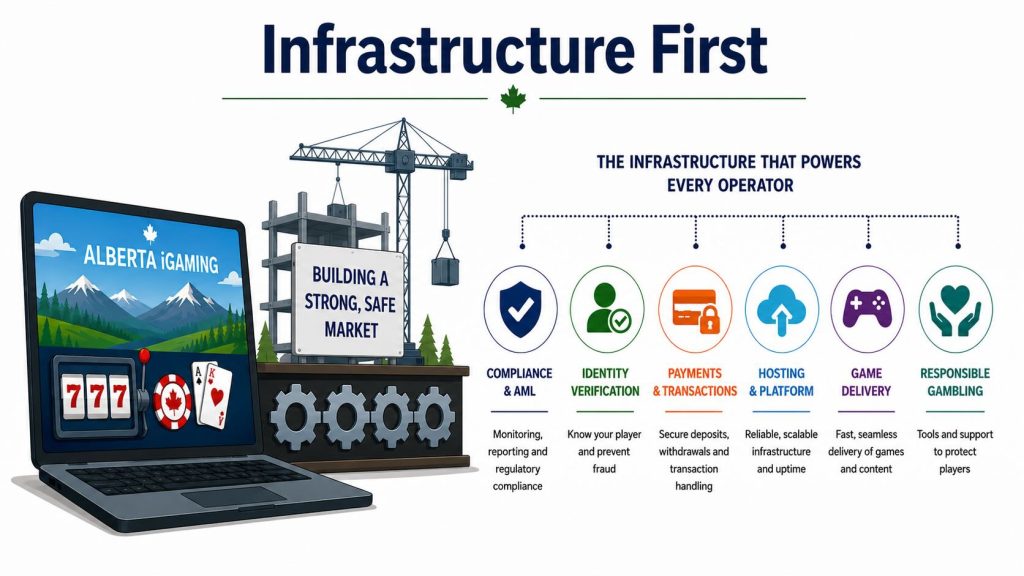
That imbalance appears deliberate. Rather than prioritizing game content first, Alberta is focusing on the technical infrastructure that operators rely on to run securely, process transactions, monitor compliance, and deliver responsible gambling protections at scale. In practice, the province is building the operational backbone of the market before consumer-facing brands fully arrive.
The approvals also suggest Alberta is taking lessons directly from Ontario’s early rollout. By certifying critical infrastructure providers ahead of launch, regulators appear to be aiming for a smoother onboarding process, stronger compliance oversight, and a market where multiple operators can plug into pre-approved systems on Day 1 of legal Alberta online casinos and sportsbooks.
35+ iGaming Suppliers Receive Green Light
Just a few weeks away from market launch, and the market regulator has already approved licensing to 35 critical gaming system providers. Apart from well-known game studios like Play’n Go, Evolution Gaming, Games Global, Blueprint Gaming, and Gaming Corps making the cut, the larger chunk of the list features infrastructure and platform technology providers. These include the likes of Continent 8 Technologies, EveryMatrix, Inspired Entertainment, Bede Gaming, and Soft2Bet, among others.
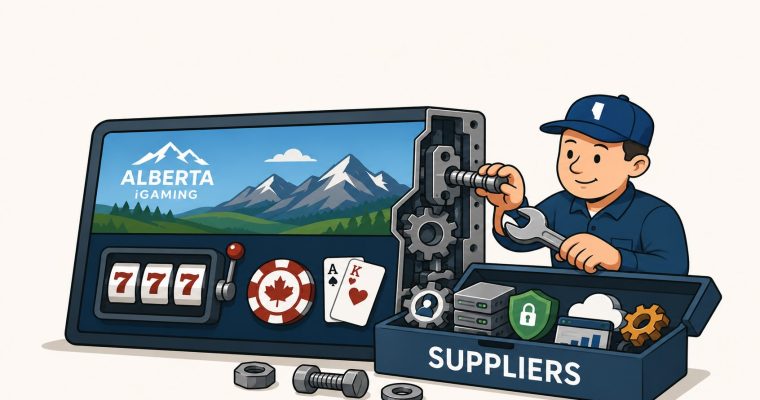
The latter are not the names Albertans will see when they open an online gambling app. Rather, they are the companies working several layers beneath the surface, keeping licensed operators running smoothly and responsibly behind the scenes.
Think of it this way. When a player logs into a licensed Alberta online casino and places a bet to spin the reels, they interact with the operator’s brand. What they do not see is the platform processing their transaction, the content delivery system serving up the games, or the compliance technology logging every action in the background. That invisible layer is precisely what these technical suppliers provide.
In other words, they are the “engine room” for modern iGaming operators. Consumer-facing operators, the likes of Jackpot City and BetMGM (those that players actually recognize), cannot function without them. And the sheer number of B2B infrastructure providers on Alberta’s approved list, relative to content studios, is worth paying attention to.
The Importance of Infrastructure First
Alberta is not just building an open online gambling market. It is building the infrastructure that a successful and reliable market can run on, and that distinction matters.
Approving a game studio means one more content provider who can supply slots, table games, and live dealer games to licensed operators. Approving a platform technology supplier, on the other hand, means every operator that depends on that technology is, by extension, operating on vetted infrastructure. That regulatory leverage is simply greater, and more interestingly, a possible volume play disguised as due diligence.
The truth is that one approved B2B platform provider can underpin five, 10, or 15 licensed operators simultaneously. From a compliance standpoint, that is a far more efficient use of regulatory resources than approving game studios one title at a time.
There is also the player protection argument. Alberta’s government has been vocal that consumer safeguards are central to its iGaming strategy. Technical suppliers are where those safeguards actually live.
Responsible gambling tools, self-exclusion systems, transaction monitoring, and identity verification all operate at the infrastructure level. Without a long list of certified technical suppliers in place, none of those protections can be switched on when an operator goes live. And that is why getting those providers approved and commercially onboarded before launch day is the only logical sequence.
Related: Alberta’s Regulated Betting Market Could Reward Operators with Better Tech
Lessons Learned from Ontario’s Playbook
Ontario was the first Canadian province to open its iGaming market to multiple private operators under a licensed framework. Its success prompted other provinces to consider how they could redirect revenue away from a dominant grey market and into regulated channels. Alberta is next in line, and, fortunately for Alberta, it is not starting from scratch.
When Ontario launched Canada’s first open iGaming market in April 2022, the early months were bumpier than the headline numbers suggested. iGaming Ontario later acknowledged it had reviewed its onboarding process to reduce friction and cut the time it took operators to go live, a sign that the original process was slower and more cumbersome than intended. The province also went live without a fully mapped out approach to AML compliance technology, leaving operators to submit reports manually in the interim.
Alberta has had four years to study those friction points. The two-step commercial onboarding requirement built into its framework, where suppliers must complete both AGLC licensing and AiGC commercial agreements before going live, appears to be a direct response to that experience.
Sure, the process might be slower by design. But the goal is to ensure that when an operator goes live in Alberta, the infrastructure underneath it has already been tested, approved, and commercially integrated.
Alberta’s Supplier Licences Come With a Two-Step Process
Every supplier that receives a conditional licence from the AGLC still has a second hurdle to clear before it can do any actual business in the province. It must complete full commercial onboarding with the Alberta iGaming Corporation, the separate conduct-and-manage body responsible for the market’s day-to-day commercial relationships. Only after both steps are completed can a supplier go live with a licensed operator.
That two-step structure serves as a deliberate quality filter. The AGLC handles regulatory fit. That includes whether a supplier meets the technical and compliance standards required to operate in the regulated market. The AiGC, however, handles commercial fit. That’s whether that supplier is genuinely ready to function within Alberta’s specific market infrastructure. Both questions need a yes before anything goes live.
What this means in practice is that Alberta is not just vetting who gets in. It is vetting whether they are operationally ready when they arrive. A supplier can hold licences across a dozen regulated jurisdictions and still need to demonstrate that their systems integrate cleanly with Alberta’s centralized platform before launch day.
For players, the distinction matters more than it might appear. Every responsible gambling tool, every self-exclusion check, every transaction flag runs through that infrastructure. A supplier that clears both hurdles demonstrates they are operationally ready, which is exactly the standard Alberta appears to be building toward from day one.