
 Share
Share 


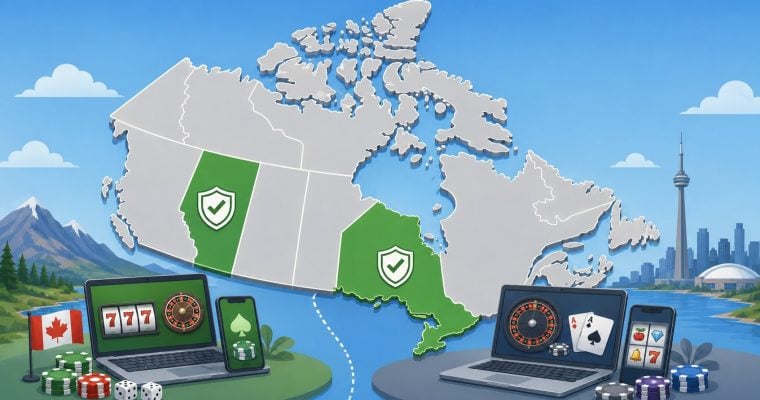
Canada now has two provinces running open, multi-operator online betting markets and eight running closed, government-only platforms. That gap just got harder to ignore.
Alberta went live on July 13, 2026, becoming the second province — after Ontario — to open its doors to competing, privately licensed online casinos in Canada and sportsbooks. Twenty-two operator sites, including bet365, DraftKings, FanDuel, theScore Bet, and Caesars Entertainment, launched on day one, with the Alberta Gaming, Liquor and Cannabis Commission (AGLC) approving 28 operators overall.
Every other province still runs gambling through a single government-owned platform. That split is now the center of a live policy fight touching a Supreme Court case and a stalled federal advertising bill.
Why Alberta Moved Now
Alberta’s government pointed to one number to justify the shift: roughly 70% of the province’s online gambling activity was already happening through unregulated, offshore operators, which offer little player protection and no obligation to report to a Canadian regulator.
“Standing still was not the responsible choice,” Service Alberta Minister Dale Nally said at the July 13 launch in Edmonton. “Albertans were already gambling.”
The province built its framework on Ontario’s model. The Alberta iGaming Corporation manages commercial agreements while the AGLC regulates and enforces — mirroring Ontario’s split between iGaming Ontario and its gaming commission. Operators paid a combined $200,000 in registration fees to enter.
The Channelization Gap
“Channelization” measures how much betting activity flows through regulated channels versus offshore sites — the number regulators cite to justify competitive markets, and where the two provinces look nothing alike.
Ontario vs. Alberta, side by side:
- Market launched: Ontario, April 2022; Alberta, July 13, 2026
- Minimum betting age: Ontario, 19; Alberta, 18
- Pre-launch offshore share: roughly 70% in both provinces
- Current/projected channelization: Ontario, 90%+ as of 2025; Alberta, ~5% now, projected toward ~70% within a year
- 2025 regulated revenue: Ontario, C$4.04 billion (+34% year over year); Alberta, projected C$1.2 billion in gross gaming revenue for FY26
Ontario’s trajectory is the case study Alberta is betting on: an International Betting Integrity Association report, citing H2 Gambling Capital data, put more than 90% of Ontario’s online sports betting revenue through licensed sites in 2025, up from roughly 70% offshore pre-launch. Alberta starts near 5% channelization, though H2 Gambling Capital projects a climb toward 70% within about a year if Ontario’s pattern repeats.
A Patchwork with Real Legal Stakes
The other eight provinces and three territories still run gambling exclusively through government lottery corporations. That structural divide has moved from an administrative curiosity into active litigation.
The case now before Canada’s top court, Atlantic Lottery Corporation, et al. v. Attorney General of Ontario, asks whether Ontario can let residents pool into online poker and daily fantasy sports with players outside Canada — something it currently bars, requiring play to stay within provincial borders. The Ontario Court of Appeal sided with Ontario in November 2025.
Atlantic Lottery, joined by lottery bodies in BC, Manitoba, and Quebec, appealed, arguing the ruling threatens the monopoly model every other province relies on and lets Ontario-licensed brands compete nationally without those provinces’ consent; its filings also allege Ontario-licensed operators already advertise where they hold no license. Alberta’s Attorney General has asked to intervene on Ontario’s side. The Supreme Court hears arguments in October 2026.
Ottawa is Circling Advertising Too
Parliament, meanwhile, has been trying to legislate the one piece every province’s model has in common: advertising volume. Bill S-211, the National Framework on Sports Betting Advertising Act, cleared the Senate and passed a House of Commons vote 291–28 in April 2026, moving to committee for further study.
It could bring whistle-to-whistle broadcast bans, limits on athlete endorsements, and restrictions on ads reaching minors. The Canadian Gaming Association has lobbied against it, and neither Ontario nor Alberta has backed it publicly. In the interim, a voluntary industry ad code took effect January 1, 2026, adding disclosure rules for influencer promotion.
What Players Get Either Way
Both provinces require licensed operators to integrate with centralized self-exclusion tools and provide deposit and time limits. What differs is scope. Alberta’s protections apply only within Alberta’s market, and there’s no national self-exclusion registry that follows a player across provincial lines.
What to Watch Next
Three threads will decide whether Canada lands on one coordinated approach or a permanent split: the October Supreme Court hearing on cross-border pooling, whether Alberta’s channelization actually climbs from 5% toward 70% at Ontario’s pace, and whether Bill S-211 produces a national ad standard or leaves provinces and a voluntary code to handle it alone.
For now, the eight provinces still running single-operator platforms are watching two very different experiments play out next door.