
 Share
Share 


Playing within your means when gambling online is both an internal and external exercise.
It starts by determining how much you can afford to spend – no matter how an iGaming session unfolds – well before that first hand, spin or even deposit. Establishing and reinforcing those boundaries is where responsible gambling tools like deposit limits and affordability checks enter the picture.
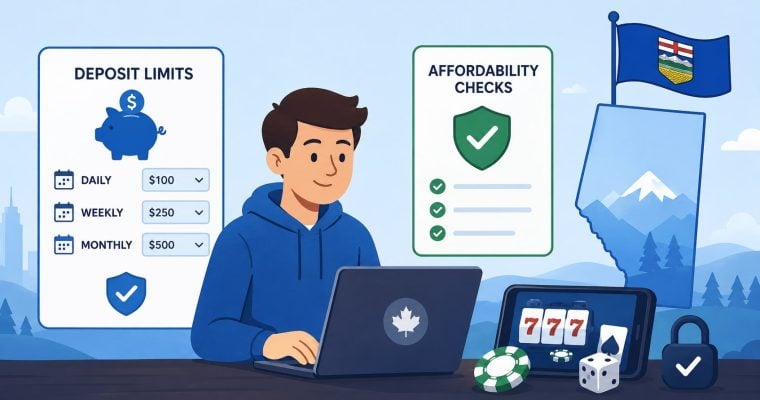
Both measures are designed to address the same underlying risk, but they do so from different sides: deposit limits help players control their spending directly, while affordability checks assess whether gambling activity is financially sustainable.
As core safeguards in regulated gambling markets across North America, each will be key components of Alberta’s comprehensive responsible gambling strategy.
What are Deposit Limits in Online Gambling?
As its name suggests, deposit limits are restrictions on how much money a player can add to their online gambling account over a specified period of time. Set by the player, these limits can be daily, weekly, or monthly, depending on the operator and the user’s preferences.
Most regulated sites will encourage players to implement deposit limits during the account registration phase, where a prompt to set the parameters is often built in. If a player chooses not to set deposit limits at registration, they can still add them anytime after.
In Alberta, all regulated operators must provide players with the ability to establish deposit limits, as outlined in Section 3.3.8(b) of Alberta Gaming, Liquor & Cannabis’ Standards and Requirements for Internet Gaming.
It’s also worth noting that most operators will treat deposit limit increases and decreases differently. Lowering a limit typically takes effect immediately, while raising one may involve a waiting period designed to discourage impulsive decisions.
How Deposit Limits Work in Practice
Whether in online casinos in Alberta or beyond, deposit limits represent one of the more accessible responsible gambling tools available. Emphasized early, and available to implement at any time, players have both instant access to and continued control over their spending through deposit limits.
As for how they work in practice, let’s use the example of a $100 weekly deposit limit. Once installed, this means a player cannot deposit more than the specified amount until the reset period begins. Do note, though, that deposit limits apply to funding an account – not how much a player can wager using their existing balance.
Deposit limits also serve different purposes for different styles of players. For more casual bettors, they may function like something of a weekly or monthly entertainment budget. For more active players, deposit limits may be a backline against overextended gaming sessions.
What all players should know is that deposit limits are set manually on an account-to-account basis, meaning that the boundaries on one account won’t automatically apply to another.
In other words, you must manage your site-to-site spending individually.
What are Affordability Checks?
While affordability checks aren’t explicitly defined in iGaming standards the way deposit limits are, they are commonly embedded in responsible gambling frameworks across the regulated landscape.
As alluded to earlier, affordability checks are broader assessments used to determine whether a player’s gambling activity appears financially stable. What they entail can vary greatly depending on the jurisdiction and individual operator.
For example, some operators may simply monitor unusual spending patterns behind the scenes, but others may identify high-risk activity and request additional documentation or identity verification from the player account.
Several other factors may also contribute to affordability reviews, including:
- Sudden increases in deposits
- How quickly money is spent
- Repeated failed deposits
- Gambling activity that appears inconsistent with a player’s profile
To that end, most affordability checks are not front-facing spectacles – they’re mainly designed to take place quietly in the background.
What they have developed, however, is a polarizing reputation. Proponents view affordability measures as crucial for identifying problematic behaviour and preventing further financial harm. Critics, on the other hand, have cited concerns surrounding privacy, friction in the customer experience, and how financial thresholds are determined.
Why Deposit Limits and Affordability Checks are Used Together
Helping players practice responsible gambling habits while controlling their spending is what unites deposit limits and affordability checks.
Deposit limits let players define how much they feel comfortable spending, but also hold them accountable with strict enforcement of the parameters they’ve chosen.
Affordability checks act as a secondary measure, monitoring and identifying potential warning signs of problem gambling from afar. They might not be expressly defined, but examples of affordability measures do exist in the Responsible Gambling Council’s Accreditation Check, which all operators must obtain to enter Alberta’s regulated market.
Examples from the RGC framework include:
- Policy and Procedures: Policies and procedures are in place to assess, detect and address situations where players may be experiencing harm.
- Identifying and Responding to High-Risk Behaviour: Systems are in place to identify and respond to players at risk of experiencing harm.
- Documenting Interactions: Player interactions are tracked and assessed. This information is systematically used to assist players.
Together, deposit limits and affordability checks bring a layered approach to player protection, balancing individual control with broader safeguards around risk and spending behaviour.
Expectations for Alberta Players
When Alberta launches its regulated iGaming market on July 13, deposit limits and affordability checks will only add to the wide range of resources and tools already outlined in the province’s responsible gambling framework.
They will join the AGLC’s omni-channel self-exclusion program, through which players can self-exclude from the online and land-based casinos of their choosing, GameSense, which provides players of all experience levels with the tools and information to make informed gambling decisions, as well as trusted non-profit organizations like the Responsible Gambling Council.
In the lead-up to its highly anticipated debut, Alberta appears intent on building its regulated market atop a foundation of robust responsible gambling measures.