
 Share
Share 


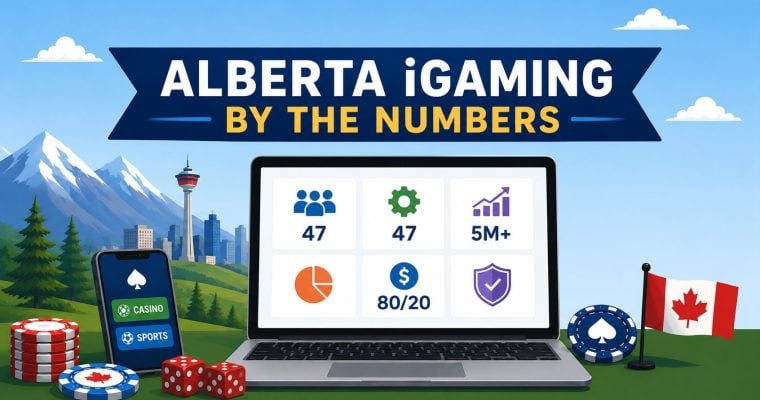
If numbers tell the story, then Alberta’s regulated online gambling market is making a compelling case ahead of its July 13 launch.
While the finishing touches are still being finalized, the current data paints a well-rounded picture of how the province’s iGaming ecosystem is shaping up.
The government, through Alberta Gaming, Liquor & Cannabis (AGLC), as well as reputable third-party analysts, have offered concrete indicators of potential scale and participation, including registration figures for both operators and gaming content suppliers.
When combined with demographic and economic benchmarks – both within the province and elsewhere – the totality of what to expect begins to feel more tangible than speculative.
See why in the six key figures at the core of Canada’s second major iGaming jurisdiction.
Operators: 47 Have Already Registered
As of June 12, the total number of approved operators on the AGLC’s registration list stood at 47. The tally has remained on a steady incline in recent weeks, growing from 28 at the beginning of May.
It’s worth noting that registration doesn’t guarantee a day-one launch, but it does signal that several leading operators view the Alberta online casino and sports betting market as a potentially lucrative opportunity.
All the major players, including BetMGM, bet365, Caesars, FanDuel, and DraftKings, have thrown their hat in the ring, each with the goal of carving out a significant market share.
Apollo Entertainment became the latest operator to sign the registration papers, adding its 888, Stardust Casino, and Vegas Club Casino brands to the competitive mix.
With early momentum already evident, the list may experience further growth before launch, now less than a month away.
Suppliers: What the 47 Approved Tell us About Alberta’s Market
The B2B (Business-to-Business) component of Alberta’s regulated market is trending towards being equally robust, with 47 gaming system providers also receiving approval from the AGLC.
What’s notable among the nearly 50 names is a clear emphasis on platform, infrastructure, and compliance technology providers like EveryMatrix, Continent 8, Bede Gaming, and Soft2Bet.
Leading game suppliers, namely Evolution, Play’n Go, and Games Global, are also featured on the approved list, but the majority of brands specialize in the technical infrastructure that operators need to run securely, process transactions, verify geolocation, and supply responsible gambling measures across a wide footprint.
In other words, Alberta is reinforcing both its structural foundation and its entertainment architecture through its welcomed suppliers.
Population: More Than 5 Million Strong
The most recent estimates from the Government of Alberta’s Economic Dashboard place the province’s population just above 5 million (as of March 18).
While less than a third of Ontario’s (about 16 million), it still represents the fourth-largest population among Canadian provinces.
The difference, however, is that Alberta routinely ranks among the country’s highest-income provinces, supported by strong labour market conditions and higher consumer spending power – the latter being especially important, as per Service Alberta and Red Tape Reduction Minister Dale Nally.
Population alone isn’t an indicator of gambling activity, but Albertans have shown a betting interest through PlayAlberta, the province’s official regulated online gambling platform.
According to AGLC, PlayAlberta generated $275 million in net revenue in the 2024-25 fiscal year, representing an increase of $35 million year-over-year.
When taken with existing grey market activity, and (hopefully) mass conversion into the regulated market, a small population appears more than capable of punching above its weight class.
Annual Revenue Totals: Is Nearly $1 billion Possible at Maturity?
Projecting annual iGaming revenue totals doesn’t come from a few taps of a calculator; it’s far more complex than that.
That said, there are third-party firms with keen analytical insights that can provide a possible ballpark, particularly $700 million USD, which converts to about $950 million CAD.
Such a figure was referenced by gaming content provider Soft2Bet in its March statement declaring its plans to enter Alberta. The supplier, which operates ToonieBet in Ontario, cited the industry projection from Citizens Bank’s JMP Securities that Alberta’s regulated iGaming market could exceed $700 million USD in annual revenue at maturity.
If realized, this would place Alberta inside the top 10-revenue generating iGaming regions in North America.
While not a 1:1 comparison, Connecticut, which has a much smaller population of approximately $3.7 million, generated $973.4 million USD in total iGaming revenue in 2025. This converts to about $1.36 billion CAD.
Tax Structure: Similar to Ontario, But One Main Difference
Under Albert’s iGaming framework, the provincial Government and registered operators will split revenue at an 80-20 ratio. Operators retain 80% of revenue, while the remaining 20% goes to the province and is treated as general tax revenue.
This division of funds is straight out of the Ontario iGaming model textbook.
The key difference, however, is that Alberta’s strategy applies a 3% “top skim” to all gross gaming revenue before the province and operators get their cuts.
Within this 3% distribution, 2% is earmarked for Alberta’s First Nations communities through the First Nations Development Fund. The remaining 1% will go towards social responsibility initiatives, including responsible gambling programs and treatment services for problem gambling.
Alberta vs. Ontario: Not Exactly One and the Same
It’s only natural that the second regulated Canadian iGaming market be compared to the first, but that doesn’t mean Alberta and Ontaio are carbon copies of each other.
For starters, players in Ontario can wager on political events, while Alberta has already declared all bets on political events illegal.
In Ontario, iGaming operators are required to pay a $100,000 registration fee each year without any application fees. In Alberta, operators must pay $150,000 per site every year, plus a one-time application fee of $50,000.
The Ontario model was initially very laissez-faire regarding its advertising policy, but tightened up after widespread backlash. Alberta appears intent on not falling into the same trap, taking a proactive approach to its advertising standards with a pre-emptive ban on athletes and celebrities appearing in promotional materials unrelated to responsible gambling.
Both provinces will feature a centralized self-exclusion program after Ontario launched BetGuard, a one-stop portal for voluntary opt-outs of all regulated iGaming platforms in the province, this past May.
Alberta’s omni-channel self-exclusion program was unveiled in April.