
 Share
Share 


Alberta is set to become the second Canadian province with a fully regulated online gambling market, and the province’s minister responsible for the market is already putting a number on what it’s worth.
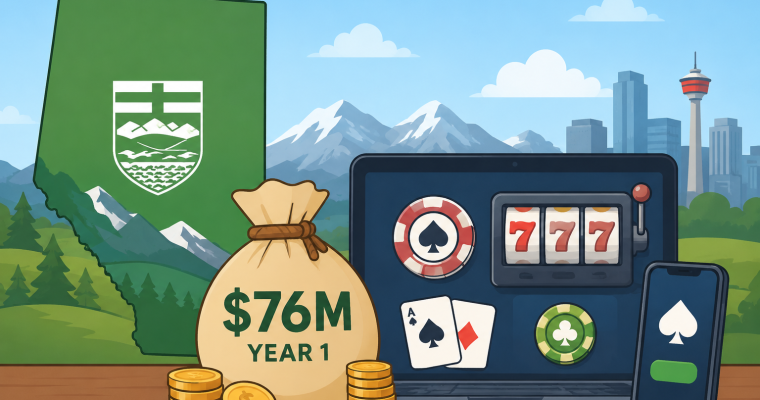
Minister of Service Alberta and Red Tape Reduction Dale Nally told the Edmonton Journal he expects the new market to bring in $76 million in government revenue during its first year of operation. Alberta online casinos and sportsbooks open for business on July 13, and the clock is already ticking for operators racing to get their paperwork in order.
Around 50 operators have cleared conditional licensing with Alberta Gaming, Liquor & Cannabis (AGLC) and paid their initial fees. That’s a strong turnout for a market that hasn’t even gone live yet, but registration with AGLC is only half the process. Every operator on that list still has to complete a second round of approvals through the Alberta iGaming Corporation (AiGC) before they can legally accept a single bet on launch day.
What It Costs to Play in Alberta
Setting up shop in Alberta isn’t cheap, but it’s structured to be predictable. Operators pay a one-time application fee of $50,000, followed by an annual registration fee of $150,000. That’s the price of entry before a single wager is placed.
Where things get more interesting is how the province splits the winnings once the money starts flowing.
A Different Formula Than Ontario
Alberta isn’t copying Ontario’s playbook, and the difference matters for anyone trying to model out what this market is actually worth. Ontario keeps things simple: the province takes a flat 20% of net iGaming revenue, that’s it.
Alberta is taking a more layered approach, built around Gross Gaming Revenue (GGR) rather than net revenue. Before the province takes its cut, 2% of GGR is set aside for First Nations, and another 1% goes toward funding social responsibility programs. Only after those allocations are made does the remaining pool get divided: operators keep 80% and the Alberta government collects the other 20%.
It’s a formula with more moving parts than Ontario’s, but it also builds in dedicated funding streams for community and harm-reduction initiatives right from the first dollar wagered.
The Math Behind the $76 Million Figure
Working backward from that revenue-sharing formula, Nally’s $76 million projection implies the province expects roughly $390 million in GGR during Alberta’s first year.
That figure looks modest next to Ontario, and it should. Ontario’s market has had years to mature. In 2025, Ontario’s regulated iGaming sector generated $4.04 billion in revenue, translating into an estimated $807 million for the provincial government across its 47 licensed operators. Worth noting is that Ontario total doesn’t even include the revenue generated separately through the government-run Ontario Lottery and Gaming Corporation (OLG).
Alberta launching at roughly a tenth of Ontario’s current government take isn’t a sign of weak demand. It’s simply what a first year looks like before a market has had time to build habits, marketing reach, and brand loyalty among players. Ontario didn’t start at $807 million, either.
Operators are Lining Up
Scale aside, Alberta has already convinced some of the biggest names in the business to commit to launch day. DraftKings, FanDuel, BetMGM, Betway, BetRivers, and bet365 are all expected to be part of the initial wave of private operators competing for Alberta players.
They won’t be alone. PlayAlberta, the province’s own government-owned platform, will operate directly alongside these private brands starting July 13, giving Alberta a hybrid market structure where a state-owned platform competes head-to-head with commercial operators from day one.
Player Safety Remains the Priority
Speaking at the SBC Summit Canada in Toronto back in May, Nally didn’t shy away from framing gambling as something he personally enjoys, while making clear that protecting players remains the province’s top priority as the market opens up.
“I like to put a few dollars on the Edmonton Oilers,” Nally said at the event. “I don’t think there’s anything wrong with doing a little bit of gambling. But if it becomes problematic, we’re going to have support systems for people. We want to have those protections in place. Player safety is going to be at the forefront of everything that we do. That’s important to us in Alberta. We want gambling to be a safe pastime for people,” Nally added.
He reiterated the notion when talking to the Edmonton Journal:
“We know that gambling will never be safe; it will never be responsible. But there are ways to make it a little safer, and there are ways to make it a little more responsible.”
According to Nally, player protection isn’t an afterthought bolted onto the launch. Instead, it’s meant to be built into how the market operates from the start. He continued to describe player safety as central to Alberta’s approach, with the goal of keeping gambling a safe form of entertainment rather than a source of harm.
What Comes Next
With July 13 just around the corner, the remaining days will be a scramble for the operators still working through their second-stage approvals with the Alberta iGaming Corporation. Missing that window likely means missing launch day entirely, and with heavyweight competitors already positioning themselves for day-one visibility, falling behind even by a few days could carry a real cost in market share.
For now, Nally’s $76 million projection gives the province as well as the industry watching from outside a benchmark to measure against once the numbers start coming in. Whether Alberta hits that figure, beats it, or falls short will say a lot about how quickly Canadian players adapt to having a second regulated option beyond Ontario, and how much appetite still exists for legal, home-grown alternatives to offshore gambling sites.