
 Share
Share 


Alberta’s regulated iGaming market officially launches on July 13, with nearly 30 major operators already approved by the Alberta Gaming, Liquor and Cannabis Commission (AGLC). As excitement builds around expanded betting options and increased competition, concerns over player privacy and data handling are also starting to grow.
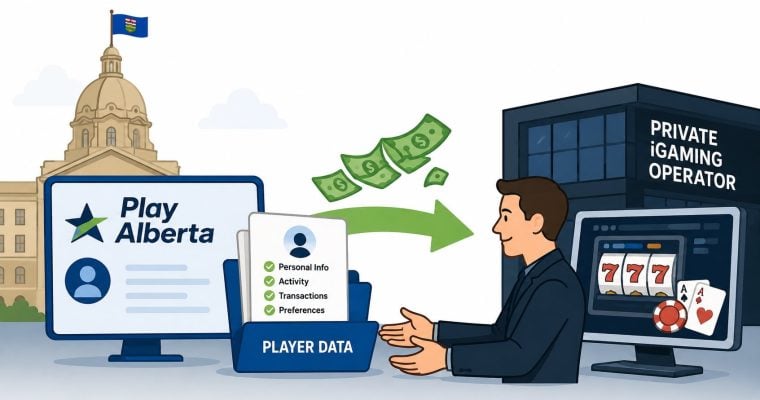
Those concerns intensified after the passing of Bill 31, legislation that creates a narrow exemption allowing the potential sale of PlayAlberta and its customer data to a private operator. While the law applies specifically to crown corporations, it arrives at a time when modern iGaming platforms increasingly rely on player data to personalise promotions, shape user experiences, and optimise engagement.
With Alberta preparing to open its online gambling market, the debate is no longer just about regulation and competition. It is also about how much trust Albertans are willing to place in the systems and companies handling their personal information.
Alberta’s Newly Passed Bill 31 Is a ‘Concerning Precedent’
As operators line up for their July 13 launch of Alberta online casinos and sportsbooks, a piece of legislation quietly passed through Alberta’s legislature on May 7 and has drawn sharp criticism from one of the province’s watchdogs. This is Bill 31, the Red Tape Reduction Statutes Amendment Act 2026, as proposed by Minister of Red Tape Reduction and Service Alberta Dale Nally.
The new law creates a narrow but significant exemption to Alberta’s Protection of Privacy Act, yet another recently passed legislation. Under POPA, public bodies are explicitly prohibited from selling personal information for any purpose.
Bill 31, however, carves out a specific exception for the AGLC. It potentially allows the crown corporation to sell government-run gambling site PlayAlberta — along with the personal data of its customers — to a private company.
In a written statement to CBC News, Alberta Information and Privacy Commissioner Danny McLeod warns that the passing of this new legislation sets a concerning precedent.
“As far as we are aware, this would be the first instance in which personal information collected by a public body would be sold to a private sector organization under POPA,” McLeod said in a statement. “What are Albertans to believe if a clearly stated prohibition in POPA is nullified through another piece of legislation?”
What Bill 31 Means for Alberta’s Upcoming AI-Powered iGaming Market
The timing of the passage of Bill 31 is difficult to separate from what AI-powered iGaming operators actually do with player data. The “Crown Corporation Data Sale” section only applies to crown corporations.
That means private iGaming operators en route to Alberta’s regulated online gambling market are excluded. However, Alberta’s Personal Information Protection Act (PIPA) still requires private-sector companies to have a valid reason and clear user consent before collecting personal data. The law also states that the information must be obtained directly from the individual.
To understand the impact of the new legislation on PlayAlberta players, understanding how iGaming operators handle data is essential.
Every session a player spends on a regulated platform feeds an algorithm. The operator collects gambling patterns, transaction history, game preferences, and bonus responses in real time. With that data, it builds individual profiles that operators use to personalise offers, adjust interfaces, and shape the entire experience around each user. The result is a platform experience built entirely around individual behaviour.
This is the environment into which the provisions under Bill 31 arrive. PlayAlberta hosted 434,000 active accounts as of 2025. These are Albertans who created accounts on a government-run platform, operating under the reasonable assumption that their personal information sat within a public framework with clear protections. Bill 31 creates a pathway for that assumption to change, with cabinet satisfaction serving as the primary and only stated safeguard.
“Customers Can Opt Out,” Says Nally
Nally has moved to address public concern about privacy protections on PlayAlberta directly. In an interview with CBC News, Nally confirmed that the AGLC has no immediate plans to sell PlayAlberta. He did say last month that some potential buyers approached the AGLC with interest to purchase PlayAlberta. The new legislation makes such a sale possible.
“Should such a sale occur, AGLC would notify customers and allow them to opt out and delete their personal information before the sale,” Nally said. “We wanted to put Albertans in the driver’s seat.”
Nally was equally firm in characterising the exemption as narrow and specific. The legislation is limited strictly to customer information tied to a government business enterprise. The AGLC echoed that position, confirming that no decisions have been made and that its current focus remains on delivering safe and responsible gaming to Albertans.
“As Alberta prepares for changes in the iGaming landscape, AGLC is routinely assessing how PlayAlberta can continue to deliver value,” an AGLC spokesperson told CBC. “No decisions have been made, and our focus remains on ensuring Albertans have access to safe, responsible gaming entertainment.”
Bill 31 also introduces advertising-related adjustments to Alberta’s gaming law, giving the AGLC greater flexibility to set and update advertising standards as the regulated market evolves. For now, PlayAlberta’s 434,000 account holders wait and watch.
“These amendments allow advertising standards to be set through the AGLC, and that will give us flexibility,” Nally said in the legislature on May 5. “It allows us to respond quickly as the market evolves, and it ensures strong protections for Albertans, clearer rules, faster updates, better safeguards.”
Bottom Line
Alberta’s iGaming is on its way. With it comes several genuine promises: regulated operators, a competitive licensing framework and strong consumer protections.
Bill 31 does not change that picture for incoming players. Private operators arriving in July operate under PIPA’s consent requirements, and the AGLC’s regulatory oversight applies across the board. The legislation’s reach is confined specifically to crown corporations, including PlayAlberta and the AGLC, which runs it.
What it does introduce is a precedent — one where a public body has legislative permission to sell personal information collected from its own customers to a private organisation. So, what can existing Play Alberta account holders do?
- Stay informed
- Understand the opt-out mechanism that Minister Nally has confirmed will be available
- Monitor official AGLC communications as the market develops
The bigger question sitting behind all of this is not whether PlayAlberta will be sold. It is whether Albertans are comfortable with the framework that now makes it possible. And also, if the AI-powered online gambling market opening this July gives them enough confidence in how their data will be handled.
The answer? We can only know for sure when the market goes live and the platforms start running. The algorithms are ready. Alberta’s players are about to find out if they are, too.