
 Share
Share 


First Nations have inhabited Alberta for nearly 11,000 years. In other words, almost 500 generations have hunted, governed, and thrived on this land prior to European contact, which took place in the 1470s.
And while much of what followed was marked by dispossession, legislation, and broken promises, First Nations gaming tells a different kind of story. It is a story of communities that looked at a system designed to exclude them, found a gap in the law, and turned it into a $900 million industry. Not bad for an activity that was technically illegal just a few decades ago.
The History of Indigenous Gaming in Alberta
Prior to European contact, gaming was an important part of Indigenous life among First Nations in Alberta. At the core, it was community-centered and culturally accepted, offering an entertaining and unifying set of activities, such as bowl games, counting games, straw games, lacrosse, and other sports-related activities.
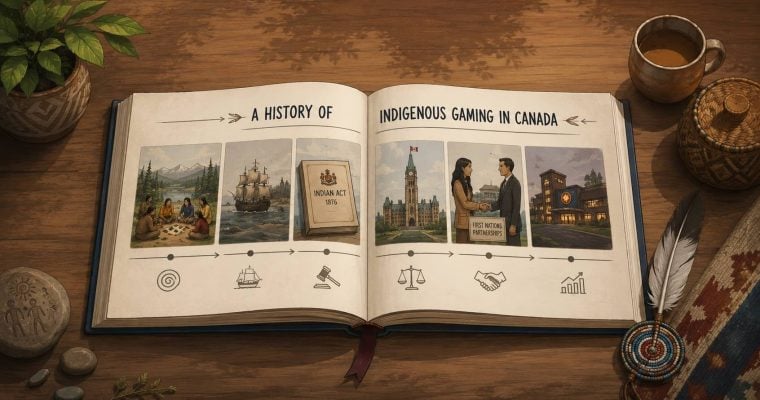
The arrival of the Europeans saw many aspects of life of the Indigenous peoples affected, and gaming was one of them. The Indian Act of 1876, alongside the Criminal Code, effectively shut down communal gambling. For the better part of a century, the legal landscape left little room for First Nations to operate any form of organized gaming.
The turning point came in 1985. Amendments to Canada’s Criminal Code gave provinces the authority to regulate gaming, and Alberta’s First Nations communities wasted little time making their case. As the provincial government quietly built its gaming monopoly, First Nations pushed back through persistent lobbying and negotiation. By the late 1990s, Alberta had little choice but to come to the table, and the province began signing formal agreements with First Nations communities for the very first time.
The first band-owned casinos followed. By 2006, the doors were officially open, and the industry has not looked back.
How Many Indigenous Casinos Are There in Alberta?
One reason Alberta’s First Nations gambling market has grown with such intensity is because of the First Nations Gaming Policy, signed in 2001. Establishing the terms and conditions of constructing and operating First Nations gaming facilities on reserve land, the policy also introduced a clear revenue share model. Under the new policy, 30% of the proceeds from government-owned slot machines goes to the Alberta Lottery Fund (ALF), another 30% returns to the Host Nations, and the remaining 40% goes to the First Nations Development Fund (FNDF).
With that legislation in place, the first indigenous casino in the Wild Rose Country was Enoch Cree Nation’s River Cree Resort and Casino (2006). Five other casinos followed, including:
- Tsuut’ina First Nation’s Grey Eagle Resort & Casino
- Stoney Nakoda First Nation’s Stoney Nakoda Resort & Casino
- Alexis Nakota Sioux Nation’s Eagle River Casino & Travel Plaza
- Cold Lake First Nation’s Casino Dene
- Louis Bull Tribe’s Bear Hills Casino & Travel Plaza
Together, they represent something bigger than a list of venues. They are the physical proof that two decades of policy fights, lobbying, and negotiation actually produced something real that’s designed to benefit the people who need it most.
The Economic and Community Impact of Indigenous Casinos in Alberta
Indigenous casinos have become a significant economic and social force in Alberta. Since the First Nations Development Fund began receiving its 40% share of slot machine revenues from Alberta’s Indigenous casinos, over $2 billion has been redirected into First Nations communities across the province since 2006. That money has built houses, funded classrooms, staffed health clinics, and kept cultural programs alive in communities that federal transfers consistently left underfunded.
More than that, casinos create direct employment on and near reserve land. Think jobs in gaming, hospitality, security, food service, and management that often represent some of the best-paying, most stable employment opportunities available in those communities. The indirect economic ripple extends further still, supporting local suppliers, contractors, and service providers who benefit from the spending that a casino resort generates.
For context, non-Indigenous gaming revenues in Alberta flow primarily into the provincial Alberta Lottery Fund, which is distributed broadly across the province with no specific community focus.
Indigenous casinos, by contrast, concentrate their reinvestment impact. When Tsuut’ina Nation’s Grey Eagle Resort generates revenue, a meaningful share of that money comes back to Tsuut’ina Nation specifically. That distinction matters enormously when you are talking about communities that have historically received a fraction of the public investment their non-Indigenous neighbours take for granted.
But the story is not entirely clean.
Key Challenges Facing Indigenous Casinos in Alberta
Despite two decades of growth in Alberta’s indigenous gaming space, the progress hasn’t been without friction. Behind the large revenue figures and the ribbon-cutting ceremonies, a set of structural challenges has quietly shaped, and in some cases limited, what Indigenous casino operators can actually achieve.
The most consistently debated issue inside First Nations communities about casino gaming is whether commercial gambling truly aligns with Indigenous values. For several elders and community members, the economic benefits simply don’t justify the social costs that can accompany a gaming industry. They are aware their communities are not insulated from problem gambling.
And although self-exclusion programs, responsible gambling resources, and on-site support services are mandatory under AGLC licensing, their effectiveness varies. After all, the social pressure on individuals in smaller communities to stay away from the local casino is often weaker than it might be in a large urban setting.
Beyond the cultural side of things, there have been structural barriers. These include:
Provincial Control: Licensing authority over Indigenous gaming sits with provincial governments and not with First Nations communities themselves. That means provinces determine where Indigenous casinos can operate, what products they can offer, and how revenues are divided.
Alberta has been more progressive than most, with its reserve casino model giving First Nations communities access to urban markets in ways that other provinces have not. But the underlying power dynamic remains unchanged. Indigenous operators work within a system they did not design and cannot fully control.
Rural Restrictions: Most Canadian provinces have confined Indigenous casinos to rural or semi-rural reserve locations, away from the population density that drives gaming revenue. Alberta’s willingness to allow casinos like Grey Eagle and River Cree to operate near Calgary and Edmonton has been the exception rather than the rule. But for First Nations communities in more remote parts of the province, geographic isolation is a ceiling on what their casino can realistically earn.
Economic Disparities: The revenue model is the same for every Indigenous casino in Alberta, even though the markets are not. A casino operating near a major urban centre draws from a vastly larger pool of potential customers than one located in a remote northern community.
The result? A growing gap between the economic outcomes of well-located Indigenous casinos and those serving smaller, more isolated populations. A disparity that the 30/30/40 revenue model was not designed to address.
The Absence of a Federal Indigenous Gaming Framework in Canada
The United States solved this problem in 1988 with the Indian Gaming Regulatory Act. Federal legislation gave tribal communities a clear legal right to operate gaming on their land while defining a regulatory pathway to do so independently of state governments. Canada has never passed equivalent legislation.
Indigenous gaming rights in this country exist within a patchwork of provincial agreements and negotiated frameworks. There are no federal guarantees underpinning any of it. That leaves First Nations in a permanently negotiated position, where the terms of their participation in the gaming market can shift with every change of provincial government.
How Alberta’s iGaming Market Could Impact Indigenous Casinos
With Alberta online casinos and sportsbooks taking shape, and the 2001 First Nations Gaming Policy says nothing about the new market. That’s because in 2001, regulated iGaming in Canada was not realistic. But today it is, and July 13, 2026 is the date Alberta’s regulated online market goes live.
For First Nations casino operators, that date has drawn mixed reactions. Land-based casinos depend on players showing up in person. Online platforms, on the other hand, are available around the clock, accessible from any device, and unburdened by the geographic and operational constraints that come with running a physical casino on reserve land. If Alberta’s iGaming launch pulls players away from physical casinos — and there is every reason to think it will — the slot machine revenues that feed the First Nations Development Fund take a hit.
The situation was serious enough that a group of First Nations did not wait to find out. A coalition filed a joint lawsuit against the Alberta government, arguing that the existing online gaming landscape, led by PlayAlberta, which currently directs nothing to First Nations communities, was already cannibalising Host First Nations casino revenue without any compensating arrangement in place. It was, in essence, a claim that the rules of the game had changed without anyone telling the people most affected.
The response came through Alberta’s new iGaming framework.
Under the model taking effect at launch, every licensed iGaming supplier operating in Alberta’s regulated market will be required to contribute 2% of their gross gaming revenue to the First Nations Development Fund. Another 1% goes to social responsibility programs. The rest is divided between operators and the provincial government.
The structure also creates a second funding stream inside the FNDF. Land-based casino revenues will continue flowing through the existing formula, with the bulk benefiting Host First Nations. The iGaming contribution will be distributed more broadly, reaching all First Nations communities in Alberta. It is a meaningful shift in how Indigenous communities relate to gaming revenue in this province.
Two percent is a formal, policy-backed, and legal recognition that First Nations communities have a legitimate stake in Alberta’s online gaming future. After years of being excluded from that conversation, that provision is significant.
The Future of Indigenous Casinos in Alberta
Alberta’s Indigenous gaming industry has come further than almost anyone expected when the First Nations Gaming Policy was signed in 2001. Six licensed First Nations casinos. Over two billion dollars flowing into First Nations communities. A revenue model that, despite its imperfections, has funded infrastructure, healthcare, and cultural programs that government transfers never adequately covered.
But the industry at present is at an inflection point.
The land-based model is maturing. The communities that have benefited most are those closest to Alberta’s major cities. From Grey Eagle near Calgary to River Cree near Edmonton. For First Nations casinos in more remote parts of the province, the returns have been real but constrained by geography in ways that no policy change has fully resolved. The playing field has never been level, and distance from a major population centre remains the single biggest determinant of how much a First Nations casino can actually earn.
iGaming is about to change the equation.
Alberta’s regulated online market launches July 13, with a framework that includes a mandatory 2% gross gaming revenue contribution to the First Nations Development Fund from every licensed online operator. It is an acknowledgement, written into policy, that digital gaming carries the same community obligations as the physical casino floor.
The broader picture is one of an industry that has consistently grown beyond the limits of the frameworks designed to contain it. It’s also about a set of local communities that have become increasingly sophisticated about knowing when to negotiate, when to litigate, and when to build.
What comes next for Alberta’s Indigenous casinos will depend on how well provincial and federal policy keeps pace with that sophistication. The communities are moving. But the question is whether the policy will also move with them.