
 Share
Share 


Alberta’s push toward a regulated iGaming market is moving from setup into execution, with operators now required to submit applications, pay required fees, and complete commercial agreements with the Alberta iGaming Corporation (AiGC).
While registration is open and compliance work is progressing, the province is still working to transition the Alberta online casino and sports betting markets currently dominated by unregulated operators into a formal system.
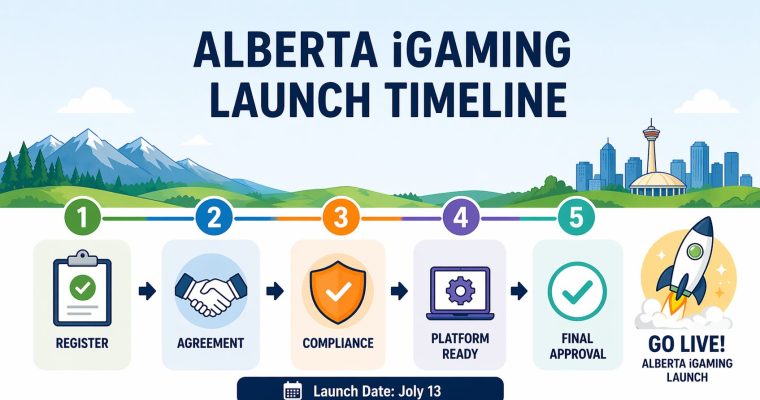
Complete AGLC Registration
The starting point is registration with the Alberta Gaming, Liquor and Cannabis Commission (AGLC), which oversees regulatory compliance.
Operators must submit full applications, pay required fees, and undergo due diligence. Once in the process, they are allowed to advertise and accept pre-registrations.
The limitation is clear: No deposits, no wagers, and no real money activity until the market officially goes live.
Secure a Commercial Agreement with AiGC
Registration alone is not enough.
Operators must also enter into a commercial agreement with the AiGC, which manages the operational side of the market, including anti-money laundering controls, financial reporting, and player protections.
This dual structure splits responsibilities. AGLC sets the rules, while AiGC determines when operators are ready to participate.
Without this agreement, operators cannot move forward toward launch.
Clear Compliance and Technical Certification
Even with registration and agreements in place, operators must still meet a detailed set of compliance requirements.
This includes completing a gap analysis against Alberta’s iGaming standards, obtaining SOC 2 Type 1 security certification, and ensuring all gaming systems are tested and approved by AGLC-registered facilities.
Core systems, including slot and table games, random number generators, and sportsbook platforms, must all meet regulatory standards before deployment.
Get Platforms Fully Launch Ready
Beyond compliance, operators need fully functioning platforms.
That means integrating Alberta’s centralized self-exclusion system, implementing geolocation tools to confirm players are within provincial borders, and ensuring account verification, payment processing, and reporting systems are operational.
These are required components for market entry.
Receive Final Go-Live Approval
Even after completing all prior steps, operators still cannot launch on their own timeline.
AiGC will determine when the market officially goes live and which operators are cleared to participate. Until that notification is issued, betting and gaming activity remains prohibited.
That makes the deadline a milestone for readiness, not a guaranteed launch date.
What This Means for the Market
The deadline creates urgency, but it does not eliminate uncertainty.
Provincial officials have pointed to a launch on July 13, but operators must quickly complete the remaining steps. At the same time, key roles within AiGC are still being filled, and industry preparation is ongoing.
Alberta’s iGaming framework is largely in place, but execution will determine how quickly the market takes shape.
Operators that move efficiently through registration, compliance, and platform readiness may be first to market. Others could face delays if they cannot meet the province’s technical and regulatory standards in time.
The rollout is shaping up to be controlled rather than simultaneous, with readiness rather than deadlines deciding who goes live first.