
 Share
Share 


Canadian bettors and gamblers who travel between provinces are subject to geolocation restrictions that limit where wagers can be placed, regardless of where their account was originally created.
Online gambling in Canada is regulated at the provincial level, meaning operators must be licensed in each jurisdiction where they offer real-money play. In practice, access is tied to where a player is currently located, not where they signed up.
Why Cross-Province Betting Is Restricted
Because each province maintains its own licensing framework, operators generally cannot accept wagers from players physically located in another province.
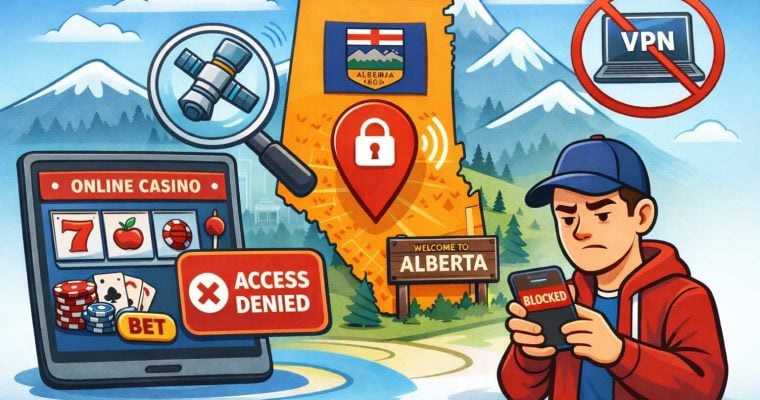
Alberta’s gaming standards make this explicit: online gaming platforms must ensure that only players physically located within the province can participate, except where conducted in conjunction with another provincial government.
The rules go further than a simple location check. The Alberta online casino and sports betting standards require that gaming systems block play when location cannot be verified, detect attempts to bypass controls such as VPNs or remote access tools, and maintain detailed logs of every verification for audit purposes.
This is a structural requirement built into the system, not a platform-level decision left to individual operators.
How Geolocation Enforcement Works in Practice
To meet these standards, operators rely on multiple layers of location verification, including IP tracking, GPS signals, and Wi-Fi data.
Verification does not end once a player logs in. Systems are required to re-check the location continuously during gameplay. If a player’s location cannot be confirmed, the session may be stopped immediately.
In Ontario, operators follow a similar approach. If location verification fails during an active session, gameplay is brought to a close, with outcomes settled where possible before access is terminated.
Attempts to bypass these systems can lead to more than just a blocked session. PointsBet, for example, warns that players attempting to circumvent geolocation controls may face account suspension and potential reporting to regulators.
Ontario Provides a Working Model
The Ontario online casino and sports betting market offers a working model of how these rules function in practice.
Players are permitted to open an account or access an existing one while outside the province, but placing a wager is not allowed unless they are physically within Ontario’s borders. The ability to log in does not extend to betting functionality.
Alberta’s upcoming market appears likely to follow a similar approach. The technical and compliance requirements outlined for operators mirror those already in place in Ontario, suggesting a consistent approach across jurisdictions rather than isolated provincial systems.
What Changes When Operators Expand Across Provinces
When operators hold licenses in multiple provinces, the experience can become more flexible, though not unrestricted.
Platforms such as Caesars Entertainment and PointsBet illustrate this shift. Players may be able to use the same app across provinces, with betting enabled based on their physical location at the time.
In theory, a player traveling between Alberta and Ontario could see more continuity if an operator is licensed in both places, although access, wallets, and account functionality may still differ by jurisdiction.
However, this does not guarantee a fully unified experience. Accounts and balances may still be managed separately at the backend level, meaning funds or settings do not always carry over seamlessly between provinces.
As more operators expand their presence across Canada, cross-provincial usability may improve. Even so, geolocation remains the final control layer, ensuring that betting is only permitted where operators are licensed and players are physically located.