
 Share
Share 


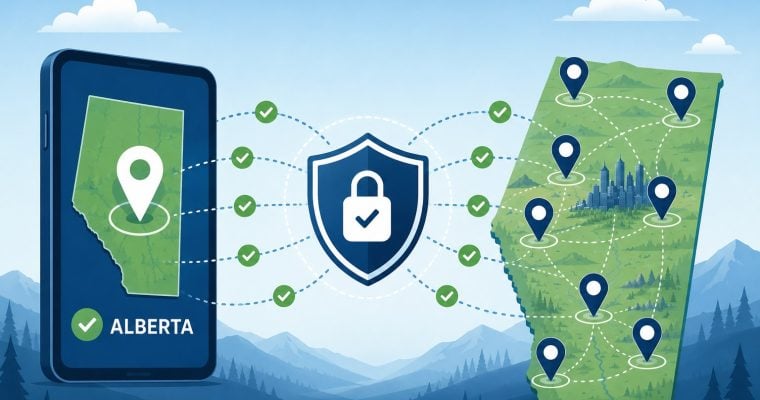
Alberta online casinos and sportsbooks processed more than 3.2 million geolocation checks in its first seven days live, according to data GeoComply released last week. The company’s Alberta-facing operator partners also saw a single-day peak of over 53,000 checks during the Spain vs. Argentina World Cup final on July 13 — the same day the province’s market opened.
The numbers come from GeoComply, the geolocation and fraud-detection vendor that verifies player location for most regulated North American gaming operators. That’s a critical caveat: this is a vendor’s own usage snapshot, not an independent market report, and it measures location checks and platform sign-ups, not deposits, bets, or revenue.
What the Data Actually Shows
- 3.2 million+ geolocation checks across GeoComply-enabled operator platforms in Alberta’s first week (July 13-19).
- 53,000+ checks in a single peak hour, tied to World Cup final viewership.
- 99.5% pass rate, meaning the vast majority of location checks correctly verified players as physically inside Alberta.
- 100% platform uptime through the launch window, per GeoComply.
- More than 100,000 Albertans signed up through GeoComply-enabled platforms in week one, according to GeoComply chair Anna Sainsbury.
A geolocation check isn’t a bet or a deposit. It’s a background verification that fires when someone opens an app, logs in, or places a wager, confirming they’re physically located in Alberta and not routing through a VPN from somewhere the operator isn’t licensed. High check volume signals real usage, but it can’t tell you how much money moved or how many of those 100,000 sign-ups turned into paying, active players.
Why the Timing Matters
Alberta launched its regulated market on July 13, 2026, becoming Canada’s second province — after Ontario in 2022 — to open online casino and sports betting to private operators under a competitive licensing model. The Alberta Gaming, Liquor and Cannabis Commission (AGLC) regulates the market, while the Alberta iGaming Corporation (AiGC) handles the commercial agreements that let registered operators actually go live.
That launch date landed in the middle of the FIFA World Cup semifinals and final, which is almost certainly why GeoComply’s numbers spike the way they do. Twenty-two operator sites, including FanDuel, DraftKings, BetMGM, BetRivers, and bet365, went live on day one, competing against the government-run PlayAlberta platform. Roughly 50 operators had completed AGLC registration by launch, though registration alone doesn’t mean a platform is live — a commercial agreement with AiGC is still required.
The bigger Number Nobody’s Celebrating
Alberta built this framework to compete with an entrenched grey market. The province’s own estimate, cited in its iGaming strategy, puts unregulated offshore betting at roughly 70% of total activity in Alberta before regulation. Ontario, by comparison, has clawed its channelization rate up to about 83.7% four years after its 2022 launch — the benchmark Alberta is chasing.
That gap is the real story behind the launch-week numbers. Strong first-week sign-ups and checks are a promising sign, but converting habitual offshore bettors into regulated, AGLC-licensed platform users takes years, not a launch week boosted by a World Cup final. GeoComply itself flagged this, noting the data is an early look and “does not purport to be definitive or representative of the entire Alberta market.”
What to watch next
Operators that registered with AGLC but weren’t ready to launch on day one have until October 13, 2026 to fully stand up their Alberta platforms or exit the market, per AGLC’s transition rules. That deadline, not launch-week World Cup traffic, will be the clearer signal of how many of the roughly 50 registered operators actually compete for Alberta players long-term — and how much of that 70% grey-market share the regulated side can realistically pull in.