
 Share
Share 


Ontario’s iGaming market has been open for four years, and in that time, gambling ads have become part of the background noise of daily life in the province. They run during hockey games, fill social media feeds, and appear on sports broadcasts almost as often as the games themselves. Now, a member of the provincial parliament wants to shut that off completely.
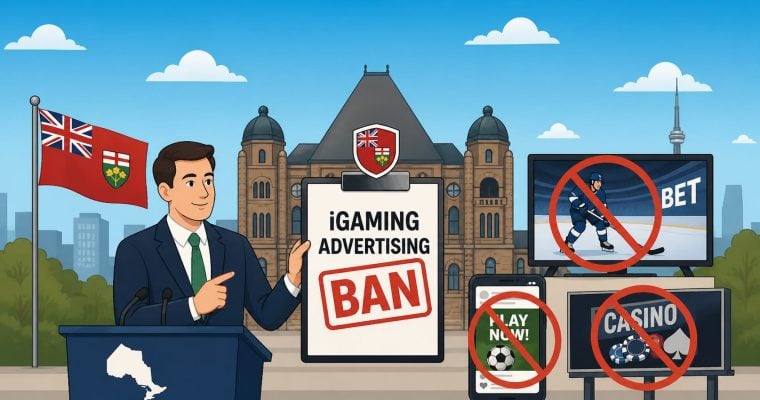
Liberal MPP Lee Fairclough on April 20 introduced the Stop Harmful Gambling Advertising Act. If passed, the bill would prohibit licensed iGaming operators from advertising on television, social media, and paid sponsorships. It is the most sweeping proposed restriction on gambling advertising Ontario has seen since the market opened.
What the Bill Actually Proposes
The bill targets the channels operators rely on most: Television, social media, and paid sponsorships would all be off-limits for gambling promotion. Operators who break the rules face fines of up to $1 million, and a second offense could result in losing their license entirely.
Fairclough has cited a sharp rise in gambling-related distress calls since the market opened in 2022, particularly among young people. The argument behind the bill is that four years of largely unrestricted exposure have caused measurable harm.
How Ontario Started and Where It Went Wrong
When Ontario online casinos and sportsbooks launched in April 2022, the advertising framework was thin. Operators were barred from promoting bonuses outside their own platforms and from marketing to minors or self-excluded players. Beyond those limits, the space was wide open.
What followed was a surge of gambling advertising across every major channel. Operators brought in celebrity athletes, ran high-frequency campaigns, and made gambling feel like a natural extension of watching sports. The framework had not anticipated the scale of what a competitive open market would produce.
Steps Taken to Rein Advertising In
The first significant correction came in 2024, when the AGCO banned recognizable athletes from appearing in gambling ads. High-profile figures, including Wayne Gretzky and Auston Matthews, were pulled from campaigns. Celebrity endorsements had become one of the main tools operators used to make betting feel aspirational, particularly to younger audiences.
Starting Jan. 1, 2026, the Canadian Gaming Association’s Code for Responsible Gaming Advertising came into effect. Administered by Ad Standards, it layered additional responsible marketing principles on top of existing AGCO rules. Bill 107 would go considerably further, moving from restriction toward the near-elimination of public-facing gambling promotion.
What Alberta Is Doing Differently
Alberta’s regulated iGaming market opens July 13, 2026. Where Ontario built its advertising rules reactively over four years, Alberta is entering with stricter standards already in place.
Athletes, both current and retired, are banned from gambling ads from day one. Targeting minors and vulnerable individuals is prohibited before a single operator goes live. A centralized self-exclusion program will be operational at launch.
Ontario spent four years arriving at the restrictions Alberta is launching on day one. Across both provinces, the direction is the same. The question is how quickly the industry adjusts.