
 Share
Share 


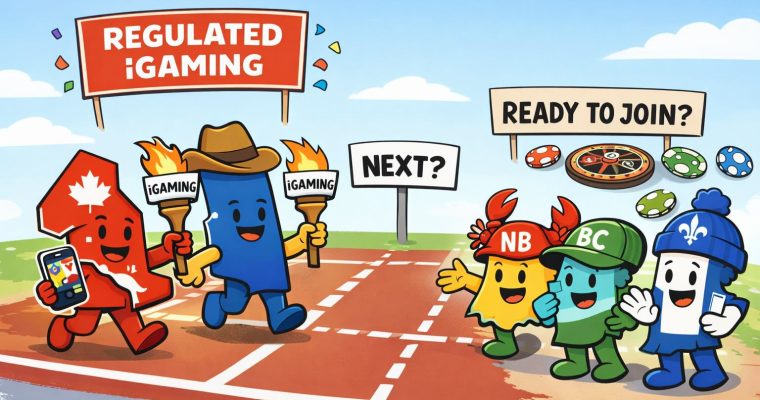
Following the anticipated launch of a competitive online gambling and betting market in Alberta on July 13, 2026, some industry experts are already wondering which of the Canadian provinces could be next to welcome Canadian online casinos and sportsbooks.
Ontario has already shown the rest of Canada what a regulated online gambling market can achieve; Alberta is keen to emulate the same level of success, albeit on a smaller scale. After all, Alberta’s population is 2.5 times smaller than in Ontario.
With Ontario’s blueprint adapted for Alberta, the province’s iGaming market is projected to generate around $900 million annually — but attention is already turning to which Canadian province could be next to follow.
Alberta Competitive Regulated Market About to Go Live
Since talks about opening the doors of Alberta online casinos and sportsbooks began in 2024, we’re finally nearing the market launch.
On July 13, 2026, all private operators with an AGLC license who have added the centralized self-exclusion system on their platforms and signed operating agreements with the AiGC (Alberta iGaming Corporation) will be free to start accepting real money bets within the province under the new iGaming framework.
Moving away from the monopoly model where PlayAlberta was the only legal option for online gambling, this new framework places player protections at the centre of Alberta’s iGaming structure, while redirecting revenue that was previously lost to offshore operators back into the province.
It is a structural overhaul that has been carefully staged. For Albertans who have spent years wagering on grey-market gambling sites with little recourse if something went wrong, the shift is a meaningful one.
Licensed operators will be held to strict standards around fair play, responsible gambling tools, and data protection, none of which offshore platforms were ever obligated to provide. The centralized digitized 24/7 self-exclusion system, in particular, is a first for the province, giving players a single, consistent mechanism to limit their own gambling activity across every licensed platform simultaneously.
New Brunswick Politicians Signal Interest in Joining Canada’s Regulated iGaming Market
According to The New Brunswick Telegraph-Journal, New Brunswick politicians have begun openly discussing the prospect of opening a competitive iGaming market, following the trail blazed by Ontario and Alberta.
The catalyst is largely financial. The New Brunswick Lotteries and Gaming Corporation fell $5.7 million short of its annual revenue target, recording $179.6 million for the year 2025. That miss lands at an uncomfortable moment, with the province projecting a record $1.37 billion deficit at the end of this fiscal year, with debt expected to climb by roughly $6 billion over the next three years, largely off the back of record healthcare spending.
Finance Minister René Legacy has since indicated the government is weighing whether an Ontario-style regulated market could help reverse that trend by pulling grey-market operators into a licensed, taxable framework.
However, it’s important to note that the move would not be straightforward. New Brunswick currently operates under the Atlantic Lottery Corporation alongside Nova Scotia, Prince Edward Island, and Newfoundland and Labrador. That means any push toward an open market would require the province to break from that regional structure and build its own regulatory path. Luckily, it has been done before. Ontario proved that much.
British Columbia and Quebec Still in iGaming Conversations
Last year, both British Columbia and Quebec engaged in discussions with the Canada Gaming Association about the possibility of opening their iGaming markets to private operators, even though neither province appears close to pulling the trigger.
In British Columbia, lobbyists on behalf of the Canadian Online Gaming Alliance (COGA) have been holding meetings with provincial policymakers to make the case for a regulated, competitive framework. Lobbying records confirm those conversations have taken place, with COGA arguing that regulated markets consistently capture far more player activity than monopoly-only systems.
However, the Ministry of Public Safety and Solicitor General has been pretty vocal about how happy it is with the current state of affairs, regardless of what’s happening in the rest of Canada.
“While regulation may enhance consumer protection and oversight for those currently gambling on unregulated sites, the B.C. government is concerned that increased accessibility and visibility of online gambling options may elevate population-level risk for gambling harms,” the ministry said in a statement. “BCLC’s PlayNow.com remains the only legal, regulated online gambling website in B.C., meeting our high standards for regulation including responsible gambling safeguards and age verification. It is also the only site that delivers net income back to government to fund important programs and services.”
As for Quebec, the Quebec Online Gaming Coalition began pushing for talks on regulating the province’s iGaming market back in 2024. The coalition commissioned an independent economic analysis that spring, using Ontario’s early iGaming performance as a blueprint to demonstrate what a regulated Quebec market could realistically deliver.
The findings were compelling. Ontario’s regulated market generated close to $230 million in revenues after expenses for the government in its first full year alone, while directly creating over 1,800 jobs. Using these numbers, the coalition framed regulating the province’s online gambling as a direct solution to Quebec’s budget pressures, arguing the province was leaving hundreds of millions in annual tax revenue on the table
Ontario’s Four-Year Anniversary Proves the Model Works
Meanwhile, Ontario’s open iGaming market marks its four-year anniversary this year on April 4. What started with 30 operators going live in the early hours of April 4, 2022, has grown into a market of 47 licensed operators running 81 gaming websites, generating approaching $11 billion in cumulative revenue and close to $2.2 billion in tax receipts over that four-year span.
In 2025 alone, total cash wagers surpassed $98.3 billion, generating $4 billion in revenue, all taxed at a 20% rate, and all separate from the Ontario Lottery and Gaming Corporation’s own performance. The numbers have done more to advance the case for regulated iGaming across Canada than any lobby group ever could.
Alberta’s July 13 launch is already shaping up as a stress test for the entire Canadian regulatory model. If the province can execute a clean, competitive market launch and begin posting meaningful revenue figures in its first year, the argument for other provinces to follow becomes considerably harder to dismiss.