



 Share
Share 



Bonus TL;DR
- Chess.com has launched Gambit, a play-money online poker platform designed to introduce players to poker.
- Gambit features all the same learning tools as the Chess.com software: tournaments, bot games, one-on-one play, coaching tools, player ratings, and post-game reviews.
- Gambit gives poker some rare mainstream exposure as a game of skill through a free platform that already promotes learning and skill development.
- Gambit is still in its early stages and will need to be refined, especially when it comes to poker strategy and tournament structures.
Chess.com has made its move into poker. At the beginning of September, the hugely popular website launched a new product called Gambit. Gambit is a play-money poker project designed to teach the game to novice players from square one while also giving users the chance to compete against one another. Much of Gambit mimics the Chess.com software.
Though Gambit is brand new, Chess.com’s entry into the poker space gives the game of poker something it hardly ever gets: a mainstream platform that promotes poker as a game of skill through various learning and training methods. This alone could make Gambit much more significant than the everyday poker product that hits the market.
On Gambit, you can play against friends and bots, compete in tournaments, solve “puzzles”, train with bot coaches, and much more. Gambit has the potential to bring poker to the masses while being presented through the same educational lens Chess.com uses for chess. The educational framing is incredibly important because the debate over whether poker is gambling or a game of skill has implications that stretch far beyond public perception and can affect the everyday lives of poker players.
The Poker-Chess Crossover is Nothing New
While the collaboration between Chess.com and poker is a very pleasant surprise, there has long been a crossover between the two games. Magnus Carlsen, largely considered to be the best chess player of all time, has made a deep run in the European Poker Tour (EPT) Main Event and has made several trips to Las Vegas for the World Series of Poker (WSOP).
The Botez sisters, who each have around 2,000 Elo and 1.3 million Twitch subscribers, have served as sponsored poker ambassadors for sites like GGPoker and ClubWPT Gold.
Woman Grandmaster and three-time National Chess Champion Jen Shahade has been a PokerStars ambassador for well over a decade. Shahade has earned nearly $1M from live poker tournaments alone.
Shahade was a PokerStars “Mind Sports Ambassador” back in 2014, when PokerStars and the now-defunct UKIPT (UK and Ireland Poker Tour) put together a combined chess and poker tournament on the Isle of Man.
Poker is Officially a Mind Sport
Poker was confirmed as a mind sport by the International Mind Sports Association (IMSA) on November 16th, 2024, at BSOP Millions in São Paulo. Poker became the ninth discipline recognized by IMSA, putting the game alongside the likes of chess, Go, and bridge.
Following the IMSA declaration, 16- and 17-year-old players could play poker on recognized poker tours if they legally emancipated themselves.
Brazil has led the way in recognizing poker as a game of skill for nearly two decades. Back in 2010, a Santa Catarina court allowed a Latin America Poker Tour (LAPT) series to carry on, granting an injunction and declaring that skill predominated over luck. Not even 18 months later, the country’s Ministry of Sport registered the Confederação Brasileira de Texas Hold’em (CBTH) as a sporting entity. The CBTH states that poker requires “intelligence, ability, and intellectual and behavioral skills to succeed.”
Why Poker Being Considered a Game of Skill Matters
The debate over whether poker is considered gambling or a game of skill has had severe consequences, mostly in the United States. Despite having 41% of all players worldwide with a recorded live tournament cash, online poker is still mostly illegal.
The tax implications are also very real. The One Big Beautiful Bill Act (OBBBA) reduced the amount of gambling losses Americans can deduct from their taxes from 100 percent to 90 percent, beginning in 2026. Poker players are, unfortunately, included in that category.
The majority of profitable tournament poker players rely on high volume and razor-thin margins. The OBBBA creates taxable income for players who are break-even or even lose money. This will undoubtedly cause many American poker players to effectively retire from tournament poker once they get the sticker shock in the upcoming tax season. Players like Erik Seidel have already declared “semi-retirement,” citing the tax change as the main reason to play fewer tournaments.
This makes Gambit, conceivably, more than just another poker product. Gambit has arrived as a mainstream educational tool in a time when poker is increasingly being viewed as a skill-based game. If Chess.com takes advantage of its enormous opportunity to grow the game of poker, they could potentially create the next wave of recreational poker players, help transform the mainstream perception of poker, and arguably help separate poker and gambling from a legal point of view.
Gambit – First Impressions
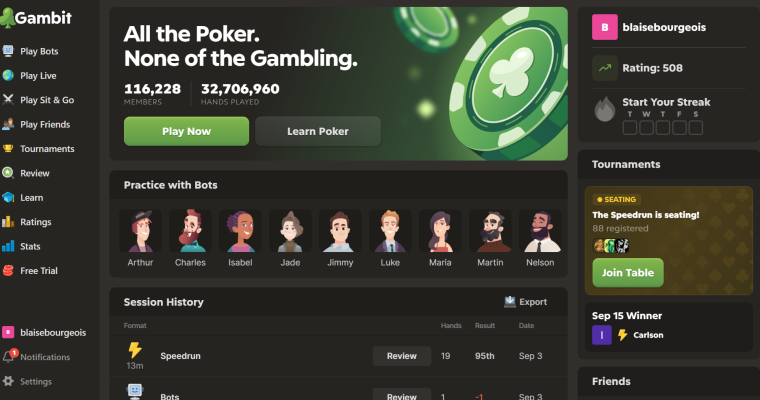
When you log into the Gambit website, you can immediately tell it’s a Chess.com product, based on the color scheme, avatars, and the icons. The website has an immediate educational feel.
I was immediately impressed that it had over 100,000 members and that there have been nearly 33 million hands played on the site. I really think this has the potential to expand poker to the masses.
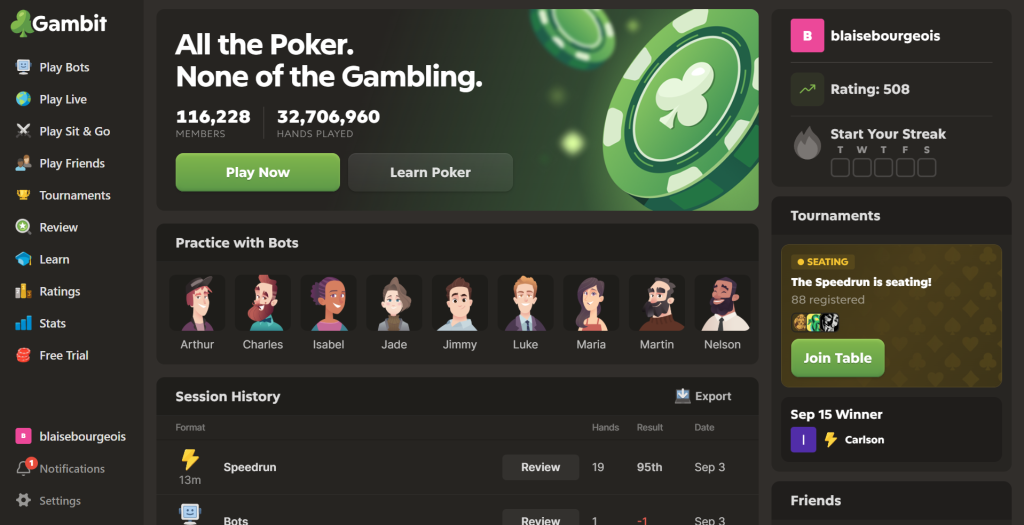
However, it’s clearly still in beta mode and has a long way to go. One big positive is that they give everyone a rating, similar to an Elo rating in chess. I’m also a big fan of their hand reviews. There are some inaccuracies and shortcomings that are too large to ignore at this stage.
Gambit’s “Learn” section does not give players an aptitude test to put them where they need to be on the learning curve. So there I was, as a professional poker player, having to be told what a royal flush was. It doesn’t make me want to go through a ton of learning modules to get to the good stuff.
Still, the modules did a great job quizzing true beginners on concepts like whether a flush is higher than a straight. It felt a bit like Duolingo for poker, which is definitely a huge positive in the grand scheme of things.
The tournaments have a ton of potential, though their blind levels are currently very unrealistic, doubling every level. They have created structures that are completely irrelevant compared to what they’ll see in actual poker tournaments if a player decides to make the jump to real money.
As you would on Chess.com, you have the ability to review all of your “moves”, aka every hand you play. While the concept is excellent and I cannot wait for them to make the necessary corrections, the data is still not completely accurate.
The hand advice isn’t ready yet either. Just a few hands into playing a $1/$2 simulation, Gambit recommended that I call 92o in the small blind against an under-the-gun limp. It’s clearly a fold. Surely, they’ll work with actual poker players to improve this feature. I’ve already volunteered my services.
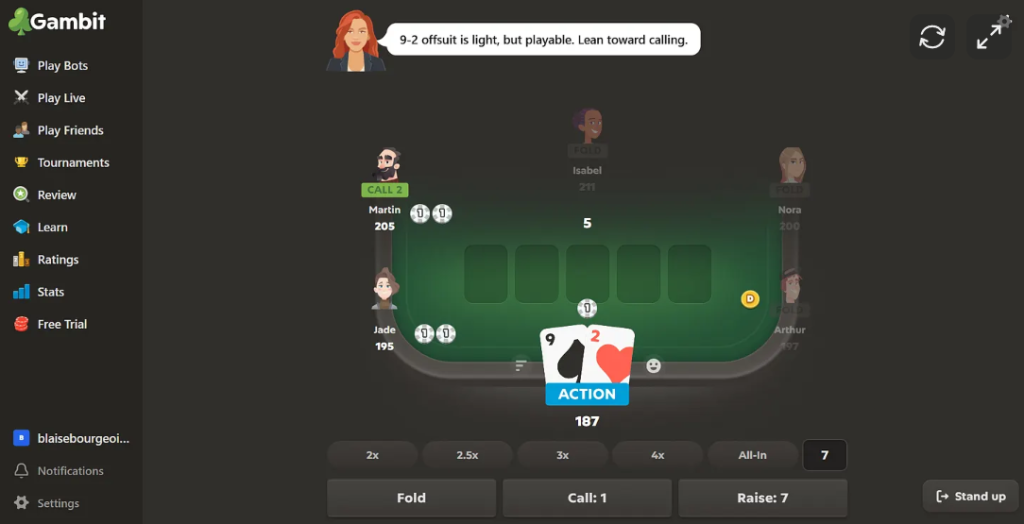
In addition, you can only play cash games against the bots. One of the biggest parts of the educational process is figuring out whether you’re a cash game player or a tournament player. These are two distinct formats with distinct strategies and differentiating appeal. Gambit should do a better job of steering players one way or the other.
Conclusion
Overall, Gambit isn’t ready to create players to send into real-money poker games just yet. But a mainstream website like Chess.com putting a poker-learning product into the ecosystem is undoubtedly one of the biggest net positives poker has seen in quite some time.
We’re still in the first month of production, so it’d be very foolish to think that Gambit would be fine-tuned for a variety of players with different goals. It’s clear that they need more influence from poker players, rather than chess players who have made poker a hobby. It’s important to state that they’re onto something great.
Chess.com has already proven that they can create better chess players en masse. If they are even a fraction as good at creating poker players who can enter games at real-money online casinos, we could be looking at a new poker boom and one of the most influential poker products of our generation.