


Kalshi Review – Prediction Market Features, Safety & How It Works
Quick Take:
If you are new to prediction markets, the biggest risk is mixing up two very different worlds: regulated event-contract exchanges and unregulated “bet-style” platforms. Kalshi sits firmly in the regulated category, operating as a CFTC-designated contract market (DCM) under the Commodity Exchange Act.
I’ve traded on Kalshi myself, and I can say that it is legit. This review focuses on what you actually need to know before you place your first order. I’ll cover the markets available, how pricing and payouts work, what safety and oversight mean in practice, and what to expect from fees, deposits, withdrawals, and platform limits.
Kalshi’s biggest differentiator is that it feels more like a trading venue than a sportsbook. That can be a strength or a frustration depending on what you want, and I’ll show you why.
Read morePros:
- Fully regulated by the CFTC
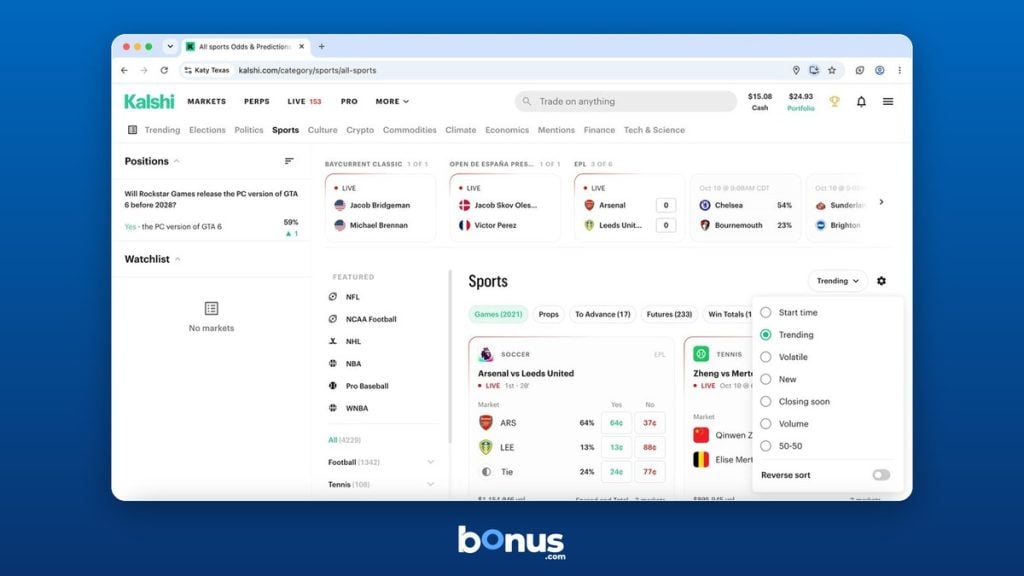
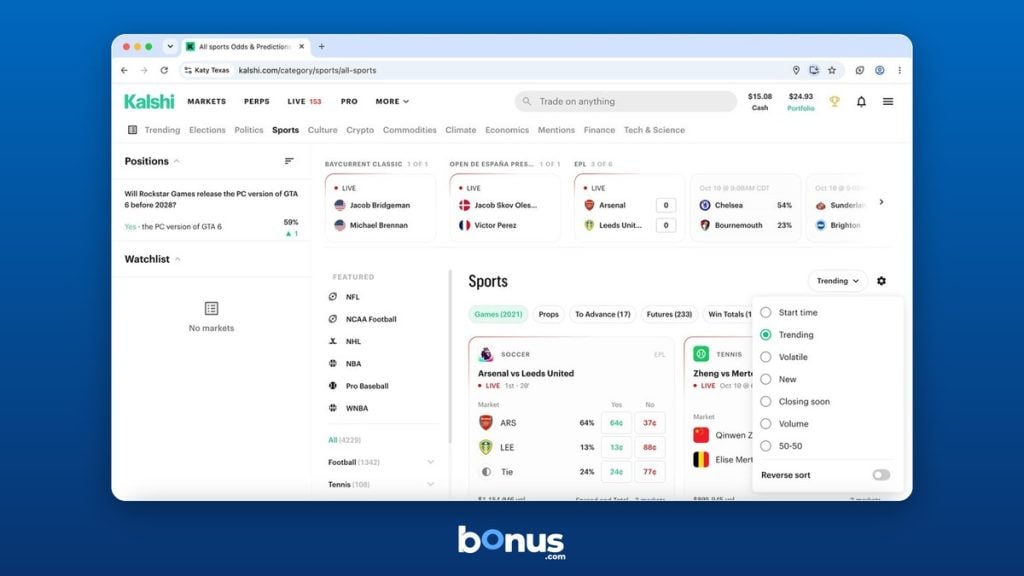
- Clean, modern UI with minimal clutter and simple navigation
- Fast order execution
- Transparent market rules
- Broad range of market categories
Cons:
- If you are used to sportsbook UX, the trading-style feel can take some adjustment
- Not all states allow all markets
- Sports contracts face legal challenges
- Fees can add up during active trading
- No social features or live chat community
Kalshi
My Experience Using Kalshi
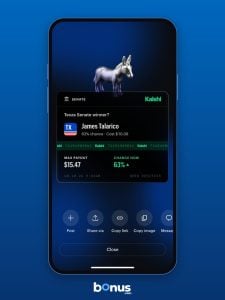
Using Kalshi on my iPhone 15 felt different from the sportsbook and trading apps I use most. The design is clean and high-contrast, with a deep navy look and bright accents that draw my attention to active markets. On the iPhone’s OLED screen, it stays crisp, and I never had to squint moving between indoor and outdoor light.
Speed was the next surprise. From a cold start, the home screen showed up in under a second in my tests. Market pages loaded instantly, and even chart-heavy views stayed smooth. Scrolling through categories was stable, with no jitter or partially loaded tiles.
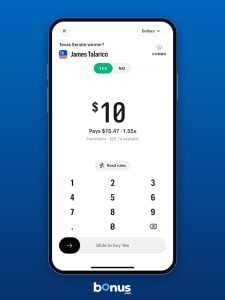
Inside a market, everything feels deliberate. The transition is subtle, the chart slides in smoothly, and the bid and ask boxes snap into place. Toggling Yes and No and adjusting size feels tactile thanks to light haptics. Order entry is exceptionally responsive: prices and sizes update in real time, and fills refresh almost immediately.
I also stress-tested network changes. Switching between Wi-Fi and 5G did not freeze the app. At worst, I saw a brief spinner during a refresh, then it recovered without reloading. Overall, it feels polished, focused, and built for trading rather than hype, day after day.

Is Kalshi Legit, Safe & Regulated?
Kalshi is regulated at the federal level by the US Commodity Futures Trading Commission (CFTC). The CFTC issued an Order of Designation granting KalshiEX LLC status as a designated contract market (DCM), and Kalshi is listed as “Designated” in the CFTC’s public filings. Kalshi also has a clearing-related affiliate registered as a derivatives clearing organization (DCO).
What does that regulation mean for you in practice:
- Rules-based markets: contracts follow defined rules and a listed settlement process
- Exchange-style trading: you trade contracts, not sportsbook odds
- Market integrity controls: oversight expectations around fair trading and market conduct
- Clearing infrastructure: clearing supports settlement and risk processes
In plain English, Kalshi feels closer to trading than gambling. Some markets still look “bet-like” because outcomes resolve as Yes/No, but the mechanics are exchange-driven rather than a bookmaking model.
One crucial nuance is sports-related legal friction. Kalshi’s sports-style event contracts have drawn attention from state regulators in some jurisdictions, and major outlets have reported enforcement actions and ongoing court disputes. That is worth knowing because it can affect where specific markets are available and how the regulatory conversation evolves — especially when compared to fully regulated sports betting platforms that operate under state-level gambling laws.
How User Funds Are Protected
When I decide whether a platform is safe to keep money on, I look for proof points: separation of customer funds, clear limits on downside risk, and friction that stops fraud. With Kalshi, the first layer is segregation. My funds sit in a dedicated U.S. customer account and are not used for operations. Collateral is treated as separate in the clearing setup. Next are position limits.
Many contracts cap maximum loss exposure at $25,000, with some markets setting different limits. Finally, security is built into onboarding and transfers. I provide personal details and may verify with ID, and withdrawals can be gated by method-based hold periods and occasional extra checks.
Geographic Restrictions
Where users can and cannot access Kalshi (US states):
| Access level | States |
|---|---|
| Fully legal (Full access) | CA, NY, TX, FL, GA, WA, VA, PA, OR, MN, WI, MA, NC, SC, AL, AK, AR, ID, IN, IA, KS, KY, LA, ME, MS, MO, NE, NM, ND, OK, SD, TN, UT, VT, WV, WY |
| Limited access (Certain contracts restricted) | AZ, IL, MD, MI, MT |
| Active challenges (Mainly sports-contract disputes) | NJ, OH, CO, NV |
Where users can and cannot access Kalshi (countries):
| Category | Countries |
|---|---|
| Can access (generally) | Mexico, Brazil, Germany, India, Japan, South Korea, and South Africa (plus most of Asia and Latin America). |
| Cannot access | Afghanistan, Algeria, Angola, Australia, Belarus, Belgium, Bolivia, Bulgaria, Burkina Faso, Cameroon, Canada, Central African Republic, Côte d’Ivoire, Cuba, Democratic Republic of the Congo, Ethiopia, France, Haiti, Iran, Iraq, Kenya, Laos, Lebanon, Libya, Mali, Monaco, Mozambique, Myanmar (Burma), Namibia, Nicaragua, Niger, North Korea, Poland, Russia, Singapore, Somalia, South Sudan, Sudan, Syria, Taiwan, Thailand, Ukraine (Crimea, Donetsk, Luhansk, Zaporizhzhia, and Kherson regions), United Kingdom, Venezuela, Yemen, Zimbabwe |
Kalshi frames these restrictions as compliance-driven, tied to applicable law and policy, not arbitrary business decisions.
Markets Available on Kalshi

Politics & Elections
Politics and elections markets on Kalshi are framed as clear, exchange-style questions with a deadline. You will see big national outcomes, such as congressional control, and even structured international election contracts, such as German Bundestag seats or “most seats” markets.
Prices can move quickly when new information hits. Poll swings, debate moments, court rulings, and major endorsements can all shift what traders will pay for “Yes” versus “No.”
This category is best for people who already follow politics closely and can stay disciplined on entry price, position size, and exits before settlement.
| What you are trading | Typical scopes | Why does the news impact pricing fast |
|---|---|---|
| Election outcomes and seat control | National, state-level, and international election structures | The “probability” is crowd-priced, so breaking news and credible polling changes immediately alter bids and asks |
Sports Markets
Sports markets are the easiest place for beginners to understand the concept, but they are also where the most legal friction has shown up.
The key difference from sportsbooks is the pricing model. You are not taking bookmaker odds on a slip. You are trading a contract price on an exchange-style structure, where you can enter and exit based on market pricing and liquidity.
| Feature | Sportsbook Model | Event Contract Model |
|---|---|---|
| Pricing | Book sets odds and lines | Market-driven price (buyers and sellers set it) |
| How do you “win” | Fixed payout based on odds | Correct side settles at $1, incorrect side settles at $0 (contract-style payoff) |
| Can you exit early? | Often limited (cash-out varies) | Designed for trading in and out when liquidity exists |
Examples of event-style sports questions (real examples reported publicly):
- NCAA-related sports event contracts discussed around state enforcement actions.
- Pro sports outcome questions like “Will the 49ers win?”
- Futures-style markets like College Football Playoff champion markets.
Sports markets can be highly responsive and liquid around game day, which makes pricing feel “fair” when volume is high. The drawback is that availability and product scope can change quickly because sports contracts have triggered disputes with some state regulators and ongoing litigation.
Crypto & Financial Markets
If, like me, you like structure, this is the category to go to. It feels the most consistent. Most markets are built around thresholds and ranges. That keeps the risk math simple. I’m basically trading whether something finishes above, below, or between a defined level by a set time.
| Format | What it means | Examples |
|---|---|---|
| Price threshold | Ends above or below a number | Will the S&P 500 close above 5,000 at the end of trading today? |
| Price range | Ends inside a band | Bitcoin range-style examples described by Kalshi (close between specific bands). |
| Policy or regulatory decision | The outcome depends on an official decision | Fed decision markets and CPI-linked repricing have been discussed in Kalshi market commentary around inflation releases. |
Volatility Considerations: These markets can move fast around scheduled events (CPI releases, Fed meetings) and sudden headlines. That is where limit orders and pre-planned exits matter most, because spread and slippage can widen when everyone rushes in at once.
Economics, Culture & Other Markets
This is the category where Kalshi feels the most diverse. I see a mix of serious macro markets and fun culture markets. The macro side usually ties to scheduled releases and official outcomes, like inflation prints and interest-rate decisions. Kalshi’s market rules also specify the timeline and verification source, so I always check them before trading.
Culture markets are just as active. Kalshi has run award-show markets and even publishes guides and market write-ups around them. If you have followed the Oscars or Grammys cycle before, the market questions feel intuitive.
Where niche knowledge becomes an edge is timing. In economic markets, the edge comes from understanding what the release measures and what the market is already pricing in. On culture markets, it’s knowing the narratives, the precursor signals, and what might shift sentiment late.
Fees, Pricing & Trading
Trading Fees Explained
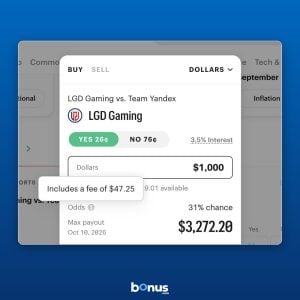
Kalshi publishes a detailed fee schedule (effective Oct 1, 2025). It states:
- Trading fees apply to orders that are immediately matched with existing orders in the order book.
- The general fee formula is: fees = round up(0.07 × C × P × (1 − P)) where:
- P = price of a contract in dollars
- C = number of contracts
- “round up” means rounding to the next cent.
- Maker fee formula (where applicable) is: round up(0.0175 × C × P × (1 − P)).
Example fee breakdown (step-by-step):
Scenario: Buy 100 contracts at $0.50 (so P = 0.50, C = 100)
- Compute $Px (1 – P) = 0.50×0.50 = 0.25$
- Multiply by $C = 100 → 100x 0.25 = 25$
- Multiply by $0.07 → 25x 0.07 = 1.75$
- Round up to the next cent $1.75 This matches Kalshi’s own example table, which shows a ~$1.75 fee for 100 contracts at $0.50.
Other fee facts from the same schedule:
- No settlement fee.
- No membership fee.
Limits & Risk Controls
When I trade on Kalshi, I treat the built-in limits as part of the product, not an afterthought. The smallest trade I can make is one contract. Contracts are quoted in dollars and cents, and the platform’s rulebook sets the minimum quote increment at $0.01.
On most markets, contracts are listed at $0.01 to $0.99, and each contract has a $1 notional value that settles to $1.00 for the correct outcome (and $0 for the incorrect side).
For risk caps, I check position limits before sizing up. Many contracts use a $ 25,000-per-member position-limit framework (often described as maximum loss exposure), and some specify different limits depending on the market.
The reason these controls exist is straightforward. They help prevent a single account from taking outsized exposure to a single market, and they support more stable trading when prices move quickly around news or settlement deadlines.
Deposits, Withdrawals & Payment Methods
Below is a payment table based on Kalshi’s help center and published fee schedule.
| Method | Deposit fee | Withdrawal fee | Processing time (deposit) | Processing time (withdrawal) | Limits/minimums |
|---|---|---|---|---|---|
| Bank transfer (ACH) | $0 (per fee schedule) | $0 (per fee schedule) | Kalshi notes it can take 1–3 business days before funds are withdrawn from your bank | N/A | N/A |
| Debit card | 2% processing fee | $2 fee | N/A | Funds “should arrive… within 30 minutes” after completion | Daily debit withdrawal limit is $2,500 |
| Crypto (via Zero Hash) | Fees may apply via a third-party processor and are disclosed before the transaction | Fees may apply via a third-party processor and are disclosed before the transaction | “Up to 30 minutes” to be applied | N/A | Deposit limit $500,000 |
| Wire | Kalshi charges no additional wire deposit fee (bank may charge its own) | Wire withdrawals not supported under $500,000 | If received by 4 pm ET, attribution within one business day | [Not applicable for most users] | Wire deposits under $1,000 are not accepted |
Deposit Options
Kalshi documents deposits via:
- Debit card (2% fee, US debit cards only).
- Bank transfer (ACH) via Aeropay (with timing notes).
- Crypto via Zero Hash (deposit can take up to 30 minutes; $500,000 limit).
- Wire (under $1,000 not accepted; timing notes).
Withdrawal Process
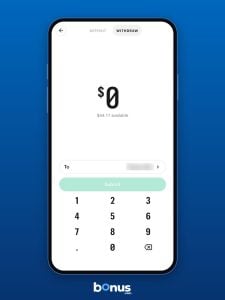
When I withdraw from Kalshi, I plan around two things: payout speed and deposit holds. If I’ve been funded by debit, I don’t expect to withdraw immediately. I wait for the 3-day hold to clear, then a debit withdrawal is the fastest option. After I confirm it, it completes quickly and is expected to land within about 30 minutes, unless an extra verification check slows it down.
If I withdraw to a bank account, I expect it to take around 3–4 business days. I also watch the bank transfer holds: 7 days if I withdraw to the same bank, and up to 90 days if I withdraw to a different bank.
Platform & App Experience
Desktop Experience
When I use Kalshi on a desktop, it feels like a proper exchange. The layout is clean, and the navigation is easy to learn. I move between Markets, Portfolio, and Account without extra clicks, so I stay focused. Pages load fast and stay clear on a larger screen. I like the space for pricing and liquidity.
The order book helps because I can see bids and asks with sizes and prices, then judge tradable levels. Finding markets is simple. I browse categories or use the search to quickly find an answer. Limit orders feel smooth, and portfolio tracking stays organized for me.
Mobile App Experience
When I use Kalshi on my phone, it feels fast and purpose-built. On iOS, the app opens quickly, market pages load almost instantly, and charts stay responsive. Even when I’m moving between screens, nothing feels laggy or clunky. I also like how clean it looks. The typography is modern, the spacing is generous, and the navigation stays simple.
In terms of features, the mobile app covers what I actually use on a desktop. I can browse markets, place orders, check positions, and track my portfolio without feeling like I’m missing core tools.
I tested it in real life by switching between Wi-Fi and 5G while checking a market. It stayed stable, and I didn’t need to force-close the app.

Customer Support & Help Resources
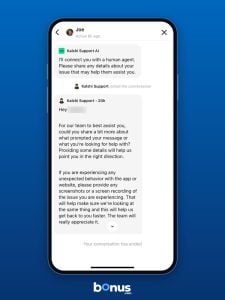
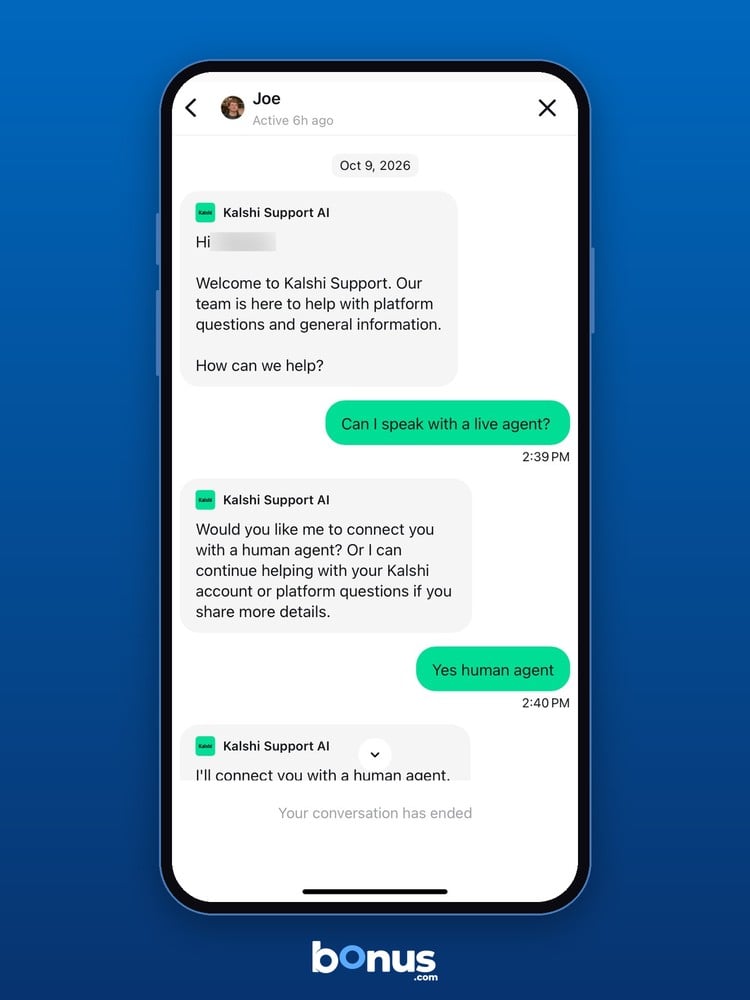
When I need help on Kalshi, the main channel is email support through the Help Center. Kalshi asks users to contact support@kalshi.com and include their account details and screenshots so the team can troubleshoot more quickly. For wire transfers, the guidance is even more specific. Kalshi tells users to email support with items such as the memo code and proof of wire if a deposit does not appear.
Kalshi does not promise a fixed response time, so I treat it as reliable but not instant. What I do like is the quality of the self-serve resources. The Help Center outlines deposits, withdrawals, holds, and security checks in a step-by-step format, and the published fee schedule is much more explicit than that of many unregulated prediction markets platforms.
How Kalshi Compares to Other Prediction Markets
Key Differences
| Platform | Market depth | Fees | Accessibility |
|---|---|---|---|
| Kalshi | Order book (resting bids/asks with price + size). | 0 platform fees (trade, deposit, withdrawal). | Forty-six named restricted jurisdictions + US comprehensive sanctions jurisdictions. |
| Polymarket | Order book (CLOB) with bids/asks. | 0 platform fees (trade, deposit, withdrawal). | 33 blocked countries + 4 blocked regions (includes US). |
| PredictIt | Exchange-style political markets under a “small-scale” framework. | 10% fee on profits + 5% withdrawal fee. | The investment cap per contract is tied to the FECA limit; $3,500 is stated in the letter (it adjusts over time). |
Who This Platform Is Best For:
- News-driven traders who want a regulated market structure and published fee math.
- Sports-focused users who want event-contract style exposure (but should be aware of potential state-level disputes around sports contracts).
- Beginners willing to learn order-book basics and use small sizing until comfortable.
Who Should Avoid It:
- Users in restricted jurisdictions.
- Users expecting a pure sportsbook flow with parlays and bookmaker-set lines.
- High-risk, high-leverage traders looking for leverage products.
Final Verdict – Is Kalshi Worth Using?
If you want a regulated, rules-first prediction market, Kalshi is worth using inside the CFTC exchange framework. The CFTC designated KalshiEX as a DCM, and Kalshi publishes explicit fee formulas and clear withdrawal-hold rules.

Trading feels like an exchange, so you may need to use limit orders and be patient when liquidity is thin. Holds can delay fast cash-outs, especially after deposits. I recommend Kalshi for news and macro traders who value transparency and structure. If you want sportsbook-style simplicity, look elsewhere.
Kalshi FAQ
KalshiEX LLC was designated as a contract market (DCM) by the CFTC (US federal regulator for commodities and derivatives markets).
Kalshi operates as a regulated exchange listing event contracts under the Commodity Exchange Act framework, which is structurally different from sportsbook wagering models.
The minimum deposit is $1.
No platform is risk-free, but Kalshi’s regulated status (DCM), clearing registration for an affiliate (DCO), position limits, and documented security holds are concrete protections and controls described in official sources.
Yes, you can. However, you will have to check which counties are allowed.
No