




Robinhood Prediction Markets: How It Works, Top Features


Prediction markets can feel confusing at first, especially if you’re used to sportsbooks or traditional investing. Robinhood’s take on prediction markets is built around event contracts. These are yes-or-no-style contracts priced in cents that settle at $1 for the correct outcome and $0 for the wrong outcome. The key difference is structure: Robinhood offers access through Robinhood Derivatives and partner exchanges regulated by the Commodity Futures Trading Commission (CFTC), rather than operating a sportsbook-style model...Read More
In this review, I break down how Robinhood prediction markets actually work in plain English, what “regulated” means in practice, what markets you’ll typically see, how orders and payouts work, what fees you pay (including the spread-vs-fee setup), and what to know about deposits, withdrawals, and restrictions.
I have traded on Robinhood myself, and I can say that it is legit. The event contracts Robinhood offers are connected to partnered exchanges regulated by the CFTC, and event-contract trading is offered via Robinhood Derivatives (a CFTC-registered futures commission merchant and NFA member).
If you’re curious why this matters, here’s why: Robinhood makes prediction markets feel more like a familiar trading workflow (contracts, orders, closes, settlement) than a betting slip, while still keeping the simple “yes/no” intuition that makes prediction markets easy to grasp.
Read Less
Sites Like Robinhood Prediction Markets: Best Alternatives
Get $100 in Predicts Bonus When You Trade $1 for 5 Days
Make Predictions on Real World Events Right in Your Phone
Trade on Sports to Culture, Financials, Crypto and More
Trade on Sports, Politics, and MORE
Largest Prediction Market in the US
Hundreds of Markets to Choose From
Huge Range of CFTC-Approved Markets (Sports, Tech, and More)
Compete with Others & Climb the Leaderboards
No User Limiting on Trades
My Experience Using Robinhood

Robinhood’s prediction markets hub feels like a “broker-grade wrapper” around event contracts. That’s the best way I can describe it. The interface is simple, the contract flow is clear, and the app does a good job of making a new category feel approachable without burying you in jargon.
The biggest win for me is structure. I’m not guessing how odds are made or what the house edge is. I’m trading contracts priced in cents, with transparent fees, and a defined payout at settlement. The trade-off is that liquidity and fills can vary by contract, and you need to recognize that these are fully collateralized, all-or-nothing outcomes if you hold to settlement.
My quick takeaways:
- I like it most for clean, binary markets (rates, elections, simple thresholds).
- I use limit pricing when I care about entry and exit.
- I treat sports-style contracts carefully because availability and rules can change by state.
Pros:
- Prediction markets are integrated into a familiar, mainstream app.
- Clear contract pricing in cents and clear $1 or $0 settlement logic.
- Transparent fees: Robinhood commission plus either an exchange fee or a built-in spread.
- Order types are consistent and straightforward (IOC for fast fills, GTD for resting orders).
- Strong educational flow inside the hub and help center.
Cons to look out for
- Not available everywhere (Maryland is excluded, Nevada has sports limits starting Dec 1, 2025).
- No stop orders and no fancy conditional tools.
- Fills depend on real market participation. If no one takes the other side, you do not get filled.
- Buying power for event contracts can be more restrictive than stock buying power (settlement timing matters).
Is Robinhood Legit, Safe & Regulated?
Regulation & Legal Status
This is the part that most people care about first, and it’s also where Robinhood is meaningfully different from many prediction-market-style sites.
When I trade event contracts on Robinhood, I do so through Robinhood Derivatives, LLC, a CFTC-registered futures commission merchant (FCM) and an NFA member. Robinhood also states it offers event contracts through RHD and its membership with partnered exchanges regulated by the CFTC.
The contracts themselves are listed and executed on regulated venues. Robinhood’s own risk disclosures explain that RHD may clear event contracts as a clearing member of ForecastEx or Kalshi, and that both are registered with the CFTC as derivatives clearing organizations (DCOs).
The simple distinction I use:
- A sportsbook takes the other side and sets odds like a dealer.
- These event contracts trade on an exchange structure with bids and asks, and settlement rules defined up front.
If you’re more interested in traditional wagering on sports outcomes, check out our complete guide to sports betting.
How User Funds Are Protected
When I judge safety, I focus on practical protections, not marketing. First, event contracts are fully collateralized. Robinhood’s risk disclosure says bids are rejected unless you have enough funds deposited to fully cover them, which caps the downside to what I put up.
Second, the account sits in a futures-style framework where customer funds are segregated under CFTC rules, but Robinhood is clear that RHD accounts are not SIPC-protected or FDIC-insured.
Third, insolvency handling is defined. The disclosure states that an RHD insolvency would be handled under commodity broker liquidation rules and CFTC Part 190, indicating the presence of documented safeguards.
Geographic Restrictions
Robinhood is US-focused here, and access is not uniform. Some restrictions are state-based, and some can be contract-based.
Here’s the cleanest way to think about it:
| Location / Status | Can you access Robinhood event contracts? | Notes |
|---|---|---|
| Eligible U.S. states/territories | Yes | Some contracts may not be available in every state or territory. |
| Maryland | No | Robinhood’s support documentation notes that event contracts aren’t available in Maryland. |
| Nevada (sports-style contracts) | Limited | Robinhood notes sports event contracts aren’t available in Nevada after a specified date (as stated in their support update). |
| Outside the U.S. | Generally no | Eligibility and product access are tied to Robinhood’s jurisdictional onboarding and derivatives eligibility. |
Restrictions exist because Robinhood operates under regulated market access rules and state-level constraints. They are not just arbitrary business decisions.
Markets Available on Robinhood
Politics & Elections
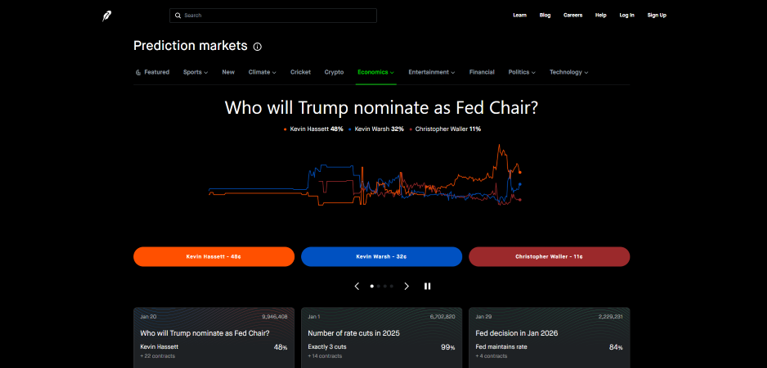
When I use Robinhood for politics, it usually shows up as big, headline-driven markets with clear resolution rules and a firm deadline. The most visible example has been national-scale contracts such as the U.S. presidential election market. Local and global politics can exist in prediction markets broadly, but in Robinhood’s hub, what I’ve personally seen promoted and explained most clearly is the national layer.
What makes these markets tricky (and fun) is how fast the price reacts to new information. A poll shift, a debate moment, a court ruling, or a surprise endorsement can push the contract price up or down quickly because the price is essentially the market’s real-time probability estimate.
| Scope I see most | How news moves pricing | Ideal user type |
|---|---|---|
| National (U.S. presidential-type markets) | News changes perceived probability, which moves the contract price in cents | Someone who follows politics closely and can stay disciplined on entries and exits |
Sports Markets
Sports is where Robinhood feels most “sportsbook-adjacent,” but the mechanics are still contract trading. I’m not placing a bet on a house line. I’m buying and selling event contracts priced in cents, and the payout is fixed at $1 for the correct side if I hold through settlement.
Robinhood also builds sports into a more guided experience: live scores, real-time updates, preset combo contracts, and player-level contracts for certain pro football markets.
Sportsbook vs Robinhood event-contract:
| What you’re doing | Sportsbook model | Robinhood event-contract model |
|---|---|---|
| Pricing | Odds/lines set by the book | Prices set in cents on exchange-traded contracts |
| Your “exit” | Usually locked once placed (unless cash-out exists) | I can close early by trading the opposite side |
| Settlement | Payout odds-based | $1 or $0 at final settlement |
Examples of event-style sports questions and formats I actually see:
| Format | What it looks like | What to watch |
|---|---|---|
| Game outcome markets | Trading on winners for pro and college football games | Liquidity varies by matchup |
| Preset combos | Outcome + total score conditions bundled into one contract | Both legs must be true to pay out |
| Player-level contracts | Yes/No on individual athlete stats (TDs, yards, etc.) | Fast price swings near kickoff and in-play |
Sports is easy to understand, and the app updates quickly. Still, it’s also the category that runs into the most legal friction and location limits, so I treat availability as “subject to change.”
Crypto & Financial Markets
Robinhood’s economics and culture markets are where the hub feels widest. I’ve traded rate-driven questions like the Fed funds upper bound contract, which has a clear schedule and an official resolution source. I also see entertainment-style contracts, including Oscar nomination markets, that trade the same Yes/No way.
When something is niche, I assume liquidity may be lighter, so I stick to limit pricing and a smaller size. If a jobs-report-style contract shows up, I treat it like rates: know the calendar, watch the release, and avoid chasing headlines. I check the timeline first, then decide if spreads and depth justify entry.
| Theme | What I can confidently point to | Why niche knowledge helps |
|---|---|---|
| Interest rates | Fed funds threshold-style markets | Knowing the calendar and decision mechanics reduces guesswork |
| Entertainment | Awards and culture-style markets appear on listings | Fans track signals and narratives earlier than general traders |
Fees, Pricing & Trading Costs
Trading Fees Explained
Robinhood states it charges a $0.01 commission per contract bought or sold. Depending on the exchange, you’ll also have either:
- an exchange fee, typically $0.01 per contract, or
- a spread embedded into pricing, where Yes + No can add up to around $1.01
Robinhood also publishes a fee schedule for Robinhood Derivatives that lists:
- Event contract commission: $0.01 per contract, per side
- Exchange fees for Kalshi products: $0.01 per contract, per side
- NFA assessment fee: $0.02 per contract, per side (regulatory)
A realistic example (the way I actually do the math):
- If I buy “Yes” at $0.47
- Add $0.01 Robinhood commission
- Add $0.01 exchange fee (if that market uses a fee model)
My total cost is $0.49 per contract. If I’m right and hold to settlement, I receive $1.00, so the max profit is $0.51 per contract.
If the market uses a spread model, Robinhood explains the math differently:
- I might buy “Yes” at $0.60
- There may be no exchange fee, but the spread is embedded
- I still pay $0.01 commission
So my total is $0.61, and the max profit is $0.39 if correct.
Limits & Risk Controls
When I trade event contracts on Robinhood, the limits feel deliberate, in a good way. On the small end, I’ve been able to place trades as low as $1, so I can test ideas without sizing up too fast.
On the exposure side, I’ve noticed the caps are contract-specific. Robinhood surfaces the limit right on certain contract pages. A clear example is the Target Fed funds market, which lists a 50,000-contract position limit per event question.
The biggest control is collateral. Robinhood treats these as fully funded positions. If I don’t have enough available funds to cover the order, it won’t go through. That keeps my downside capped and prevents me from taking on exposure I can’t actually support.
Withdrawals & Payment Methods
Withdrawal Process
Withdrawals and proceeds on Robinhood feel more settlement-driven than most people expect. In my experience, my account only updates after I close a position or after the contract pays out. While I’m holding contracts, my buying power doesn’t move in real time, even if the market price swings in my favor.
My typical flow is simple: I enter with funds that are already settled for event contracts. If I close early, the result credits after the close, but buying power can still lag while funds shift between the derivatives and investing side. If I hold to settlement, proceeds usually move over the next business day.
Platform & App Experience
Desktop Experience
On desktop, Robinhood feels like a cleaner “account management and research” environment for me. I like the bigger screen for monitoring positions, reviewing balances, and scanning markets at a high level.
That said, prediction markets are clearly designed as an in-app experience first. When I’m actually trading event contracts, I’m usually doing it inside the mobile hub because that’s where the full flow is frictionless, from discovery to execution.
Desktop is still useful for the broader Robinhood ecosystem, but for prediction markets specifically, mobile is where it feels most complete.
Mobile App Experience
The prediction markets hub fits naturally into Robinhood’s mobile layout. I can jump into investing, open Prediction Markets, and swipe through categories without feeling like I’m entering a totally different product.
What I like is how quickly it goes from “browse” to “trade.” I can:
- Find a contract quickly through categories or search
- See the Yes/No sides clearly
- Place an IOC order when I want speed
- Place a GTD order when I care about price
In real use, the app does a good job of keeping the contract mechanics simple. It also keeps me aware of the core risk. This is not “odds.” This is a contract that becomes $1 or $0 at settlement if I hold it. That clarity makes me more disciplined with sizing.
There are several ways for users to get help from customer support at Robinhood:
- Phone: No direct dial-in. You can request a callback through web or app support.
- Email: support@Robinhood.com
- Live chat: Yes, 24/7 on app or website
- Social: Instagram, X, LinkedIn, Facebook, Instagram, Discord
- Help center: Extensive article selection, FAQ section
When I’ve needed help on Robinhood, support feels like a feature of a mainstream brokerage setup. I usually start in the app, where 24/7 chat is the quickest option. If it’s urgent, I request a callback, and Robinhood frames callbacks as typically arriving within 30 minutes when agents are available.
Phone support follows set hours (7 AM to 9 PM ET), and investing-feature calls are mainly weekday-based, so chat is my default. The help center is also strong for event contracts. It explains pricing, settlement, IOC vs GTD orders, buying power timing, and why some contracts price as $1.01 total.
How Robinhood Compares to Other Prediction Markets
Here’s a concise comparison table using the four points that matter most: regulation, markets, fees, and accessibility.
| Platform | Regulation model | Markets style | Typical fees (event contracts) | Accessibility |
|---|---|---|---|---|
| Robinhood | Trades through Robinhood Derivatives (CFTC-registered FCM, NFA member) on CFTC-regulated exchanges | Curated hub across categories (sports, politics, economics, culture, more) | $0.01/contract/side commission + $0.01/contract exchange fee or embedded spread; $0.02/contract/side NFA assessment fee | US-focused; MD excluded; NV sports limits starting Dec 1, 2025; other contract-based limits |
| Kalshi | CFTC-designated DCM (exchange) | Broad event-contract exchange across many categories | Kalshi uses its own exchange fee structure (maker/taker logic varies by market) | US-focused; availability can vary |
| PredictIt | Operates under a specific regulatory and legal framework that has been publicly disputed | Politics-heavy | Commonly described as taking a cut of profits and charging withdrawal fees | Primarily US users, but access can be constrained by platform rules |
Robinhood’s advantage is not that it invented event contracts. It’s what wrapped them into a mainstream workflow and made them feel familiar to normal investors.
Who This Platform Is Best For
Robinhood is best for hobbyist investors and active traders who want a simple way to trade event contracts inside a familiar investing app. I think it works especially well for beginners because the interface is easy to learn and the cost structure is clear.
It also suits more analytical users who like tracking markets, managing entries, and using real-time information to make disciplined trades.
Who Should Avoid It
Robinhood is not a great fit for casual bettors or anyone treating prediction markets like entertainment. If you’re used to fixed-odds gambling or you want to wing it without understanding contract pricing, the experience can feel frustrating.
I’d also avoid it if you want a pure sportsbook-style flow, because this product is built for regulated event contracts, not traditional betting.
Explore Other Prediction Market Platforms
If you’re comparing options or just exploring how different platforms approach real-money predictions, here are other regulated and widely discussed alternatives:
- Crypto.com Prediction Markets: Explore how this crypto-focused app is venturing into prediction markets with regulated event contracts.
- Kalshi: One of the first fully CFTC-regulated platforms designed exclusively for trading on real-world outcomes.
- FanDuel Predicts: FanDuel’s experimental product for predictive event trading, now live for select users.
- PredictIt: A long-standing academic-based prediction exchange with strong focus on political outcomes.
Final Verdict – Is Robinhood Worth Using?
If your priority is legitimacy, structure, and transparency, Robinhood’s prediction markets hub is a strong option. It runs through Robinhood Derivatives as a regulated FCM pathway, uses exchange-traded event contracts with defined settlement terms, and clearly spells out fees.
The tradeoff is that it won’t feel like a sportsbook, and you cannot ignore liquidity, fills, and settlement timing. If you’re comfortable trading in cents, using IOC or GTD orders, and managing capped-risk positions, Robinhood is worth using as a mainstream on-ramp to prediction markets.
Robinhood Prediction Markets FAQ
Yes, eligible users can trade event contracts through Robinhood Derivatives on CFTC-regulated venues.
It’s event-contract trading with $1 or $0 settlement, not a sportsbook model.
The minimum deposit is $1.
Positions are fully collateralized and handled under futures-style protections, but RHD accounts are not SIPC- or FDIC-insured.
Generally no.
Unfortunately, it does not.
