




Polymarket Review: How It Works, Features & Regulation Explained




- Deposit $10, Get a $25 Bonus
- No trading, deposit, or withdrawal fees
- Six deposit methods including Venmo, Apple Pay, and Google Pay
The Polymarket promo code gets new users a lucrative welcome offer: deposit $10, get a $25 Trading Bonus.
Polymarket is available in the following US states: AK, AL, AR, AZ, CA, CO, CT, DC, DE, FL, GA, HI, IA, ID, IL, IN, KS, KY, LA, MA, MD, ME, MI, MN, MO, MS, MT, NC, ND, NE, NH, NJ, NM, NY, OH, OK, OR, PA, RI, SC, SD, TN, TX, UT, VA, VT, WA, WI, WV & WY....Read More
18+ Only. Restrictions and eligibility requirements apply. Not available in all jurisdictions. Trading involves high risk and may result in loss of your entire investment. See polymarket.us/tos for more information. The Polymarket US App serves as an independent software provider and affiliate of Polymarket US and Polymarket Clearing, the CFTC-regulated derivatives exchange and clearing organization.Prediction markets can feel confusing at first, especially if you are used to sportsbooks or traditional investing. Polymarket sits in a middle ground that is easy to misunderstand: it is built around event contracts with prices that behave like probabilities, but the platform’s structure, funding rails, and regulation story have shifted over time.
In this review, I explain how Polymarket works in plain English, how contract pricing and settlement actually play out, what kinds of markets you will see (politics, sports, crypto, economy, and culture), and what to know about fees, deposits, withdrawals, and access rules.
I have personally used Polymarket, and I can say that it is legit. Polymarket initially faced U.S. regulatory action in 2022. Still, in 2025, a Polymarket-branded U.S. venue (QCX LLC, doing business as Polymarket US) received CFTC designation as a designated contract market (DCM), along with related CFTC relief and approvals for event contracts.
Read Less
My Experience Using Polymarket
Polymarket makes the most sense for people who like event-driven trading and are comfortable with a learning curve. If you already think in probabilities, follow the news closely, and are comfortable with USDC and wallet-style funding, the core concept clicks quickly. The best part is the simplicity of the risk math: a contract is priced between $0.01 and $0.99, and it settles at $1 if you are right (or $0 if you are not). That makes position sizing feel clean and capped.
Where Polymarket can frustrate beginners is not the idea, it is the operational reality: liquidity varies market to market, spreads can matter more than “fees,” and settlement depends on clearly defined rules and an oracle-driven resolution process. If you want a set price that never moves, or you want instant fiat rails everywhere, this will feel more like a market than a fixed-price product.
Pros:
- Wide selection of markets
- Sports contracts covering margin and combined-score outcomes, not just winners
- Strong liquidity on high-profile events
- No trading or deposit fees
- Great user interface with fast browsing speed
Cons:
- May be inconvenient for those unfamiliar with cryptocurrency
- Fewer built-in trading limit and account control tools than a traditional brokerage
Is Polymarket Legit, Safe & Regulated?
Regulation & Legal Status
Polymarket’s legal story has two distinct phases that matter for users.
Phase 1 (the exit era): In 2022, the CFTC brought an action against Blockratize, Inc. (Polymarket), and the matter ended with a CFTC order that required the company to stop offering certain event-based binary options to U.S. persons without proper registration and compliance.
Phase 2 (the U.S. return era): In 2025, QCX LLC (doing business as Polymarket US) received a CFTC order of designation as a DCM, and the CFTC also issued a no-action letter providing relief tied to event contract recordkeeping and reporting. This matters because it signals a regulated pathway for event contracts in the U.S. under the federal commodities framework.
Trading vs gambling, in plain English: Polymarket contracts can feel “bet-like” because they are yes/no outcomes, but the regulated pathway (where applicable) is framed as derivatives and event contracts, not sportsbook wagering.
How User Funds Are Protected
Polymarket’s protections are not “bank-style” protections. They are architecture-style protections. Polymarket operates on Polygon and uses USDC as the trading unit. That means funds and positions live in a crypto-native environment rather than a traditional brokerage ledger.
From a practical user perspective, the safety checklist looks like this:
- Stable denomination: USDC is designed to track the U.S. dollar, reducing the day-to-day volatility you would experience with a non-stable token.
- On-chain transparency: transactions are recorded on a blockchain, which adds traceability to balances and transfers (with the usual tradeoff that you must take custody, wallet, and phishing risk seriously).
- Smart contract risk: Polymarket has published security and audit-related materials in its documentation, but smart contract risk is never zero.
If you want a simple takeaway: Polymarket’s model can be transparent, but it pushes more responsibility onto the user than a typical regulated brokerage account.
Geographic Restrictions
Polymarket US operates as a CFTC-designated contract market and is available to users in every U.S. state except Nevada. Onboarding requires identity verification and you must be 18 or older.
Outside the U.S., access runs through the international platform, which restricts a list of prohibited jurisdictions set out in Polymarket’s terms of service. Check that list before funding an account, and do not attempt to route around a block.
Markets Available on Polymarket
Polymarket’s market mix is one of the main reasons it became the reference point for prediction market pricing in public conversation. The platform has visible categories for politics, sports, crypto, and economy-style questions, with markets often showing volume and liquidity indicators.
Politics & Elections
Politics markets are where Polymarket became mainstream. These are usually framed as direct questions with hard resolution timelines and deadlines, and pricing responds quickly to news cycles.
| Scope | Typical market formats | What moves pricing fastest | Ideal user type |
|---|---|---|---|
| National elections | winner, party control, balance-of-power combos | polling shifts, debates, legal rulings, endorsements | news-heavy traders who can stay disciplined |
| Global elections | head-to-head outcomes, coalition outcomes, seat outcomes | local reporting, late-breaking coalition signals | people with regional knowledge and language edge |
| Governance events | confirmations, appointments, resignations | credible leaks, official calendars, procedural steps | traders who understand process timing |
Sports Markets
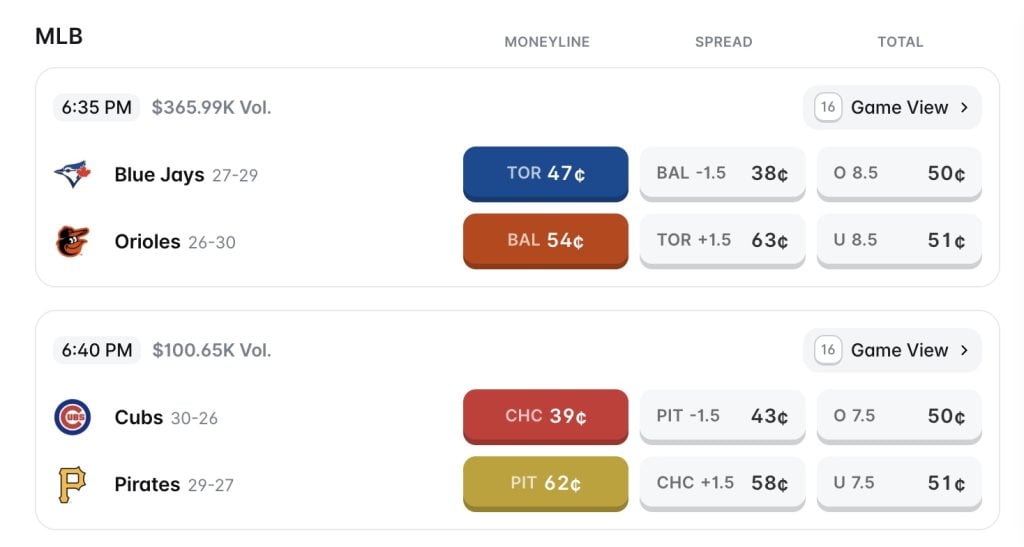
Sports markets are structured like event contracts, not bookmaker odds. The key difference is that order-book pricing is set by participants rather than by a sportsbook trading team.
| What you see | Example market types | Strengths | Limitations |
|---|---|---|---|
| Futures | league winner, championship winner | precise yes/no framing, transparent market-driven pricing | Liquidity varies by league and event |
| Game-level | match winner, series outcome | fast reaction to lineups and injuries | Rules matter a lot, especially edge cases |
| Live-adjacent | short-window questions | quick expression of opinion | execution risk increases when prices move fast |
If you come from sportsbooks, the mindset shift is simple: you are trading probability rather than taking a fixed-odds price.
Crypto & Financial Markets
Crypto markets are a natural fit for Polymarket because participants already use stablecoins and respond quickly to narratives. You will see threshold questions (“above X by date”), ranges, and milestone hits.
| Sub-category | Typical market formats | Volatility considerations | Best for |
|---|---|---|---|
| Crypto price levels | BTC closes above a specific level on a given date, and ETH reaches a defined price by year-end | spreads widen during fast moves | traders who use limit orders and sizing discipline |
| Token events | airdrop timing, FDV thresholds | Thin books can move hard on rumors | niche insiders who can verify info fast |
| Macro-linked crypto sentiment | rate decisions, recession probability, policy questions | Narratives can flip quickly | people who track macro + crypto together |
Economics, Culture & Other Markets
This is where Polymarket gets broad. The economy category can include Fed decisions, recession probability, inflation prints, and corporate outcomes. Culture can consist of awards and entertainment outcomes.
| Theme | Example market types | Why niche knowledge can be an edge |
|---|---|---|
| Economy and rates | Fed decision outcomes, recession probability, inflation prints | Understanding calendars and definitions helps you avoid bad trades |
| Businesses and companies | “largest company end of year,” acquisition outcomes | Reading incentives and deal timelines matters |
| Entertainment and culture | Oscar and award outcomes | Late-cycle information and industry chatter can move prices fast |
| “Everything else” | news-driven one-off questions | Edge comes from speed plus rules comprehension |
Fees, Pricing & Trading Costs
Trading Fees Explained
Polymarket’s headline claim is simple: it states there are no fees on trades, deposits, or withdrawals.
So where do “costs” show up in real life?
- Spread: if the best bid is $0.39 and the best ask is $0.41, the $0.02 spread is a cost of impatient execution.
- Slippage: if you try to buy size into a thin book, you may end up paying more than you expected.
- Funding rails: card on-ramps and exchange transfers can include third-party fees that Polymarket itself does not control.
Simple profitability example:
- You buy 100 “Yes” contracts at $0.40 = $40.
- The market resolves “Yes” and settles at $1.00 = $100.
- Gross profit = $60.
- Platform fee (per Polymarket’s docs) = $0.
- Your real friction is execution quality, not a posted trading fee.
One way to translate a price if you are new to it: a contract trading at 48% means roughly $100 risked returns about $208 if it settles Yes. Polymarket displays prices as percentages, which is the same thing as the probability the market assigns to that outcome.
Limits & Risk Controls
When I trade on Polymarket, my first “risk control” is structural: every position is capped by what I pay for it. If I buy “Yes” at $0.62, my maximum loss on that share is $0.62 if it settles at $0, and the upside is capped at $1.00 if it resolves “Yes.”
The next layer is execution discipline. Polymarket runs on a central limit order book, and markets can have different guardrails, such as minimum order size and tick size, which I treat as a reminder that not every market trades with the same smoothness. When liquidity is thin, those small mechanics matter because they affect how precisely I can enter and exit.
Finally, settlement has its own control system. Polymarket’s resolution pipeline is built around UMA’s Optimistic Oracle, with a dispute path that can escalate to UMA’s Data Verification Mechanism if the outcome is challenged. That dispute backstop is the reason I always read the resolution criteria before sizing up, especially in edge-case events where wording matters.
Source notes: Polymarket docs on contract pricing basics and order book mechanics, plus the UMA resolution integration and developer changelog fields for min order size and tick size.
Deposits, Withdrawals & Payment Methods
Deposit Options
Below is a payment table based on Polymarket’s help center and published fee schedule.
| Method | What you deposit | Typical speed | Fees | Minimums |
|---|---|---|---|---|
| Crypto wallet transfer | USDC on Polygon | network-dependent | blockchain gas | N/A |
| Coinbase | USDC routed into Polymarket | depends on Coinbase processing | Coinbase fees may apply | Varies by Coinbase account |
| MoonPay (card/bank, where available) | USDC on Polygon via on-ramp | from minutes to hours | MoonPay fees | MoonPay minimums vary |
| Bridging from other chains | USDC via bridge flows | variable | bridge fees + gas | Depends on bridge settings |
Withdrawal Process
If I’m cashing out from Polymarket, the flow is straightforward: I withdraw USDC back to my wallet, and the “time to funds” mainly depends on on-chain confirmation and the route I choose. There isn’t a bank-style hold period baked into the process. Once the withdrawal is initiated, it behaves like a crypto transfer, not a pending sportsbook payout.
The one detail that can surprise first-timers is the USDC.e vs. native USDC situation. If I’m withdrawing in a way that involves USDC.e, the platform can swap it into native USDC through a Uniswap v3 pool, with the interface aiming to keep the output difference very small. If liquidity is tight, I would either withdraw USDC directly, split the withdrawal into smaller chunks, or wait and try again later if the pool needs time to rebalance.
Platform & App Experience
Desktop Experience
When I use Polymarket on desktop, it feels like the “real” way to trade it. I can quickly scan categories, open a market, and immediately see the order book with bids, asks, and the spread, which helps me judge whether the price is actually tradable or just reflects thin liquidity.
Most of the time, I lean on limit orders because they let me control entry price instead of chasing the current ask. If the price comes to me, it fills. If it does not, my order simply sits there, and I can cancel it at any time. I also like that open orders show up right under the order book and that I can monitor everything across markets from the portfolio view.
One detail I keep in mind for sports markets is that outstanding limit orders are cancelled once the game begins, and marketable orders have a short delay. That affects how I time entries around the start time.
Mobile App Experience
On my phone, Polymarket is best for quick decisions and position management. I can check prices, watch a market react to news, and adjust without needing a full desktop setup. The core mechanics stay the same: I look at the order book, decide whether I want immediacy or price control, then place a trade accordingly.
When using mobile, I am even more careful about spreads, so I default to limit orders unless the book is clearly deep. I also rely on the portfolio view to keep track of open positions and orders across multiple markets, because hopping from market to market on a small screen can get messy fast.
If I’m trading sports markets on mobile, I plan around the same constraints as desktop. Orders can be cleared at game start, and marketable orders can have a short delay, so I avoid last-second clicking unless I’m fine with the execution risk.
Customer Support & Help Resources
There are several ways for users to get help from customer support at Polymarket:
- Live chat: Available 24/7
- Phone: Not supported
- X: https://x.com/polymarket
When I need help with Polymarket, I usually start on the platform. The official support flow includes a website chat option (the blue chat icon) for submitting tickets directly, which is the quickest route when the issue is account-specific. If I want technical help or I’m stuck on a process step, Polymarket also directs users to its Discord support ticket channel, which opens a private conversation with its team.
What I like most is the quality of the documentation. The help resources go in depth on the things users actually get wrong, such as deposits, withdrawals, bridging, and token variants like USDC.e. That makes the self-serve path realistic rather than a generic FAQ page.
Compared with regulated, broker-style prediction products, Polymarket support feels more crypto-native, meaning strong docs and community-driven channels rather than a traditional call-center experience.
Tracking Your Activity: Polymarket Analytics
If you want more visibility into your own trading than Polymarket’s native portfolio view gives you, or you’re curious who else is trading a given market, Polymarket Analytics is worth knowing about. It’s a free, browser-based dashboard that ranks Polymarket wallets by win rate and profit, pulls up detailed trader histories, and tracks live market volume, all without requiring a wallet connection unless you want your own positions tracked or want to trade directly from the dashboard. Read our full Polymarket Analytics review for a closer look at pricing, features, and whether it’s worth adding to your routine.
How Polymarket Compares to Other Prediction Markets
| Platform | Regulation | Market depth | Fees | Accessibility |
|---|---|---|---|---|
| Polymarket | Historically faced U.S. restrictions in 2022; Polymarket US received the CFTC DCM designation in 2025 | Often very deep in headline politics, sports, and crypto | Polymarket states no fees on trades, deposits, or withdrawals | Jurisdiction-dependent; U.S. access evolving via a regulated pathway |
| Kalshi | CFTC-regulated DCM model | Strong in U.S.-listed event contracts | Published fee schedules | U.S.-focused with compliance rules |
| Moomoo Prediction Markets | CFTC-regulated DCM model | Same market depth as Kalshi | Advertises no fees | U.S.-focused with compliance rules |
| Robinhood Predicts | Broker-led access to event contracts via a futures-style framework | Designed for mainstream retail UX | Broker disclosures define costs | U.S. brokerage ecosystem |
If your priority is “deep global liquidity and crypto-native markets,” Polymarket stands out. If your priority is “traditional U.S. regulated rails and clearer consumer expectations,” a DCM-first platform may feel simpler.
Who This Platform Is Best For
- ✅ Traders who want a simple, bounded-payoff way to express a view on outcomes
- ✅ People comfortable with limit orders and market microstructure
- ✅ Builders who want to embed live probabilities and market data
Who Should Avoid It
- ⚠️ Anyone in a restricted region or with an uncertain legal status
- ⚠️ Users who do not want to think about settlement rules
- ⚠️ People who hate spreads and price impact in thin markets
Explore Other Prediction Market Platforms
If you’re comparing options or just exploring how different platforms approach real-money predictions, here are other regulated and widely discussed alternatives:
- Crypto.com Prediction Markets: Explore how this crypto-focused app is venturing into prediction markets with regulated event contracts.
- Kalshi: One of the first fully CFTC-regulated platforms designed exclusively for trading on real-world outcomes.
- FanDuel Predicts: FanDuel’s experimental product for predictive event trading, now live for select users.
- PredictIt: A long-standing academic-based prediction exchange with strong focus on political outcomes.
Final Verdict: Is Polymarket Worth Using?
Polymarket is worth considering if you want event-driven trading with a probability-based price model, and you are comfortable with crypto-native funding and the idea that execution quality (spreads, slippage, liquidity) matters more than headline fees. It also helps if you are the kind of person who reads market rules before clicking buy.
The tradeoff is complexity. You need to respect settlement rules, understand USDC on Polygon, and confirm access eligibility in your jurisdiction, especially given Polymarket’s shift toward a regulated U.S. pathway in 2025.
Want to compare Polymarket to other prediction markets, including CFTC-regulated options? Visit our prediction markets hub for the full list.
Polymarket FAQ
Polymarket’s U.S. status changed over time: it faced CFTC action in 2022, and in 2025, Polymarket US (QCX LLC) received a CFTC DCM designation tied to event contracts.
No. Polymarket lists event contracts, which are derivatives traded on a regulated exchange at prices set by market participants. Legal treatment can still vary by jurisdiction.
The minimum deposit is $1, though the current welcome offer requires a $10 deposit to qualify.
Funds are crypto-based (USDC on Polygon). That adds transparency but also introduces wallet and smart contract risk.
Polymarket US is available in every state except Nevada. You must be 18 or older and complete identity verification.
It depends on the jurisdiction. Polymarket restricts specific locations in its terms of service.
No, it does not.

