




NinjaTrader Review 2026: Regulated Futures Trading Platform Tested


If you are new to prediction markets, the biggest risk is mixing up two very different worlds: regulated, exchange-listed event contracts and unregulated bet-style platforms. NinjaTrader fits on the regulated side by giving you access to CME Group Event Contracts, which are simple Yes/No contracts that let you make a precise prediction about where a primary market will close. I have traded using a funded live NinjaTrader account on Windows desktop and iOS mobile, and this review breaks down how these prediction-style contracts actually work, without the hype.
Sites Like NinjaTrader: Best True Prediction Markets
Get $100 in Predicts Bonus When You Trade $1 for 5 Days
Make Predictions on Real World Events Right in Your Phone
Trade on Sports to Culture, Financials, Crypto and More
Get $100 in Predicts Bonus When You Trade $1 for 5 Days
Make Predictions on Real World Events Right in Your Phone
Trade on Sports to Culture, Financials, Crypto and More
Trade on Sports, Politics, and MORE
Largest Prediction Market in the US
Hundreds of Markets to Choose From
Trade on Sports, Politics, and MORE
Largest Prediction Market in the US
Hundreds of Markets to Choose From
Huge Range of CFTC-Approved Markets (Sports, Tech, and More)
Compete with Others & Climb the Leaderboards
No User Limiting on Trades
Huge Range of CFTC-Approved Markets (Sports, Tech, and More)
Compete with Others & Climb the Leaderboards
No User Limiting on Trades
What Is NinjaTrader?
One important positioning note up front: NinjaTrader is not a prediction market operator. It is a futures trading platform and futures brokerage, meaning you trade standardised futures contracts (including crypto futures) on regulated futures exchanges with a real order book, margin, and contract expirations. NinjaTrader’s brokerage services are provided by NinjaTrader Clearing, LLC, which is a registered futures commission merchant (FCM).
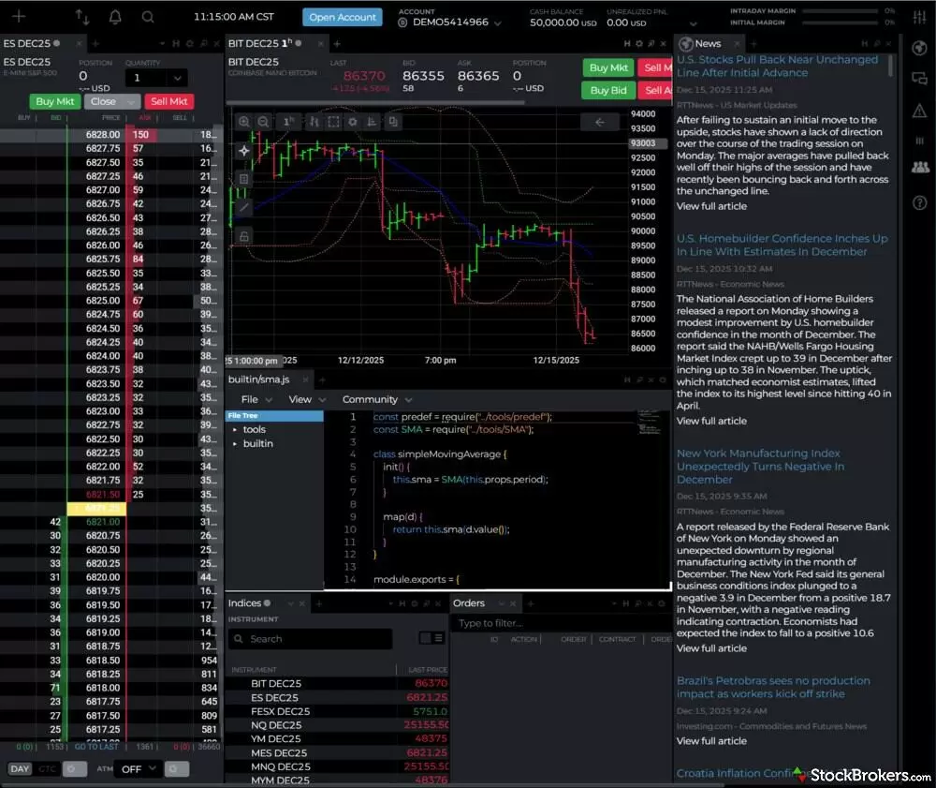
In this guide, I will explain the core mechanics, the real costs (commissions, data, routing), how funds protection works in futures, what you can trade (with a focus on crypto futures), and what the platform experience feels like across desktop and mobile. If you are looking for a discount or pricing deal, NinjaTrader’s pricing page is the place to check, as it is where plan tiers and commission rates are published.
My Experience Using Ninja Trader

Overall Platform Rating & Key Takeaways
NinjaTrader is one of the more “serious” platforms I have used, in a good way. It is built around the realities of futures: order books, margin, and active trade management.
For my crypto futures trading, the biggest strength is control. Desktop gives me the space and tooling to execute cleanly, especially with SuperDOM depth and chart-based order entry. iOS is where I stay connected and manage exposure when I am away from my desk.
The main tradeoff is that nothing is simplified into a casual “tap and hope” flow. Costs are transparent, but you have to actually account for them, including market data and operational fees
Pros
- Low, clearly tiered commissions. Free is $0.39 per micro per side; Monthly is $0.29; Lifetime is $0.09.
- I can trade from desktop, web, and mobile under the same account setup.
- Strong order-book tools for active trading (Depth of Market and fast order management).
- Transparent “real cost” schedule, including clearing $0.19/contract and Rithmic routing $0.25/contract (when used).
- Market data pricing is published and predictable: CME bundle is $12/month (Level I) or $41/month (Level II) for non-pros.
- Solid customer-funds transparency, including daily segregated funds statements (CFTC 1.55 reporting).
Cons
- If I log in but do not place a live trade for 30 days on a free plan, there is a $35 minimum activity fee.
- Data fees add up fast if I want full depth, pro rates, or extra exchanges.
- Non-commission costs can stack (routing, clearing, platform integrations).
- Wire withdrawals are not free ($30 domestic, $40 international, per the schedule).
- The platform is built for futures trading. It rewards experienced execution habits and can feel heavy if you want a simple, casual interface.
Is Ninja Trader Legit, Safe & Regulated?
Regulation & Legal Status
NinjaTrader’s brokerage services are provided by NinjaTrader Clearing, LLC (doing business as NinjaTrader and Tradovate), and the firm is described as a registered futures commission merchant (FCM).
Practically, that means you are operating inside the U.S. futures regulatory framework (CFTC and NFA oversight), rather than using an offshore, unregulated venue. This regulatory structure is fundamentally different from traditional gambling products and even from U.S. sports betting platforms, which are governed at the state level under gaming laws instead of federal financial regulation.
It also means there are formal rules around how customer funds must be handled, how reporting works, and what disclosures the firm must provide.
How User Funds Are Protected
In futures, the core protection concept is segregation.
NinjaTrader Clearing explains that it maintains different account types based on what you trade, including segregated-fund accounts for U.S.-listed futures and foreign-futures-secured funds accounts for foreign products.
Its disclosure materials describe that segregated funds are held in clearly identified segregated accounts separate from the firm’s own funds, and customer funds cannot be used to meet the firm’s obligations.
What I like here is that NinjaTrader also publishes a dedicated customer funds disclosures hub, including daily segregation statements, which is the kind of transparency I expect from a serious FCM setup.
Geographic Restrictions
NinjaTrader’s platform and brokerage are built around regulated futures access. Futures eligibility and onboarding can vary depending on customer type and jurisdiction, and the firm’s disclosures explicitly acknowledge both U.S. and foreign futures account structures.
The simple way I think about it is this: restrictions are compliance-driven, not random. If your jurisdiction cannot legally be serviced for futures brokerage, you will run into limits at the account level, not just at the “what markets are visible” level
| Category | Where it works | What does that mean in practice |
|---|---|---|
| Available in the US | United States | NinjaTrader Clearing, LLC is a CFTC-registered futures commission merchant (FCM) and NFA member, so the core brokerage offering is built for US futures customers. |
| International access (case-by-case) | Some non-US jurisdictions | NinjaTrader’s disclosures describe account structures for both US-listed futures and foreign board of trade futures (including 30.7 secured funds). That supports international product access, but it does not publish a simple public “countries list,” so eligibility is still account-approval and compliance-dependent. |
| Restricted due to sanctions or risk policy | Sanctioned or high-risk jurisdictions (example: certain Ukrainian regions and applications tied to those restrictions) | NinjaTrader staff have stated on their official forum that OFAC-sanctioned regions (Crimea, Donetsk, Luhansk) are relevant and that their policy may reject applications connected to that risk profile. |
| Access challenges (site/platform) | Russia (connectivity/access disruptions reported) | Independent reporting and NinjaTrader forum posts indicate that ninjatrader.com experienced access issues in Russia, including periods when users could not access the site or connect normally. |
What Is Ninja Trader & How Do Prediction Markets Work?
Prediction Markets Explained
A prediction market lets you trade on a real-world question using event contracts with two sides: “Yes” and “No.” Prices usually range from $0.01 to $0.99, and at settlement, the correct side pays $1.00 while the incorrect side pays $0.00.
Simple example:
If a “Yes” contract is priced at $0.40, you’re paying $0.40 per contract. If the event occurs, it settles at $1.00, so your gross profit per contract is $1.00 − $0.40 = $0.60, minus fees. If it doesn’t happen, it settles at $0.00, and your loss is the $0.40 you paid.
The key intuition is that price often roughly reflects the market’s current view of the chance of “Yes.”
How Trading Works on Ninja Trader
On NinjaTrader, trading is classic futures trading. I pick a contract (for example, Micro Bitcoin futures) and decide whether I want long exposure (buy) or short exposure (sell). I can enter with a market order when I want speed, but most of my serious entries are limit-based because I want price control.
The platform supports professional-style order entry and management tools such as Chart Trader and SuperDOM, which are built around active order management, stop-and-limit logic, and position monitoring.
Settlement and expiration are also “futures-native.” Contracts have defined expirations (often monthly), and the mechanics depend on the specific product, including how the reference rate is calculated and how the contract settles.
Understanding the Order Book
This is absolutely applicable to NinjaTrader. The order book is not a side detail. It is the core of how you get in and out.
NinjaTrader’s SuperDOM is explicitly designed around Depth of Market, showing market depth and inside bid and ask levels in a price ladder view.
In practice, I watch three things:
- Bids and asks: where liquidity is sitting and how quickly it refreshes.
- Spreads: Tighter spreads generally mean cheaper execution.
- Depth: thin depth means you can move the price with your own order size, which increases slippage risk.
Liquidity directly changes execution quality. In fast crypto futures conditions, a thin book can turn a “reasonable” market order into a worse average fill than you expect. SuperDOM and chart-based order tools are built to help you manage that reality, not hide it.
Markets Available on Ninja Trader
Politics & Election
NinjaTrader is not a politics prediction market. On my account, I do not see election-style “who wins” markets because this is a futures platform, not an event-contract exchange.
| What are you looking for | What you get on NinjaTrader | How news impacts pricing | Ideal user type | Strengths and limitations |
|---|---|---|---|---|
| Elections and political outcome contracts | Not offered as “Yes/No” event contracts | Political news can move rates, FX, and indices indirectly | Macro traders who express views through financial futures | Strong for indirect exposure, not for direct election contracts |
Sports Markets
Same story as politics. NinjaTrader is neither a sportsbook nor an event-contract sports exchange. I do not use it for “Team A wins” type markets.
| What are you looking for | What you get on NinjaTrader | How does this differ from sportsbooks | Example question formats | Strengths and limitations |
|---|---|---|---|---|
| Sports outcome markets | Not offered as direct sports event contracts | Sportsbooks price odds, futures exchanges price contracts tied to financial underlying's | Not applicable | Great execution tools, but not a sports predictions venue |
Crypto & Financial Markets
This is where NinjaTrader actually shines for me.
Because NinjaTrader is a futures platform, crypto exposure comes through crypto futures. For example, CME’s Micro Bitcoin futures (MBT) are 0.1 bitcoin per contract and are cash-settled based on the CME CF Bitcoin Reference Rate, with a tick size where one tick equals $0.50.
On the ETH side, CME’s Ether futures are 50 Ether per contract, and Micro Ether futures are 0.1 Ether per contract.
| Market type | Example instruments | What you are really trading | Volatility considerations | Best for |
|---|---|---|---|---|
| Crypto futures | Micro Bitcoin (MBT), Bitcoin (BTC), Micro Ether (MET), Ether (ETH) | Exchange-traded futures tied to published reference rates | Fast moves make limit orders and sizing discipline essential | Traders who want regulated crypto derivatives and can manage leverage |
| Financial futures | Index, rates, commodities (varies by exchange access) | Standard futures with expirations and margin | News can gap price, liquidity matters | Traders who want one platform for multi-asset futures workflows |
Economics, Culture & Other Markets
This category is “economics-heavy” on NinjaTrader, not entertainment-heavy. Instead of awards shows or pop culture outcomes, I’m using macro-linked futures where scheduled data and policy decisions matter.
Think jobs data, inflation, central bank decisions, and risk-on risk-off swings. The edge here is not a special contract category. It is preparation: knowing what data hits when, and understanding how volatility shows up in spreads and liquidity.
| Theme | Example market types | Useful “spec” detail | Why niche knowledge can be an edge |
|---|---|---|---|
| Rates and central-bank expectations | SOFR futures | One-month SOFR futures: each one bp move is worth $41.67 per contract (SR1). | Scheduled macro data and Fed messaging can shift rate expectations fast, and that can show up in short-rate pricing. |
| Broad risk-on, risk-off | Micro E-mini equity index futures | Micro E-mini S&P 500 (MES): $5 × index, tick 0.25 = $1.25. | Knowing when major releases hit (CPI, jobs, Fed) helps you plan entries around volatility windows instead of reacting late. |
| Energy and geopolitics | WTI crude oil futures | Micro WTI (MCL): 100 barrels, tick $0.01 = $1. | Inventory data, OPEC+ headlines, and geopolitical risk can move prices quickly, especially when liquidity thins. |
| Inflation hedges and safe-haven flows | Gold futures | COMEX gold (GC): 100 troy ounces, tick $0.10 = $10. | Macro narratives (real yields, USD strength, risk sentiment) often drive directional bursts. Context matters more than chart-watching alone. |
| Agriculture and weather sensitivity | Corn futures | Corn (ZC): 5,000 bushels, tick ¼ cent = $12.50. | Traders who follow USDA calendars and crop/weather updates can understand why price jumps happen, not just that they happened. |
| Crypto futures (regulated venue) | Bitcoin and Ether futures | Micro Bitcoin (MBT): 0.10 BTC, one tick move equals $0.50. | Crypto reacts to both crypto-native news and macro liquidity. Knowing which is driving the move helps with sizing and timing. |
| Crypto (alt exposure) | Ether futures | Ether futures (ETH): 50 ether, min tick $0.50/ETH = $25 per contract. | Volatility can be sharp around major crypto catalysts, so understanding contract size helps avoid accidental oversizing. |
Fees, Pricing & Trading Costs
Trading Fees Explained

NinjaTrader pricing is plan-based, and commissions are published on a per-side basis. On the published plan page, NinjaTrader lists commission examples like:
- Free plan: $0.39 per micro contract per side, $1.29 per standard contract per side
- Monthly plan: $0.29 per micro per side, $0.99 per standard per side
It also advertises commissions “as low as $0.09 per micro contract,” depending on plan tier.
Beyond commissions, the account fee schedule shows additional per-contract and operational costs, including a clearing fee of $0.19 per contract and an order routing fee (Rithmic) of $0.25 per contract if you use that routing setup.
A realistic “fee mindset” example (simplified) looks like this: if I trade one micro contract, I think in layers: commission (plan-based), clearing, routing (if applicable), plus exchange and regulatory pass-through fees.
NinjaTrader does not “set” spreads. The exchange order book does. That means spreads and fill quality are a function of the contract’s liquidity and the time you trade.
This is why I lean on order-book tools. SuperDOM is built specifically to show inside markets and depth, which helps me judge whether I can enter cleanly or risk hidden slippage.
The hidden costs are rarely “secret,” but they are easy to underestimate if you only look at commission headlines.
Here are the big ones I actually budget for:
- Market data fees: CME bundle top-of-book data for non-pro users is listed at $12/month, and full depth is listed at $41/month (bundle pricing shown in NinjaTrader’s schedule).
- Inactivity fee: the schedule lists an inactivity fee for some free plans if you log in but do not trade in a live environment within the stated window.
- Operational fees, including margin call and liquidation-related fees, are explicitly listed.
Limits & Risk Controls
NinjaTrader feels intentionally “risk-aware,” which is what I want in a futures platform.
From a trading cost and access perspective, NinjaTrader markets that there is no deposit minimum required, but that does not mean you can trade without sufficient margin. In real usage, the risk controls show up more through margin requirements, exchange rules, and platform-level safeguards.
There are also explicit administrative and trade-management controls that apply when things go wrong, such as margin calls and liquidation-related fees listed in its published schedule.
That combination forces the correct mindset: futures is not “tap-to-bet.” It is leveraged derivatives trading with strict rules.
Deposits, Withdrawals & Payment Methods
Below is a payment table based on Ninja Trader’s help centre and published fee schedule.
| Method | Deposit fee | Withdrawal fee | Notes |
|---|---|---|---|
| ACH | $0 | $0 | Schedule lists ACH deposits and withdrawals as free |
| Check | $0 | N/A | Check deposits are listed as free |
| Domestic wire | $0 | $30 | Domestic wire withdrawals are listed at $30 |
| International wire | $0 | $40 | International wire withdrawals are listed at $40 |
Deposit Options
NinjaTrader publishes a clear account fee schedule for deposits.
Based on its schedule, deposits include:
- ACH: free
- Check: free
- Domestic wire: free
- International wire: free
Minimums: NinjaTrader states there is no deposit minimum, although you still need enough capital to meet margin requirements for the contracts you trade.
Withdrawal Process
For withdrawals, the schedule is straightforward: ACH withdrawals are free, domestic wires are $30, and international wires are $40.
In real usage, I treat withdrawals like part of my risk routine. I do not assume I can instantly “recycle” cash the way people often expect in sportsbook-style systems. If I need funds on a specific timeline, I plan around banking rails and operational review steps, especially during volatile periods when my account activity is heavier.
Platform & App Experience
Desktop Experience
On a Windows desktop, NinjaTrader feels like a real trading workstation, not a simplified mobile-first interface.
The navigation is built around trading tasks: charts, order entry, positions, and workspace layouts. When I am trading crypto futures, I usually run a chart in Chart Trader for precise entries and keep SuperDOM open when I want to read depth and work orders directly on the ladder. SuperDOM is explicitly designed for Depth of Market and efficient order and position management.
This is also where the platform’s “power user” reputation makes sense. The desktop environment is designed for repeatable workflows, fast order modification, and tight control over stop and target logic.
Mobile App Experience
On iOS, NinjaTrader is more about monitoring and clean execution than full workstation complexity.
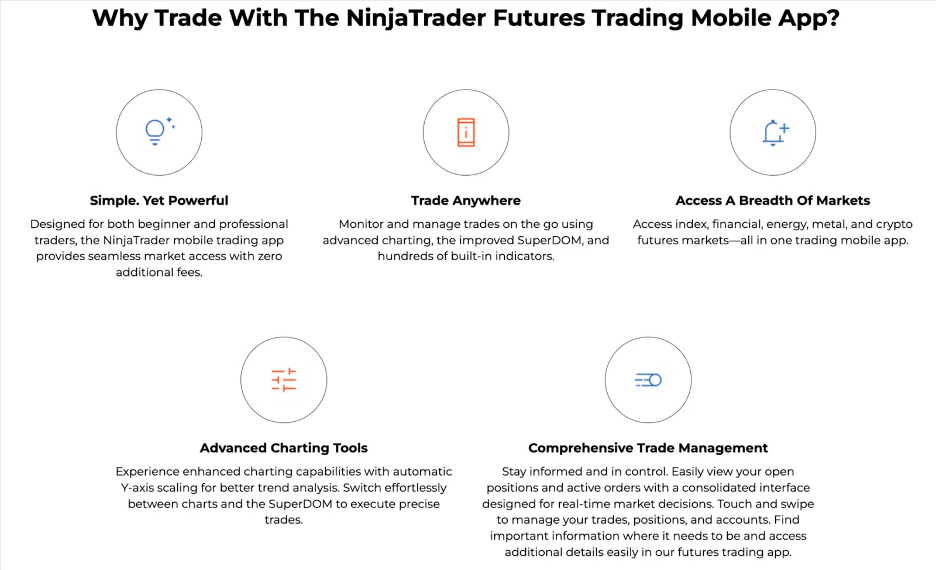
I can still check positions, watch price action, and manage orders without feeling lost. The key is that the mobile experience stays connected to the same futures-native model. You are not switching into a different “lite” product. NinjaTrader’s plan page explicitly positions Desktop, Web, and Mobile as part of a unified multi-device platform offering.
For me, mobile is where I handle quick adjustments and oversight, especially when crypto futures volatility picks up outside my desk hours. Desktop remains my main environment for deep analysis and heavy order management.
Customer Support & Help Resources
When I need help, I want two things: clear self-serve documentation and a support path that does not feel like a dead end. NinjaTrader publishes detailed platform help guides for order entry and order management, including how chart-based order options work and how SuperDOM displays market depth.
On the brokerage side, its published schedule also references services like an emergency trade desk (free for emergency use), which signals a real trading-operations mindset. Compared to many consumer trading apps, the knowledge base reads like it was written for traders who actually place and manage orders, not just people clicking “buy.”
How Ninja Trader Compares to Other Prediction Markets
Key Differences
Even though this template is prediction-market oriented, the comparison is still helpful because it clarifies what NinjaTrader is and is not.
| Category | NinjaTrader | Typical prediction market operator |
|---|---|---|
| Regulation | Futures brokerage via a registered FCM structure | Varies widely, often not futures-regulated |
| Market depth | Complete exchange order book and depth tools (SuperDOM) | Some have order books, some are AMM-style |
| Fees | Commission plus clearing, routing, and data fees | Often a simple fee model, but sometimes opaque |
| Accessibility | No deposit minimum is marketed, but a margin is required | Often low entry sizes, sometimes restricted by geography or funding rails |
If you want “Yes/No” contracts on politics or sports, this is the wrong category. If you wish to use serious futures tooling and regulated exchange-traded derivatives, NinjaTrader fits the bill.
Who This Platform Is Best For
If you like structured trading, NinjaTrader is a strong fit. I think it suits traders who want real futures execution, order-book visibility, and platform tools that support disciplined entries and exits. It is especially relevant if you wish to regulate crypto futures exposure through standardised contracts and are comfortable thinking in terms of contracts, margin, and expirations.
Who Should Avoid It
If you want prediction-market style simplicity, entertainment-style markets, or sportsbook-like flows, NinjaTrader will feel like the wrong product. Futures trading demands active risk management, and the cost stack (commissions, data, routing) is real even when headline commissions look low.
Related Prediction Market Platforms & Alternatives
While NinjaTrader is built for futures traders rather than outcome-based event contracts, some users may be specifically looking for platforms that focus on binary “Yes/No” prediction markets instead of leveraged derivatives.
If that’s your case, it may be worth exploring other prediction market platforms that are structured around event contracts rather than futures execution. For a more casual or event-focused experience, check out:
These platforms differ in regulation, market focus, and user experience—but they may be a better fit if you want to trade on politics, sports, or cultural events rather than manage regulated futures positions.
Final Verdict – Is Ninja Trader Worth Using?
If you want a regulated futures platform with fundamental depth-of-market tools and plan-based commission pricing, NinjaTrader is worth serious consideration. It is not a prediction market operator, and it is not designed for casual outcome speculation. It is intended for futures traders who care about execution, order management, and repeatable workflows.
My honest view is simple: if you are willing to treat crypto futures like professional derivatives, not like a game, NinjaTrader’s toolset and published transparency make it a strong option.
FAQ Section
NinjaTrader’s brokerage services are described as provided by NinjaTrader Clearing, LLC, a registered futures commission merchant.
No. It is futures trading, which is regulated derivatives trading with margin and contract rules.
NinjaTrader has no deposit minimum, but you still need enough funds to meet margin requirements.
Customer funds are held under futures segregation frameworks, and NinjaTrader publishes customer funds disclosures and daily segregation statements.
NinjaTrader disclosures describe both U.S. segregated accounts and foreign futures secured accounts, but eligibility depends on jurisdiction and compliance rules.
NinjaTrader’s plan page states free simulated trading is included across plans.

