




Prediction Markets vs DFS (2026): What’s the Difference and Which Should You Try?


Prediction markets and DFS may both appeal to the same type of people, but how you participate, win, and manage risk is significantly different. We’ll compare their strengths, limitations, and who they’re best suited for to help you choose. If you’re already leaning towards prediction markets, our prediction markets guide explains the basics and compares the top platforms to help you get started.
Get $100 in Predicts Bonus When You Trade $1 for 5 Days
Make Predictions on Real World Events Right in Your Phone
Trade on Sports to Culture, Financials, Crypto and More
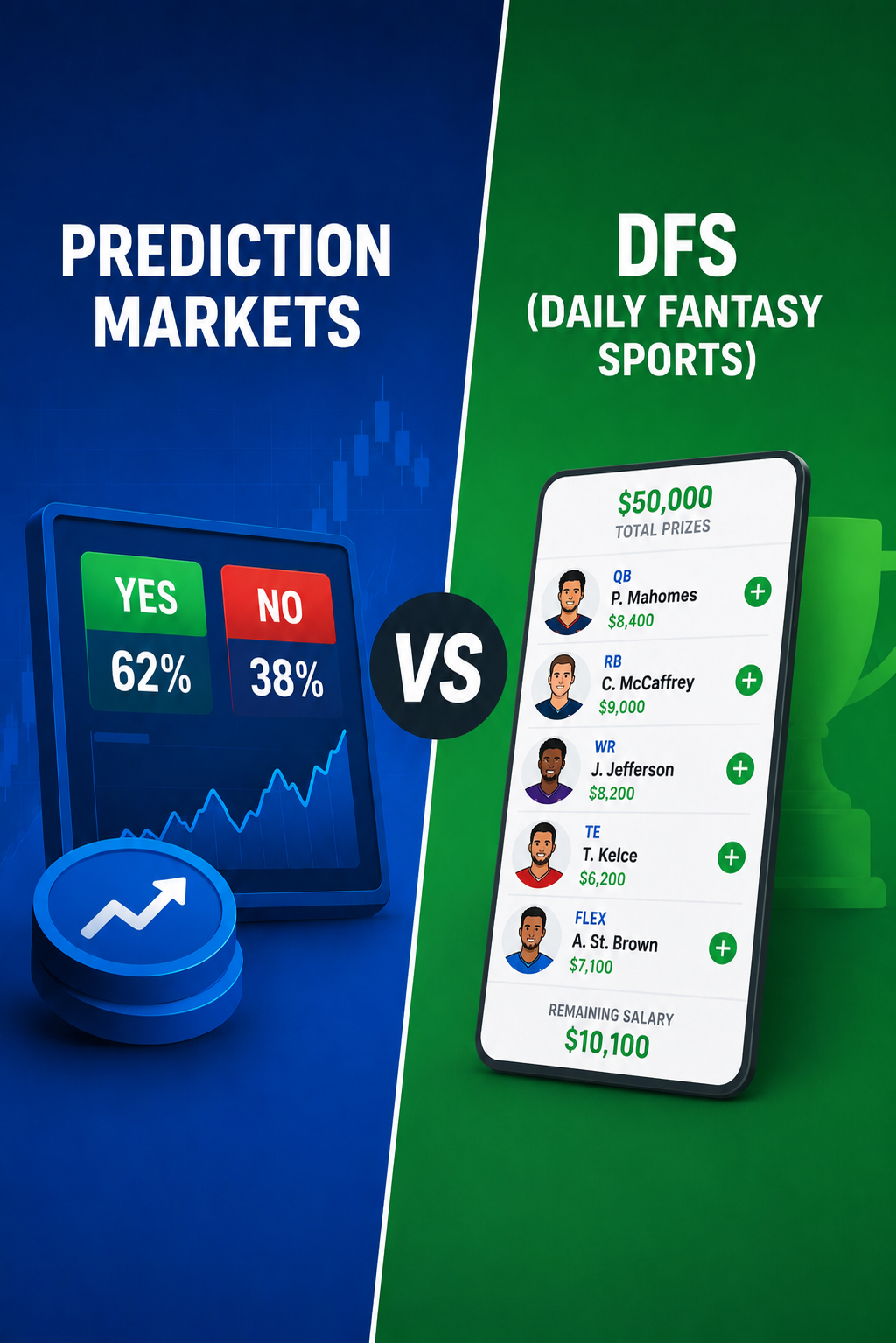
Quick Verdict
Both options can be fun if you know your sports and want to put that knowledge to use, but the right choice depends on how you want to do it and how much time you intend to spend each day.
Prediction markets are a great pick if you’d like to make predictions on topics besides sports, enjoy reacting to new information in real time, and would like the flexibility to exit positions early.
You’ll likely prefer DFS if you want to create lineups and measure your performance on a leaderboard once everything is set up. It’s the better option for those who prefer to let the action play out without having to constantly react to the news.
Prediction Markets vs DFS: Side-by-Side Comparison
| Feature | Prediction Markets | DFS |
|---|---|---|
| How You Make Money | You get $1 for each contract you predict correctly | You get a share of the contest prize pot if your lineup earns enough points |
| Skill Required | Assessing probabilities; analyzing market sentiment; timing trades | Salary cap management; game theory; strategic planning |
| Platform Fee | Trading fee (e.g., $0.01 per buy/sell trade) | Contest rake (e.g., 13% per contest; varies per contest type and platform) |
| Regulated in the US | Yes, regulated by the CFTC | Yes, regulated at the state level |
| Legal in All 50 States | No | No |
| Minimum Entry/Trade | $0.01 | $1 |
| Maximum Loss Per Entry | Entry amount | Entry fee amount |
| Fee Structure | Traders get charged a fixed fee per trading position | Fixed entry fee per contest; rake charged from prize pool |
| Competition Structure | Peer-to-peer trades with other users | Against other players' lineups for the prize pool |
| Tax Treatment | Taxable trading/investment income * | Taxable gambling winnings * |
Table last updated: October 2026
How Each Platform Works
How Prediction Markets Work
Prediction markets let you trade on whether you think something will happen. Markets are presented as a question, and you can either buy the Yes or No position (event contracts) that are priced between $0.01 and $0.99. Prices update in real time, and the higher the price of the position, the more traders believe it will happen.
Each market has rules that establish until when the market will remain open for trades, what must happen for the event to settle, and who is responsible for determining the result.
You’ll win $1.00 for each correct position you hold once the market settles. Until that happens, you can sell your positions to other traders or buy theirs, paying a fee for each transaction (usually $0.01).
Let’s consider this market as an example: Will the USA win the FIFA World Cup? You buy 50 Yes positions at $0.40 each, and against market sentiment, the national team wins the title: Cost: 50 × $0.40 = $20. Fees: 50 × $0.01 = $0.50. Wins: 50 × $1 = $50. Profit: $50 − $20 − $0.50 = $29.50.
If another nation takes the cup, you only lose the $20.50 you spent.
How DFS Works
In DFS, short for Daily Fantasy Sports, you create a lineup of athletes under a salary cap and win points according to their real-life performance.
The goal is to earn more points than other players, climb the leaderboard, and finish above the cash line, which varies by contest format: Cash games: usually, the top 50% of entries win a share worth the same amount. Guaranteed Prize Pool (GPP) tournaments: typically, only the top 20% (or fewer) of entries are paid, and the highest-ranked lineups receive the largest prizes.
Contests have a set entry fee, which can range from $1 to several hundred dollars, a limited number of participants, and rules on lineup requirements and scoring details. Here’s how one might work: Contest format: GPP. Entry fee: $15. Participants: 470. Prize pool: $6,000. Cash line: Top 98 finishers.
You enter this contest, select your lineup before the event goes live, and once it does, the platform automatically tracks your points. When the event ends, you’ll either get a prize if you’re one of the top 98 entrants (in this case, ranging from $25 to $2,000), or you’ll lose the $15 fee if you’re not.
Safety & Regulation
The regulatory status of prediction markets and DFS is more nuanced than a yes-or-no answer, especially as regulators and courts review how each product should be classified based on what it actually offers. Here’s an overview of the legality of both:
Prediction markets are federally regulated and overseen by the Commodity Futures Trading Commission (CFTC) as event contracts under the Commodity Exchange Act. You might also encounter cryptocurrency-based prediction markets that operate under a different framework.
Some states, including Arizona, Nevada, Michigan, California, and Texas, have challenged sports-specific markets. Similar blockages have happened regarding predictions on politics and elections, with Arizona and Kentucky taking legal action against these platforms.
Many of these situations are still playing out, so we recommend you always check the local regulations in your state of residence.
Yes, DFS is legal at a federal level but regulated at the state level. This means that states have the power to determine what is allowed and what is not. More than 30 states have passed laws specifically to authorize and regulate how paid DFS contests can operate, and you’ll find platforms available in 45 states.
Hawaii, Washington, Montana, Idaho, and Nevada don’t allow real-money DFS contests for now. However, this might change, so we recommend you always confirm the state-by-state eligibility rules provided by the platforms and check the local jurisdiction before participating.
Risk & Potential Returns
One important thing to keep in mind is that neither prediction markets nor DFS guarantee a profit, even if you’re an experienced user.
Discipline, research, and good decision-making skills can help, but ultimately, your results will also depend on luck, as winning or losing is impacted by external factors you can’t control, such as unexpected injuries or results, which can trip up even the most experienced and knowledgeable users.
If you’re unsure which option is best for your risk profile, see how they compare:
| Feature | Prediction Markets | DFS |
|---|---|---|
| Profit Potential | Your maximum profit is easy to calculate before you place a trade because each winning contract pays $1.00. | Your payout depends on the contest. Cash games usually offer modest returns, while tournaments can pay much larger prizes to the top finishers. |
| Risk of Losing Money | You lose money if the event doesn't go your way or you sell your position for less than you paid. | You lose money if your lineup doesn't finish high enough to win a prize. |
| Maximum Loss | Limited to the amount you invest in your position and associated fees. | Limited to the contest entry fee. |
| How Predictable Are Returns? | More predictable because you know how much a winning contract is worth before you trade. | Less predictable because your payout depends on how other participants perform and where your lineup ranks. |
| If You're Skilled | Good research and smart risk management can help you earn steady profits over time, although there are no guarantees. | Skilled players can make money over the long run, but results are often less consistent because tournament payouts can vary widely. |
| If You're New | Many beginners lose money until they learn how to judge probabilities and find good value. | Many beginners lose money because they compete against experienced players and may not build the strongest lineups |
Skill vs Chance
Ask yourself whether you can accurately judge how likely an event is to happen based on public information, whether you follow the news and can react quickly to it, and whether you have the market knowledge to spot opportunities that appear over- or under-priced. If so, prediction markets are likely a good match for your skills.
On the other hand, if you’re always on top of what athletes and teams are up to, keep score of injury news and lineup changes, and can see the bigger picture to match lineup requirements to the salary cap, DFS may be the better fit.
There’s no right or wrong answer, but whichever set of skills sounds more like you probably matches your profile. However, remember that you can’t control what happens during a game or how a market reacts to new information, so make sure you understand that luck also plays a part.
Which Is Better for Beginners?
If this is your first time approaching any of these formats, prediction markets are the easiest place to start. You can begin for as little as $0.01, and the mechanics are relatively simple: just pick “Yes” or “No” on whether an event will happen. Some prediction market platforms require some getting used to, but they also offer tutorials and guides to help you get started. The low entrance point lets you try and error, so you can understand how the markets react to the news and learn how to strategically buy or sell positions.
DFS also promotes some low-entry-fee contests that you can use to explore how everything works, but the learning curve is steeper, especially if you’re not up to date with what’s happening in sports. You’ll also have to learn how fantasy scoring works and how to construct lineups according to specific contest rules while competing with very high-level experienced users.
You’ll find educational products readily available on both types of platforms, but prediction markets usually require fewer concepts to master upfront, making them more accessible for beginners.
Which Is Better for Experienced Users?
Both options make a strong case for experienced users, as each reward (and probably attracts) people with different skills and interests.
Prediction markets are an excellent pick if you like to analyze probabilities and can react quickly to new information, especially if you want to venture outside pure sports platforms. DFS might be better aligned with users who already have deep knowledge of player performance and contest strategy and can adapt lineups to requirements.
Many experienced sports enthusiasts combine the two, and if you’re comfortable with sports analytics and are disciplined at bankroll management, you’ll be able to apply your skills in both.
Final Verdict
Neither option is better than the other. If you want a simple format that you can quickly understand and participate in, we recommend prediction markets. DFS is an excellent choice for people who are always on top of sports, but it usually takes longer to master.
If prediction markets sound like a better fit, we suggest you explore our best prediction markets guide to find one that matches what you’re looking for.
Prediction Markets vs DFS: FAQ
In prediction markets, you’re buying and selling contracts based on whether an event will happen, and you can often close your position before the event is resolved. It also covers topics besides sports, such as entertainment, finance, economics, and culture. In DFS, you’re building a fantasy lineup and competing against other players, with your result determined by how your roster performs once the games begin.
Yes, prediction markets are legal and federally regulated in much of the country under the oversight of the Commodity Futures Trading Commission (CFTC). However, availability varies nationwide, and some states are involved in ongoing legal or regulatory disputes over their availability. Always check the latest regulatory news in your state.
DFS is available in most U.S. states and is federally legal as a game of skill. States either oversee these platforms under dedicated fantasy sports legislation or contest-specific rules. A small number of states, including Hawaii and Idaho, generally prohibit paid DFS contests, while others remain legal gray areas. State laws and operator policies can change, so you should always check your state’s current regulations and the platform’s terms before entering a contest.
Neither is automatically more profitable, especially since luck also plays a role. Your returns will depend on things you can control, like your skill level, research, timing, contest selection, and bankroll management, but also on things you can’t, like how markets react to news or unexpected events. Prediction markets offer more flexibility because you can close your position early, while DFS can offer larger tournament payouts but with higher variance.
Yes. Nothing prevents you from using both products, as long as each is available where you live and you meet the platform’s eligibility requirements. Many experienced users combine prediction markets and DFS because the skills overlap, although you’ll need to register separate accounts if the products are offered by different operators. Always check state regulations and each platform’s terms before registering.
DFS is usually harder to learn than prediction markets due to the in-depth knowledge you must have to build a lineup that is likely to earn plenty of points. To do well in DFS, you need to research players, build strong lineups, manage a salary cap, choose the right contests, and understand how other players are likely to build their teams so you can have the upper hand. Prediction markets also reward skill, especially in judging probabilities and managing risk, but their basic mechanics are easier for most beginners to understand.
Profits from prediction markets and DFS winnings are usually considered taxable income, but the exact treatment depends on your jurisdiction and individual situation. DFS winnings are typically treated as gambling income, while profits from CFTC-regulated prediction markets tend to be treated as investment gains. We recommend contacting a qualified tax professional for advice specific to your situation.
