


 Share
Share 



Bonus TL;DR
- A senior leader of The Church of Jesus Christ of Latter-day Saints publicly condemned sports betting and prediction markets during the church’s October general conference, declaring the rapidly expanding platforms as “morally wrong” and harmful to young adults.
- Elder D. Todd Christofferson’s high-profile remarks directly bolster Utah’s ongoing legal offensive to classify and ban event-contract platforms like Kalshi and Polymarket under the state’s strict anti-gambling laws, a rigid stance that increasingly places Utah at odds with the Trump administration’s argument that prediction markets operate as financial products rather than traditional gambling.
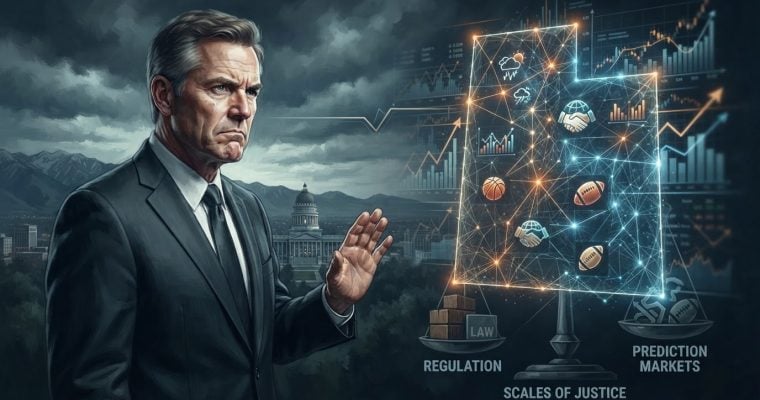
A senior leader of The Church of Jesus Christ of Latter-day Saints publicly condemned sports betting and prediction markets over the weekend, adding a high-profile voice to Utah’s ongoing legal and political fight over whether platforms such as Kalshi and Polymarket should be regulated as gambling.
The remarks matter because they come from one of the faith’s top leaders in a state with some of the nation’s strictest anti-gambling laws. They also highlight a growing split between Utah and the Trump administration, which has argued that prediction markets are not gambling and should not face the same restrictions.
D. Todd Christofferson, speaking at the church’s twice-annual general conference in Salt Lake City, said the rapid spread of smartphone-based wagering is harming young people in particular. He said teenagers and young adults are losing time from studies and relationships because betting is now available anywhere.
“For us as Latter-day Saints, overarching all other concerns is the fact that gambling is morally wrong. Gambling is built on the desire to obtain something for nothing,” Christofferson said.
Utah has become a key battleground over prediction markets
The church’s stance aligns with Utah’s broader effort to apply its gambling laws to prediction markets, a fast-growing sector that lets users wager on outcomes ranging from weather events to geopolitical developments.
According to the report, a federal judge ruled in August that Utah officials can enforce the state’s strict anti-gambling laws on prediction markets. The state also enacted legislation this year that made Utah’s gambling laws stricter and amended language in a way the article says would almost certainly apply to prediction markets.
That fight has made Utah a central venue in the national dispute over whether prediction markets should be treated more like financial products or gambling. The article says the Trump administration has argued platforms including Kalshi and Polymarket do not constitute gambling and should not be subject to restrictions in states such as Utah.
Utah’s anti-gambling framework is unusually strict. The state has no casinos, no lotteries and no racetracks that allow bets, and the prohibition is rooted in long-standing political and religious opposition to gambling.
Church criticism adds to wider backlash against betting expansion
Christofferson tied sports betting and prediction markets together as part of a broader national expansion in gambling access. In criticizing prediction markets, he referenced contracts on events as varied as Los Angeles weather and even “the timing of the Second Coming,” then asked, “Where do you go to collect on that bet?”
The broader concern is not limited to Utah. Religious institutions and policymakers in several parts of the country have increasingly pushed back as legal sports betting expands and prediction markets test the boundaries of existing gambling law.
Matthew Bowman, a religion professor quoted in the report, said, “The rise of predictive markets, and the legalization of sports gambling, this is just really taking off all across the country. And a lot of institutions — religious, state and otherwise — are grappling with this problem.”
What comes next in Utah is still unclear from the report. Open questions include whether the August ruling will be appealed and what specific restrictions state officials may continue trying to enforce against prediction market operators.
Source: As reported by MATTHEW BROWN and HANNAH SCHOENBAUM.