





 Share
Share 



Bonus TL;DR
- Michigan tribal casino contributions to state funds plummeted sharply over recent years as several sovereign operators withheld payments.
- The widening financial dispute stems from frustrations over state-level gambling expansion, including online wagering, sports betting, and growing prediction markets.
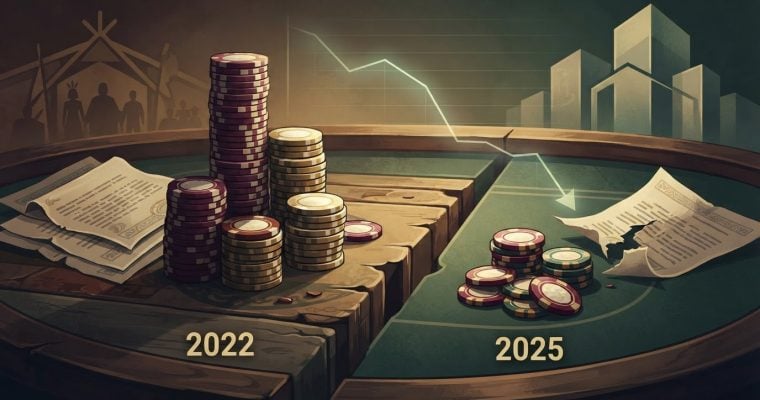
Michigan tribal casino revenue-share payments to the Michigan Strategic Fund fell 71% from $52.8 million in 2022 to $15.4 million in 2025 as more tribes withheld payments in a widening dispute over gambling compact exclusivity.
The decline matters because the payments help finance the Michigan Economic Development Corp., and the tribes argue the state’s expansion of gambling offerings has eroded the exclusivity they were promised under their compacts. The disagreement now reaches beyond retail gaming and touches online gambling, sports betting, lottery products, horse racing expansion, and prediction markets.
More tribes stop or withhold state payments
According to figures cited from the Michigan Gaming Control Board, the drop accelerated as additional tribes stopped sending full revenue-sharing payments to the state.
The Pokagon Band of Potawatomi Indians joined tribes withholding payments in 2025 after sharing $11.7 million with the state that year. The Nottawaseppi Huron Band of the Potawatomi stopped payments in February after contributing $18.5 million the previous year. The Gun Lake Tribe also began withholding payments in 2025, while the Little River Band of Ottawa Indians stopped in 2023. The source also reported that other Michigan tribes had ceased making payments years earlier.
One tribe is still making full state revenue-sharing payments: the Hannahville Indian Community, which contributed about $644,000 for 2025.
The article notes that tribes are continuing to make separate compact payments to local governments, even as state payments are being challenged.
Why exclusivity is at the center of the dispute
The tribes’ position is that Michigan’s gambling expansion has undermined the exclusivity terms in their gaming compacts. The source identifies several areas at issue, including online lottery games, online casinos, sports betting, horse racing expansion, and prediction markets.
That makes the dispute notable for the broader U.S. gaming industry, because it links newer forms of regulated and quasi-regulated wagering to older tribal compact terms that were negotiated around exclusivity.
At the same time, Michigan’s online gambling market remains a major state revenue source. Tribal and commercial online operators paid $624.6 million in state taxes and other payments during 2025, according to the source.
What comes next in Michigan
The funding pressure arrives as the MEDC recently announced layoffs affecting up to 15% of filled and vacant positions. The source says tribes have contributed more than $1.1 billion to the Strategic Fund since revenue sharing began.
Several Michigan gaming compacts also reach potential renegotiation points in 2028 or 2030, which could become the next major milestone in the dispute. Key open questions include how Michigan interprets exclusivity under each compact and whether further gambling expansion will prompt additional tribes to withhold state payments.
Source: As reported by Philip Conneller.


