
 Share
Share 



Bonus TL;DR
- As a 120-day pause mandated by the Pennsylvania Supreme Court expires on October 13, state lawmakers and industry groups have filed urgent petitions requesting a deadline extension to prevent the state from immediately seizing tens of thousands of unregulated skill game machines.
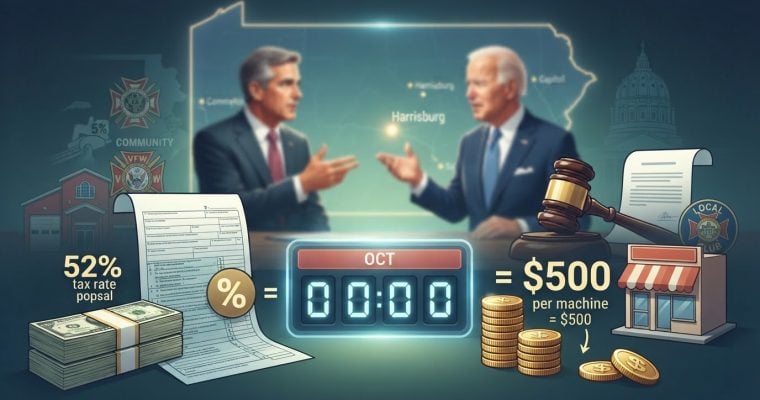
- The looming enforcement deadline has escalated a political showdown over how to formally integrate the machines into the state’s gaming framework, with Gov. Josh Shapiro pushing for a 52% tax rate akin to casino slots, while Treasurer Stacy Garrity advocates for a flat $500 monthly per-machine fee to protect local businesses and social clubs.
Pennsylvania’s skill games industry is nearing an Oct. 13 legal deadline as Gov. Josh Shapiro and state Treasurer Stacy Garrity push competing plans to regulate and tax the machines.
The debate matters because the Pennsylvania Supreme Court ruled on June 15 that skill games are subject to the state’s Gaming Act and Crimes Code, meaning anyone operating the devices must be licensed by the state Gaming Control Board. With the court’s 120-day pause set to expire, operators, small businesses and lawmakers are all pressing for clarity on what happens next. This high-stakes clash over physical arcade-style terminals and electronic slots mirrors broader state-level tensions over how to balance local commerce with strict regulatory oversight, much like the debates surrounding traditional brick-and-mortar casinos, mobile wagering, and digital online casino compliance.
Competing tax plans emerge as deadline approaches
During a gubernatorial debate in Harrisburg on Wednesday, Garrity backed a flat $500 monthly fee per machine. She said that with 50,000 machines operating statewide, the approach would bring in about $300 million in new revenue.
Garrity also attacked Shapiro’s proposal to tax skill games at 52%, saying the rate would effectively wipe out the industry. She argued the machines support groups and businesses including American Legions, VFW posts, fire halls and small businesses.
Shapiro said he wants to regulate and tax skill games at the same rate as casinos. According to the source report, he said revenue would flow into the general fund, with part of it used to support mass transit across Pennsylvania.
Shapiro also said the state House has already passed legislation reflecting his plan, but that the Republican-led Senate has not brought it up for a vote.
Lawmakers and industry ask court to extend the stay
As the deadline neared, state Sens. Gene Yaw and Anthony Williams and Rep. Jonathan Fritz filed, withdrew and refiled a petition asking the Pennsylvania Supreme Court to extend its stay until Feb. 10. Furthermore, industry advocates stress that establishing a transparent regulatory framework is critical for maintaining consumer trust and funding robust responsible gaming programs across the commonwealth.
A group described as the Skill Games Business Consortium also filed a petition to intervene in support of an extension. The lawmakers’ filing argued that without more time, the state could end up seizing devices that a future regulatory program is meant to license.
At the same time, Pennsylvania State Police and the state Attorney General’s Office have warned that all skill game machines must be removed from establishments before the ruling takes effect.
District attorneys press lawmakers to act
The fight is not limited to the candidates and the courts. Seven district attorneys signed a letter urging the General Assembly to pass skill game legislation, citing public safety concerns tied to some machine locations, including theft and other criminal activity.
That leaves several unresolved questions for the market: whether the Supreme Court will grant the requested extension, whether lawmakers can agree on a final tax and regulatory framework, and how many machines would ultimately qualify to operate under a licensed system.
Source: As reported by Peter Hall.