


 Share
Share 



While soccer fans were screaming at their televisions, millions of them were also trading on the outcome.
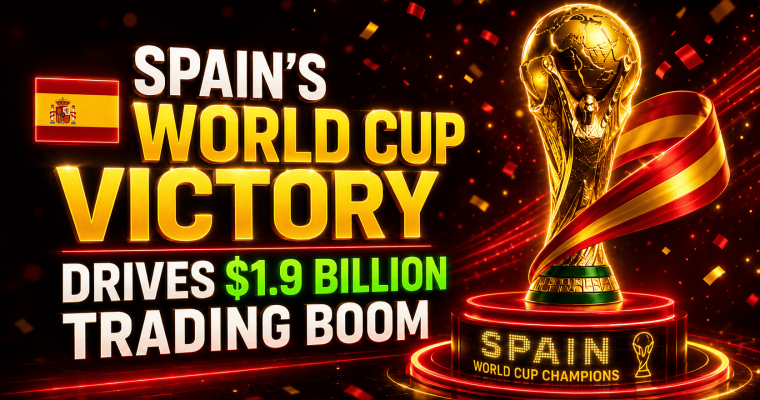
Kalshi just reported that the tournament brought in three million new users. Even crazier, traders poured 1.9 billion dollars into contracts predicting Spain’s World Cup victory.
The final winner’s market stole the show
The biggest attraction was exactly what most people expected.
The market asking who would lift the World Cup trophy got more than $1.2 billion in trades on its own, making it one of the largest single event markets ever hosted on the prediction market platform.
Traders could buy and sell contracts throughout the tournament as each team’s chances changed after every match.
Instead of simply making one prediction before the tournament began, users could react to every twist along the way.
A surprise group stage result could send one team’s price soaring while another’s collapsed within minutes. Every knockout round created another opportunity for traders to adjust their positions.
Ferran Torres scored a goal in the 106th minute of extra time to seal a 1 to 0 victory for Spain. That single goal officially settled nearly 1.893 billion dollars in trades on Kalshi.
By the time Spain reached the final, the market had already become one of Kalshi’s busiest prediction events ever.
Not Kalshi’s first rodeo
If you think this soccer buzz is a total fluke, think again. Soccer is far from the only pop culture phenomenon that Kalshi has managed to turn into a trading frenzy.
Before soccer fans took over the platform, reality TV junkies proved that TV gossip can move markets just as fast as athletes. The TV show Love Island previously got a $50 million trading spree on the platform.
In fact, Kalshi revealed that two thirds of all the traders betting on Villa drama were women.
How Kalshi won the tournament marketing game
You might wonder how a trading app convinced three million regular soccer fans to start predicting outcomes. I’d say it was pure marketing genius.
Kalshi did not even need an official FIFA sponsorship to steal the spotlight. Instead, they pulled off partnerships across sports and pop culture.
They signed Croatian soccer star Luka Modrić as a brand ambassador for custom video commercials.
They teamed up with the Argentina national squad, landing a shoutout on Lionel Messi’s Instagram page for his 500 million followers.
They partnered with OpenAI so that anyone searching for match predictions on ChatGPT saw live Kalshi odds right on their screen.
They ran viral commercials starring Hollywood actor Timothée Chalamet and music star J Balvin.
“Our volumes are where the news is at. It’s a lot of the approach for the World Cup. … The most important thing is enabling creativity based on what’s happening,” said Kalshi CEO Tarek Mansour.
It turns out you do not need an official invitation to throw the best party at the World Cup.
Research firm Meltwater revealed that non sponsor brands completely stole the spotlight during the tournament buildup. Unofficial brand team ups pulled in 61 million interactions on social media, while the official sponsors who paid huge bucks were left in the dust with just 33 million.
Crashing the gate literally got these rebellious brands double the love.
“A big takeaway from this World Cup is that you don’t need an official sponsorship to own the cultural moment anymore. The brands that will win the next tournament aren’t necessarily the ones with the biggest budgets, but instead the ones who are set up to see what’s trending in real time, have the creativity to connect it back to your brand, and have the speed to act before the moment passes,” Meltwater CEO John Box said.