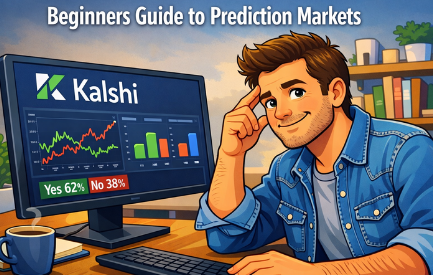
Prediction markets sound complicated at first, but once you get the idea, they’re actually pretty simple. Think of them as a place where people trade opinions about what will happen in the real world, using money as the signal for confidence.
If you have ever said, “I’m sure this will happen” or “No way that happens,” then congratulations. You already think like a prediction market user. So let’s break it all down.
What Is a Prediction Market?
A prediction market is a platform where people buy and sell contracts based on the outcome of a real-world event. And each contract is tied to a yes or no question like:
- Will a certain candidate win an election?
- Will inflation rise above a certain number?
- Will a company hit a specific milestone?
- Will a sports team win a game/championship?
If you think the answer is yes, you buy a yes contract. If you think the answer is no, you buy a no contract.
When the event is decided, the contracts settle. If you were right, your contract pays out. If you were wrong, it does not. That’s the core idea.
How Prediction Markets Actually Work
Instead of placing a traditional bet, you are trading contracts. Each contract usually costs between zero and one dollar. The price reflects how likely the market thinks an outcome is.
For example, if a yes contract is trading at 70 cents, the market is basically saying there is a 70 percent chance this will happen. So if you think the real chance is higher than that, you buy. If you think it is lower, you sell or buy “no.”
As more people trade, prices move. The market constantly updates based on what people believe, what information is coming in, and how confident traders feel. In short, the price becomes a live prediction.
How You Make or Lose Money
You make money by being right earlier than everyone else. If you buy a contract at 40 cents and the market later moves to 80 cents, you can sell it before the event ends and lock in a profit.
If you hold the contract until the outcome is decided and you are right, it typically settles at one dollar. If you are wrong, it settles at zero, minus any applicable fees. That’s it. No complicated math required.
How This Is Different From Sports Betting
This is where people get confused.
In sports betting, you place a wager against a sportsbook. The odds are set by the house, and you either win or lose based on the result.
In prediction markets, you trade against other users. There is no fixed line. Prices move based on supply and demand.
Another key difference is regulation. Many prediction markets operate under federal commodities rules instead of state gambling laws. That is why they can sometimes exist in places where sports betting is not legal. This distinction is also why prediction markets are currently a big topic of debate in the United States.
What Kinds of Things Can You Predict?
Prediction markets are not just about sports. You will often see markets covering:
- Politics and elections
- Economic indicators
- Interest rate decisions
- Company performance
- Major news events
- Entertainment outcomes
Anything with a clear, verifiable outcome can become a market. If it can be answered with a yes or no and settled objectively, it can probably be traded. In theory, the market becomes smarter than any one person.
Who Regulates Prediction Markets?
Most prediction markets in the United States are not regulated as gambling at all. Instead, they operate under federal commodities laws, similar to financial markets.
The key regulator here is the Commodity Futures Trading Commission (CFTC). They oversee markets that trade contracts tied to real-world outcomes, as long as they are structured like commodities or derivatives and not traditional wagers. Because of this, prediction markets can sometimes operate nationwide, even in states where sports betting is illegal. Examples of some well-known prediction market platforms include:
- Kalshi
- Polymarket
- DraftKings Predictions
- Fanatics Markets
As opposed to prediction markets, sportsbooks are regulated at the state level, not federally. Each state decides whether sports betting is legal. Which operators can offer it? What taxes and fees apply, and what kinds of bets are allowed?
This is why sportsbooks like FanDuel, DraftKings, BetMGM, Caesars, and Fanatics Sportsbook are only available in certain states.
If sports betting is not legal in your state, those apps cannot operate there. There is no single national sports betting license in the US.
About the Author