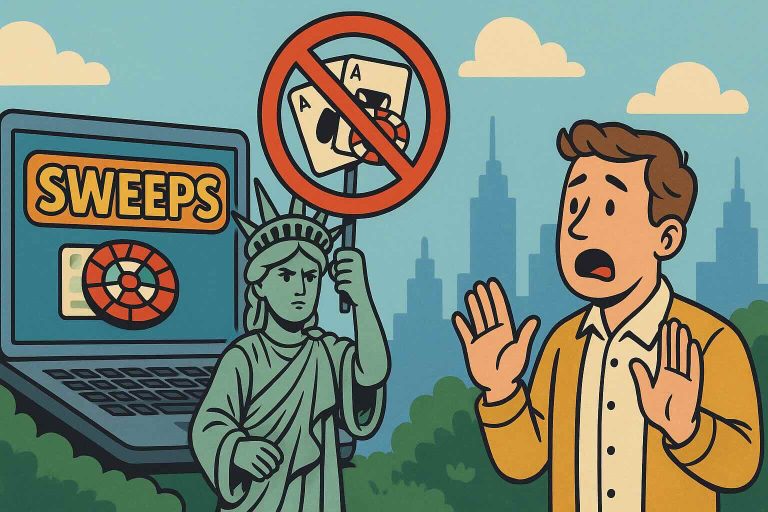
On December 1, 2025, Kathy Hochul officially received Senate Bill 5935 (S5935) on her desk — the latest salvo in New York’s crackdown on unregulated “sweepstakes casino” platforms. The legislation now sits with her, awaiting signature, veto, or silent inaction by year’s end. The clock is ticking.
If signed (or allowed to lapse under specific legislative rules), the bill would ban a broad category of online games long operating in legal gray zones: digital games that mimic slots, poker, roulette, or lotteries by using a “dual-currency” structure — typically a purchasable virtual currency plus a promotional currency redeemable for cash or equivalents.
That dual-currency definition is the heart of the bill — and also its lever for enforcement. The legislation empowers the New York State Gaming Commission (NYSGC) — alongside the New York State Attorney General’s Office — to define what qualifies as a “dual-currency system,” decide when a game crosses the line into prohibited territory, and enforce penalties that include fines between $10,000 and $100,000 per violation, plus loss or ineligibility for gaming licenses.
While lawmakers passed SB5935 over the summer, by holding the bill until December 1, they ensured the governor’s decision window lands at the end of the calendar year.
The Bill’s Scope Is Broad — Operators and Enablers Could Be Penalized
One of the most consequential aspects of S5935 is that it doesn’t just target the casinos themselves. The legislation extends its prohibitions to the entire supporting ecosystem — including financial institutions, payment processors, geolocation providers, gaming-content and platform suppliers, and media affiliates. Anyone facilitating or promoting a sweepstakes-style casino could be deemed in violation.
That expansive approach suggests lawmakers intend not only to shut down existing platforms, but also to deter future attempts — even if operators try to rebrand, change currency names, or pivot to superficially different models. By handing definitional power to regulators, the law could dynamically adapt to evolving business practices.
This Isn’t Just About Unregulated Gambling
Supporters of the bill — including the bill’s sponsor, Joseph Addabbo Jr. — argue that sweepstakes casinos operate without the safeguards required of regulated gambling: there are no consumer-protection standards, no responsible-gaming tools, and no anti-money-laundering oversight. That’s especially worrisome when underage individuals can access games that mimic real-money gambling.
Legislators have framed the effort as a matter of fairness for the state’s regulated casinos and pari-mutuel gaming — entities that pay taxes, follow licensing rules, and are subject to consumer-safety mandates. Proponents say preventing sweepstakes casinos from competing unfairly preserves the integrity of regulated gaming markets.
In addition, the bill earmarks collected fines to support problem-gambling education and treatment programs — suggesting lawmakers view this crackdown not just as regulatory maintenance, but public-health policy.
Industry Pushback — Why Some Stakeholders Are Alarmed
Opposition to S5935 has been vocal and came early. The Social and Promotional Games Association (SPGA) has criticized what it calls a “blatant overreach.” The association argues that sweeping definitions could catch legitimate social-gaming or marketing-promotion activity, not just “casino-style” gambling.
When the Senate amended the bill to give the NYSGC the authority to define “dual-currency system,” the SPGA described that move as a “political patch” that fails to resolve core legal uncertainties — while potentially exposing a wide swath of businesses (even outside gaming) to liability.
Critics warn the law could chill innovation in New York’s tech and digital-entertainment sectors by dissuading venture capital, discouraging app developers, and raising compliance risks — especially for firms that rely on virtual-currency micro-transactions or promotional credits.
Some operators have already begun to pull out: multiple platforms reportedly stopped serving New York users as the bill advanced.
What’s Next — What to Watch in the Coming Weeks
Governor Hochul’s decision: Her choice is likely the single biggest determinant of what happens next. Will she sign, veto, or allow a silent enactment?
Regulator’s first moves: If the law becomes active, the NYSGC’s first definitions and enforcement actions (whom they target first, how broadly they define “dual-currency,” whether they go after back-end providers) will set the precedent.
Industry response: Will remaining operators exit New York? Will companies that support sweepstakes casinos (payment processors, content suppliers) pre-emptively sever ties? That could accelerate the collapse of the industry inside New York and possibly push it to shrink nationally.
Push toward regulated iGaming: Lawmakers and industry insiders may use the ban’s passage to build support for a controlled, licensed, taxed online casino market — arguing that regulated iGaming is a safer, more transparent alternative to the wild-west sweepstakes model.
Legal challenges or unintended consequences: Given the broad language and regulatory discretion, there may be legal challenges (especially from nontraditional operators) or controversy if legitimate digital entertainment/marketing businesses claim to be wrongly targeted.
Why This Matters
This moment reflects a larger shift in how states across the US — starting with a major player like New York — are confronting a new generation of digital gambling.
If New York enforces S5935 aggressively, it could reshape the sweepstakes-casino industry nationwide, close legal loopholes for developers and affiliates, and push the U.S. toward a more regulated online gambling future. Or, it could trigger a backlash from tech, gaming, and digital-entertainment firms that fear overbroad regulation and legal uncertainty.
About the Author