




Pariflow Review October 2026: Options, Stocks, and Prediction Markets



Quick Take:
Pariflow is a prediction market platform for trading real-world outcomes. It offers an alternative to traditional online casino games and sportsbooks for users interested in event-driven forecasting markets. The big question most users want answered is whether Pariflow is legitimate and safe to use–but the answer isn’t simple. Legality and access depend on where users live and how the platform operates within the evolving US prediction market framework. In this review, I’ll break down how Pariflow works, which prediction markets are available, what fees and limits to expect, and whether its safety, transparency, and usability justify opening an account.
Sites Like Pariflow: Best Alternatives
Get $100 in Predicts Bonus When You Trade $1 for 5 Days
Make Predictions on Real World Events Right in Your Phone
Trade on Sports to Culture, Financials, Crypto and More
Trade on Sports, Politics, and MORE
Largest Prediction Market in the US
Hundreds of Markets to Choose From
Huge Range of CFTC-Approved Markets (Sports, Tech, and More)
Compete with Others & Climb the Leaderboards
No User Limiting on Trades
Pariflow at a Glance
| Regulatory Status | Not CFTC-regulated – availability and access may vary by jurisdiction |
|---|---|
| Platform Type | Crypto-based prediction market platform |
| Available Markets | Sports, Esports, Crypto, Elections, Business, Economy, Finance, Culture, Science, Tech, World, and Live |
| Trading Fee | Small fee applied to winning trades – exact structure not publicly listed |
| Minimum Trade | $0.50 |
| Payment Methods | Crypto deposits via the Polygon network |
| US Availability | Available in some jurisdictions – users should check eligibility before registering |
| Mobile App | Not available |
| Current Promotion | 100% Deposit, up to $50 (2x playthrough) |
| Trust Score | 3.5/5 |
Pros & Cons of Pariflow
Pros
- Wide selection of prediction market categories
- Low $0.50 minimum trade size
- Fast crypto-based deposits and onboarding
- Flexible trading versus fixed-odds betting
Cons
- Limited public regulatory transparency
- Crypto wallet setup increases entry friction
- US access may vary by jurisdiction
- Trading fees lack clear public disclosure
- Learning curve versus traditional sportsbooks
- Lower liquidity in smaller markets
- No iOS or Android mobile app available
Platform Overview: What Is Pariflow?
Launched in late 2025, Pariflow is a prediction market platform that allows users to trade based on event outcomes. Pariflow markets (sports, crypto, business, etc.) display prices in a probability-style format with the value of positions fluctuating as the market reprices before its predetermined resolution.
Pariflow positions itself as an alternative to Polymarket and aims to offer a user experience that makes prediction markets easier to browse, compare, and understand. Its strengths lie in helping users move from “I saw a market” to “I understand the market well enough to decide what to do next.”
From a regulatory perspective, Pariflow does not publicly present itself as a CFTC-licensed Designated Contract Market (DCM) or as a licensed US sportsbook offering event contracts.
Instead, it operates as an international prediction market platform and notes that access, product availability, and regulatory status may vary by jurisdiction.
Markets Available on Pariflow
Pariflow offers a broad range of prediction markets, allowing users to trade on outcomes across sports & esports, crypto, elections, business, economy, and more.
Sports and eSports
Sports and esports markets cover outcome-based contracts on match winners, tournament results, and player/team performance.
Examples of Sports contracts include:
- Milwaukee Brewers to win against the St. Louis Cardinals
- Yes: $0.67 / No: $0.33
- Max Holloway to win against Conor McGregor
- Yes: $0.68 / No: $0.32
These markets typically resolve at the end of scheduled games or tournaments, meaning timelines range from same-day settlement for individual matches to several weeks for major events.
This category is best for users who prefer familiar, event-driven trading tied to real-world competition cycles. Liquidity tends to be strongest around major sporting events, while smaller leagues may see thinner order books and wider spreads.
Crypto
Crypto markets focus on price-based and event-based outcomes, such as whether a token reaches a specific price level by a set date.
Resolution timelines vary widely depending on the contract, ranging from same-day moves to weeks or months. Examples of contracts include:
- What price will Bitcoin hit in 2026?
- $55,000 – Yes: $0.72 / No: $0.28
- Will Base launch a token by ___?
- December 31, 2026 – Yes: $0.33 / No: $0.67
This category is ideal for traders who monitor crypto volatility and seek short- to medium-term exposure to price movements. Market activity tends to be highly reactive, with liquidity concentrating around major coins instead of smaller assets.
Elections
Election markets allow users to trade on political outcomes such as winners, party control, or key referendum results.
These markets typically resolve on election day or once official results are certified, which can take anywhere from hours to several days, depending on the jurisdiction. Examples of contracts include:
- Who will be the next Prime Minister of Israel after the next election?
- Gadi Eizenkot – Yes: $0.37 / No: $0.67
- Presidential Election Winner 2028
- JD Vance – Yes: $0.20 / No: $0.80
This category is best suited for users who follow political news cycles and want longer-dated, event-driven exposure. Liquidity often spikes during peak election periods but can be lower between cycles.
Business
Business markets include company-related outcomes such as earnings results, leadership changes, or corporate milestones.
Resolution timelines depend on corporate reporting schedules or announcement dates, often aligning with quarterly earnings cycles or specific event triggers. Examples of contracts include:
- Richest person on December 31, 2026?
- Elon Musk – Yes: $0.95 / No: $0.05
- Kraken IPO by December 31, 2026?
- December 31, 2026 – Yes: $0.30 / No: $0.73
This category suits users tracking individual companies or broader corporate news flows. New markets are usually event-driven rather than continuous, so availability can be sporadic.
Economy
Economic markets focus on macro indicators such as inflation data, GDP releases, and employment figures.
These contracts typically resolve on scheduled government release dates, making timelines highly predictable. Examples of contracts include:
- Will the U.S. enter a recession by the end of 2026?
- Yes: $0.41 / No: $0.62
- Germany’s GDP growth in Q2 2026?
- 0.4-0.6% – Yes: $0.46 / No: $0.54
This category is best for macro-focused traders who follow economic calendars and data releases. Liquidity tends to spike around major announcements, but can be limited outside key reporting windows.
Finance
Financial markets encompass broader financial outcomes, such as interest rate decisions, index levels, and market benchmarks.
Resolution is tied to central bank meetings or defined measurement dates, often following structured economic calendars. Some bets are tied to specific projected monetary amounts or dates. Examples of contracts include:
- Oura IPO Closing Market Cap
- $7.5B – $10B – Yes: $0.27 / No: $0.73
- Will Silver (SI) hit ___ by the end of June?
- $60 – Yes: $0.46 / No: $0.54
This category is best for users who track monetary policy and traditional financial markets. Activity tends to concentrate around Federal Reserve and major central bank events.
Culture
Culture markets include entertainment, media, and public-interest events such as award shows, viral trends, and celebrity-related outcomes.
Resolution timelines vary from same-day to event-end, depending on the specific contract. Examples of contracts include:
- Taylor Swift pregnant in 2026?
- Yes: $0.25 / No: $0.75
- Highest-grossing movie in 2026?
- Spider-Man: Brand New Day – Yes: $0.67 / No: $0.33
This category is best for users who prefer shorter-term, high-engagement markets driven by public sentiment. Liquidity is often uneven, with spikes around major cultural events.
Science
Science markets cover research outcomes, space events, and verified scientific milestones.
These markets typically resolve over longer timelines, often tied to formal announcements or experimental confirmations. Examples of contracts include:
- How many SpaceX launches in 2026?
- 140-159 – Yes: $0.71 / No: $0.29
- Measles cases in the U.S. in 2026?
- 3,000+ – Yes: $0.81 / No: $0.19
This category is best for users interested in long-dated, low-frequency speculative outcomes. Market creation is less frequent, so availability may be more limited than in other categories.
Tech
Tech markets focus on product launches, adoption milestones, and major announcements from technology companies.
Resolution timelines depend on launch dates or official disclosures and often range from weeks to months. Examples of contracts include:
- Which companies will be acquired before 2027?
- Perplexity AI – Yes: $0.22 / No: $0.78
- OpenAI IPO Closing Market Cap
- No IPO by December 31, 2026: $0.48 / No: $0.52
This category is best for users tracking innovation cycles and industry developments. Liquidity is usually higher around major companies and product releases.
World
World markets cover global geopolitical events, international agreements, and major news developments.
Resolution timing varies significantly depending on the event, from same-day announcements to multi-month outcomes. Examples of contracts include:
- Brazil Presidential Election
- Luiz Inácio Lula da Silva – Yes: $0.55 / No: $0.45
- Nobel Peace Prize Winner 2026
- Volodymyr Zelenskyy – Yes: $0.10 / No: $0.90
This category is best for users who follow global affairs and macro risk events. Market flow is event-driven and can be irregular in frequency.
Live
Live markets are fast-moving contracts that settle in real time or within short time windows in response to ongoing events or data updates.
These markets often feature rapid price changes and short resolution horizons, sometimes within minutes or hours. This category is best for active traders seeking high-frequency opportunities. Liquidity can vary significantly depending on current live event activity.
How Trading Works on Pariflow
Trading on Pariflow works through binary event contracts whose prices move as market expectations change before the outcome is resolved.
A binary event contract has two sides: YES and NO. Users can place a trade on either the YES market (the event will happen) or the NO market (the event will not happen). Contracts are priced at $0.01–$0.99 per contract, with the price indicating market confidence – how likely something is to happen.
The price you pay determines both your potential upside and your risk. Buying at lower prices offers higher potential returns but implies lower market confidence. If the market resolves in your favor, winning shares settle at $1.00 each, while losing shares settle at $0.00.
For example, in an upcoming World Cup match, the England-to-win (YES) market is priced at $0.85 per contract. This means that the chances of this occurring are likely (approximately 85%). If a user purchased 10 contracts at $0.85 for a total of $8.50 in shares, a win would settle at $1.00 per share, earning a return of $10.00 and a profit of $1.50.
The resolution of all contracts at Pariflow is set by a predetermined conclusion – in this example, it is set by the conclusion of the game. Other markets may be brought to a conclusion by a set date/time or earlier if the platform confirms the official outcome, and settlement is processed.
Fees and Pricing for Pariflow
Pariflow does not publish a fully itemized public fee schedule, so the exact trading cost structure is not transparently broken down using a standard maker/taker model.
Instead, fees appear to be embedded at the point of trade and/or applied at settlement, depending on the market, rather than displayed as a fixed percentage per order. Fees should be shown before confirmation or described in the relevant product flow.
In practical terms, your total cost is determined by the price at which you enter the contract and any platform fee applied when the position is closed or settled. Because of this structure, users should assume that active trading can lead to cumulative costs that are not always visible upfront, unlike on traditional exchanges.
As Pariflow operates on a crypto-based funding model, network fees may also apply to blockchain transactions. In most cases, users are responsible for standard network (gas) fees when transferring funds.
Withdrawal costs, if any, depend on the destination wallet and network fees, not on a fixed platform charge.
How to Sign Up and Get Verified on Pariflow
Signing up and getting verified on Pariflow was quick and easy – I was able to open an account within just 2-3 minutes using the step-by-step guide below:
Click on Sign-Up
First, I headed to the Pariflow website and clicked sign up.
Complete Signup
Next, I entered my email, and a “Complete your signup” link was sent to my inbox.
Create Password
After clicking, I could then create a password for my account.
Secure My Account
I could then choose to secure my account by enabling:
- TOTP
- Passkey
Deposit
During testing, I was able to create an account and make a deposit without completing identity verification. However, Pariflow may require KYC before withdrawals or higher-volume trading activity.
I was then able to proceed with depositing and claiming my welcome offer.
Deposits, Withdrawals and Payment Methods
Below is a payment table based on Pariflow’s help center and published fee schedule.
| Method | Deposit Fee | Withdrawal Fee | Deposit Speed | Withdrawal Speed | Daily Limits |
|---|---|---|---|---|---|
| Crypto (Polygon USDC.e via external wallet) | Not publicly listed (network fees may apply) | Not publicly listed (network fees may apply) | Near-instant after confirmations | Depends on network confirmation times | Not publicly listed |
Deposit Options
Users currently have two deposit options on Pariflow: “Transfer Crypto” and “Connect Wallet” (MetaMask or WalletConnect). Both deposit options are currently limited to Crypto and the Polygon network – Base and BSC are noted to be “coming soon”.
Only USDC.e can be sent on Polygon. Sending the wrong token or network can result in permanent loss.
Withdrawal Process
Withdrawals on Pariflow are transferred to the user’s linked crypto wallet, with speed primarily determined by blockchain confirmation times rather than internal processing. Usually, transactions are settled once the Polygon network confirms the transfer, but delays may occur due to network congestion or platform security checks.
Platform and App Experience
Desktop Experience
Accessing Pariflow on a desktop, I found the site to be well structured around a trading dashboard layout. Markets are listed in a central feed and can be filtered by category, such as sports, crypto, elections, and finance.
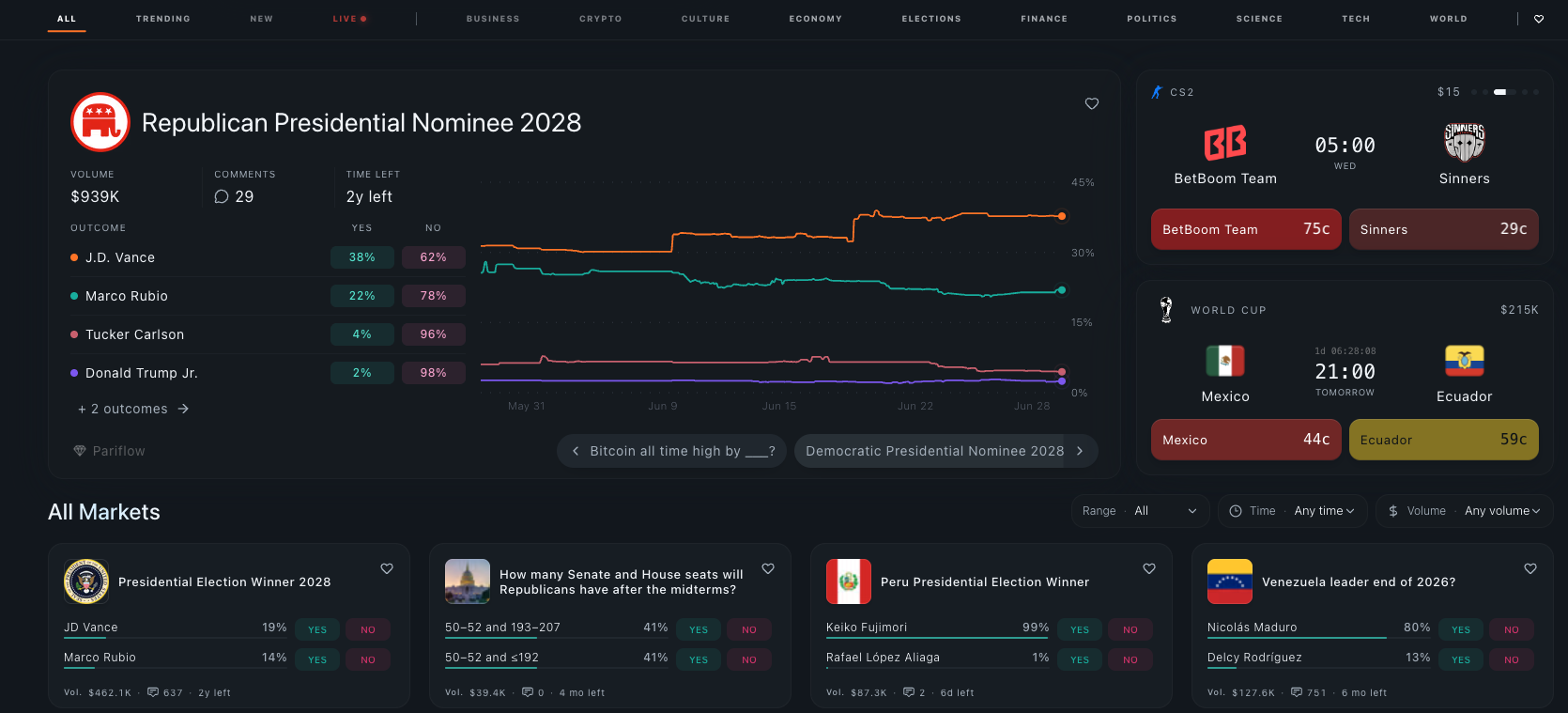
Navigation and the general layout are one of the core strengths of Pariflow, focusing on a user experience that makes prediction markets easier to browse, compare, and understand. It’s efficient to move between discovery and execution, though new users may need time to understand how markets are grouped and prioritized.
Market pages display an order book-style interface, showing bid/ask pricing for YES and NO contracts. Users place trades directly through an order entry panel, where they can select quantity, choose a price (for limit orders), or execute immediately at the best available market price.
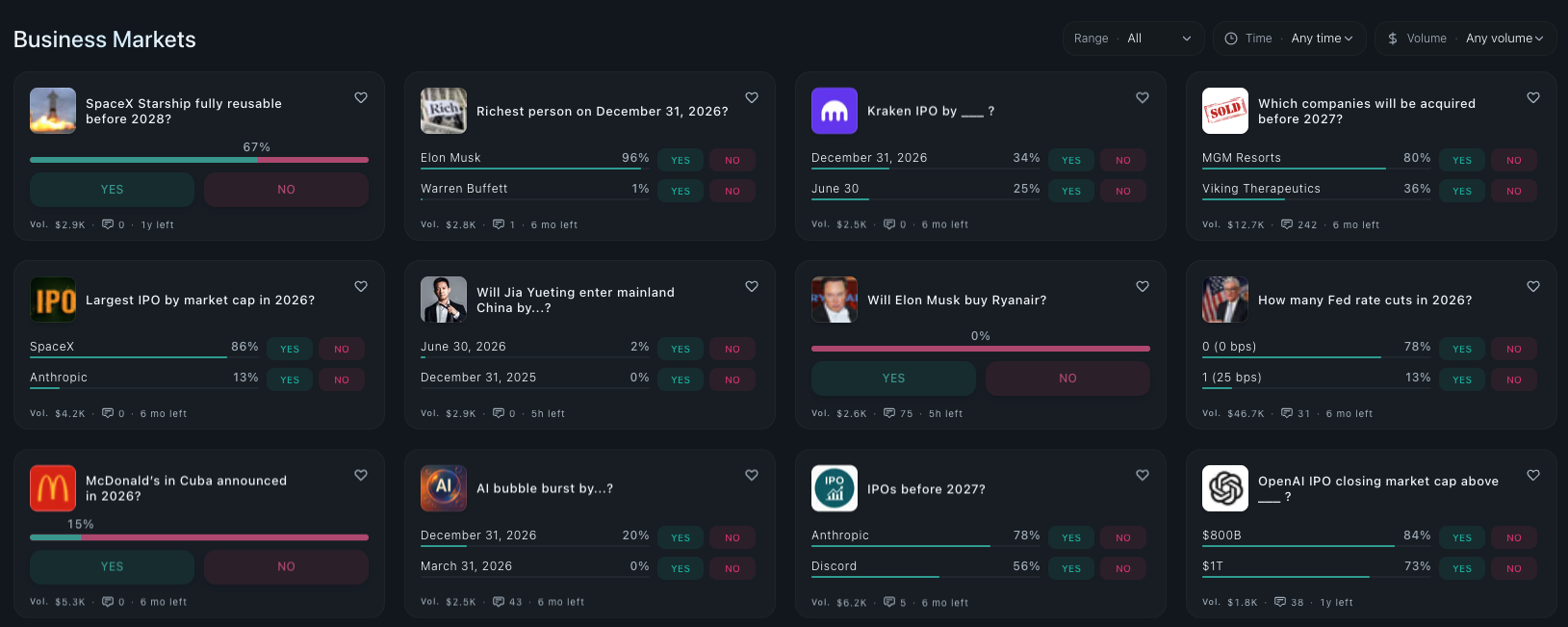
There is no iOS or Android mobile app available for Pariflow. Instead, mobile users may only access the platform in-browser. I found the in-browser version of Pariflow highly usable, offering full functionality across all markets available in the desktop version.
It’s clear that the team has spent a lot of time and energy creating a genuinely impressive mobile-first website.
Safety, Regulation and Trust
Pariflow operates in a crypto-based prediction market structure where regulatory coverage depends on jurisdiction and local rules.
Pariflow does not publicly state that it operates as a CFTC-licensed Designated Contract Market (DCM) or under a US-regulated exchange framework such as those used by federally supervised prediction markets (Kalshi, Crypto.com, etc.).
This means users are not trading on a platform subject to the same level of federal market oversight, segregation requirements, or investor protections as apply to regulated US derivatives venues.
User funds are typically held in crypto wallets rather than traditional custodial brokerage accounts. Public documentation does not clearly outline segregated custody arrangements or clearinghouse protections, meaning users face greater counterparty and platform risk than they would on a federally regulated exchange.
Pariflow requires identity verification (KYC) for full access, particularly around withdrawals and higher-value trading activity. Additional checks may be triggered by unusual trading patterns, large cashouts, or compliance monitoring.
Geographic Restrictions
Pariflow does not currently publish a comprehensive public list of supported U.S. states or international jurisdictions. Product availability may vary based on local regulations, sanctions restrictions, and Pariflow’s compliance policies. Users should review the platform’s Terms of Service and account eligibility requirements before funding an account
Bonuses and Promotions on Pariflow
Pariflow is currently offering a first-deposit bonus to all new players who create an account on the platform.
The brand is offering a 100% deposit match up to $50, which can be claimed once per account.
The bonus funds cannot be cashed out, and the bonus must be traded 2x before it can be withdrawn. There’s no promo code or opt-in required – simply create an account, deposit, and your bonus will be automatically applied to your account.




Who Is This Platform Best For
- Traders who are comfortable with crypto wallets and on-chain funding flows
- Users seeking broad, multi-category prediction markets beyond politics-only platforms
- Users who prefer flexible market access over a strict CFTC-regulated structure
- People seeking low-entry contract sizes for small-position experimentation
Who Should Avoid It
- Users who prefer fully CFTC-regulated exchange protections and clearing guarantees
- Traders who prefer fiat deposits via card or bank transfer
- Users who are uncomfortable managing crypto wallets or network transactions
Best Alternatives to Pariflow
While Pariflow offers a sleek, crypto-native prediction market experience, it is far from the only option available. Depending on what you value most—whether that’s regulatory oversight, market liquidity, platform reputation, or access to a wider range of events—several strong alternatives are worth considering. Below, we take a closer look at the best Pariflow alternatives, highlighting who each platform is best suited for and where it stands out from the competition.
Kalshi
Kalshi is the obvious alternative to Pariflow and addresses most of the platform’s weaknesses.
The CFTC-regulated prediction market operates under formal US regulatory oversight and offers event contracts across elections, politics, sports, culture, crypto, commodities, and more. It is best suited to users who prioritize a regulated market structure, clearer fee transparency, and stronger consumer protections in the US.
Polymarket
Similar to Pariflow, Polymarket is another crypto-native prediction market and a fantastic alternative that also runs on blockchain infrastructure.
Some may say that Pariflow has been clearly inspired by Polymarket, with the pair offering a near-identical product down to the platform’s branding. It is a good alternative for those searching for a crypto-focused product from a more established brand.
Final Verdict
Pariflow offers a strong prediction-market experience with low minimum trade sizes and broad coverage of global event categories. However, its lack of clear public regulatory classification and limited transparency around fees and protections will be a concern for more cautious users.
It is best suited to users comfortable with crypto-based trading who want flexible exposure to prediction markets across multiple categories, but less appropriate for those who prioritize fully regulated US exchanges or the simplicity of fiat-based trading.
Pariflow FAQ
Yes, Pariflow operates as a crypto-based prediction market platform, but it is not recognized as a CFTC-regulated exchange or licensed US sportsbook.
It operates in the prediction markets sector without a publicly disclosed CFTC Designated Contract Market (DCM) registration or equivalent federal oversight, and regulatory status may vary by jurisdiction.
Pariflow is not publicly confirmed as CFTC-regulated and does not appear to offer traditional segregated brokerage-style fund protections, with user balances typically held in crypto wallets.
While KYC checks are used for access and withdrawals, users remain exposed to platform risk and to full trading losses, with no built-in loss limits beyond their account balance.
No, Pariflow is not formally classified as gambling, as it operates through event-based prediction contracts rather than sportsbook-style betting. However, it is not publicly confirmed as a CFTC-regulated exchange, so its legal and regulatory treatment can vary by jurisdiction.
The minimum deposit on Pariflow is not publicly disclosed. Users should expect deposit requirements to vary by crypto asset, network fees, or platform conditions at the time of funding.
Pariflow does not publish a full list of supported countries, and access depends on local regulatory and crypto restrictions.
US availability is limited and varies by eligibility, while international access is not clearly defined and may be restricted depending on jurisdiction.
No, Pariflow does not offer an official iOS or Android mobile app. Users may, however, access the platform in a browser.
Pariflow withdrawals go to a connected crypto wallet, with processing usually taking minutes to an hour on Polygon, depending on blockchain speeds.
Delays may also come from security checks or temporary holds before funds are released.
Yes, Pariflow’s Demo mode allows users to practice order entry, price movement, P&L, and settlement mechanics with a demo balance.

