


 Share
Share 



- The CFTC is struggling to define “gaming,” leaving the regulatory boundary between prediction markets and sportsbooks unsettled.
- Operators are expanding sports-outcome contracts under federal rules while state regulators aggressively assert local gambling authority.
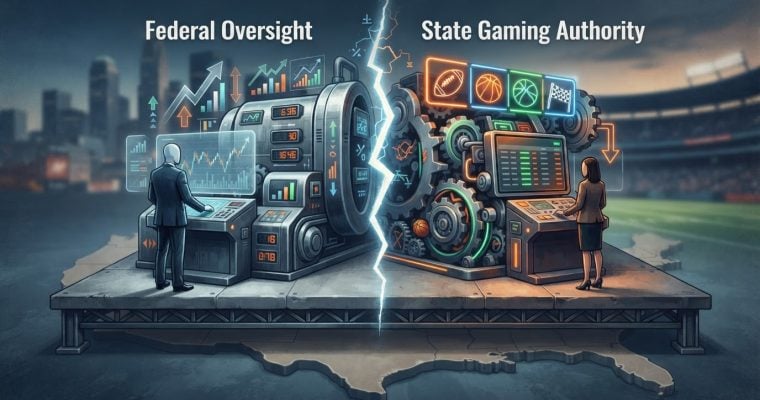
The Commodity Futures Trading Commission is still grappling with how to define “gaming” in event contracts, leaving prediction markets operators and sportsbooks fighting over where federal derivatives law ends and state gambling law begins.
That matters because the line is no longer theoretical. Operators including Kalshi, Novig, ProphetX and DraftKings are all tied to products that look increasingly sportsbook-like, even as the legal framework remains unsettled. At the same time, states including Nevada and New Jersey are still pressing their own authority over sports-outcome contracts offered to residents.
How the CFTC says prediction markets differ from sportsbooks
According to the source article, CFTC Chairman Michael S. Selig said the statute does not define the words “gaming” and “involve” in the event-contract context. Selig warned undefined terms leave applications “at risk of rejection based upon arbitrary whims or political biases.”
The mechanical distinction described in the report is straightforward: a traditional bookmaker sets odds and takes the other side of a wager, while an event-contract exchange matches buyers and sellers and settles contracts at $1 or zero. The article said Kalshi contracts trade from one to 99 cents before settlement.
That exchange-based argument has also been made by operators. ProphetX CEO Dean Sisun wrote in a comment letter that a federally supervised, peer-to-peer exchange “is not simply another way to package the state sportsbook model.” The CFTC register lists ProphetX LLC as a designated contract market from June 11, 2026.
The agency’s rulemaking is still in motion. The article said the CFTC is expected to amend Parts 38 and 40 and rewrite Rule 40.11, which currently bars contracts involving or relating to terrorism, assassination, war, gaming, or unlawful activity.
State regulators and courts are still challenging sports contracts
Even with federal oversight in play, states have not backed off. The article said Nevada obtained a court order barring Kalshi from serving state residents, and the Nevada Gaming Control Board later accused the company of failing to stop in-state trading. The board asked the court for $120,000 a day for alleged violations.
On Aug. 28, the Ninth Circuit held that Kalshi had not shown the Commodity Exchange Act likely preempted Nevada’s gaming regulations for sports event contracts. Then on Sept. 2, New Jersey’s attorney general asked the U.S. Supreme Court to review whether sports wagers on prediction markets can avoid state sports-gambling laws.
Market growth is accelerating before the rules are settled
The commercial push is continuing while regulators debate definitions. Novig launched nationally on Aug. 4 after the CFTC granted designated contract market status to its Ludlow Exchange LLC subsidiary on June 16. Novig said its first week produced more than $125 million in notional volume, with parlays making up roughly a third of activity.
The article also said DraftKings filed its first event-contract templates with the CFTC in May for DKeX.
What comes next is the key question for operators and regulators. The article said the CFTC’s June proposal would define “gaming” and “involve,” set public-interest factors, and treat player-injury and other discrete-action contracts as likely contrary to the public interest. Until those rules are finalized, the business models may keep converging faster than the law can separate them.
Source: As reported by Tanya Chepkova.