



 Share
Share 



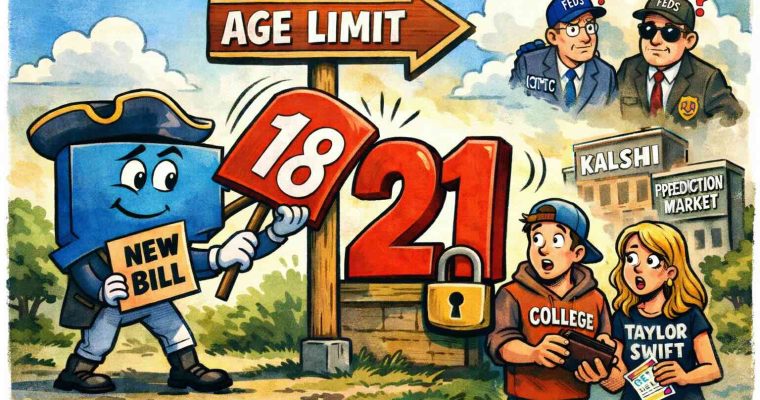
If you are a college student in Connecticut who spent the last semester betting your textbook money on election results or Taylor Swift’s next breakup, Governor Ned Lamont has some bad news for you.
A brand new proposal called House Bill 5038 is making its way through the state legislature right now, and its main mission is to make prediction markets a “21 and over” club.
Why the Change of Heart?
Right now, many of these platforms allow anyone 18 or older to join the party. But Gov. Lamont argues that the lines between “investing” and “gambling” have become way too blurry for comfort. So the new bill wants to:
- Raise the bar: Move the minimum age from 18 to 21.
- Ban college ads: Stop these companies from plastering their logos all over college campuses.
- Force a “Check-In”: Require platforms to use high-tech geolocation and age verification to make sure you are actually a grown-up in the Nutmeg State.
If a company gets caught letting a 19-year-old trade on the next Fed rate hike, it could face fines of up to $10,000 per violation. If it keeps doing it, those fines could increase to $50,000.
Opposition Parties Swing In
Of course, not everyone is cheering for this change. The big players in the prediction market world, along with some federal regulators, are essentially saying, “Hold your horses, Connecticut.”
These markets are regulated at the federal level by the Commodity Futures Trading Commission (CFTC); individual states shouldn’t be able to just jump in and change the rules, they say. It has turned into a legal tug-of-war between state leaders and federal bosses who want a single set of rules for the whole country.
Even the local tribes in Connecticut, like the Mashantucket Pequot and the Mohegan Tribe, are giving this bill the side-eye. They are worried that by creating rules for these markets, the state is accidentally “legalizing” something that competes with their own licensed casinos.
But a spokesperson for Gov. Lamont said the bill is just a measure to protect minors, and nothing more.
“We appreciate the concerns raised by the Mashantucket Pequot Tribal Nation and the Mohegan Tribe and recognize the importance of Connecticut’s longstanding tribal-state gaming partnership. [House Bill] 5038 is intended as a narrow consumer-protection measure.”
What Happens Next?
The bill had its big public hearing Feb. 18, and it is currently being poked and prodded by the General Law Committee. If it passes all the obstacles, it would officially kick in on July 1, 2027.
Until then, the state’s Department of Consumer Protection is already playing “bad cop.” Dec. 3, the department officially went on the warpath, firing off “Cease and Desist” orders to some of the biggest names in the prediction game.
Kalshi was the main target. It was ordered to stop offering “sports event contracts” immediately. Kalshi didn’t blink; it sued the state the very next day.
Robinhood (Derivatives LLC), on the other hand, was told to pull its new prediction features for anyone with a Connecticut zip code.
Even though those orders were sent out in December, things are currently at a standstill. On Dec. 8, a federal judge stepped in and hit the “pause button” on Connecticut’s crackdown against Kalshi.
Judge Vernon Oliver ruled that the state has to keep its hands off the platform while the court decides who actually has the power here — the state or the federal government.