



 Share
Share 



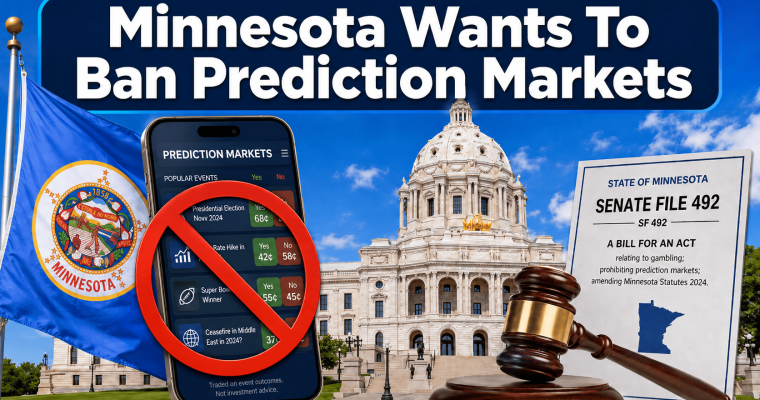
On Tuesday, Minnesota lawmakers pushed forward a bill that will ban prediction markets.
The public safety bill called SF 4760 basically treats these platforms like a glitch in the Matrix that needs to be deleted. And if Governor Tim Walz signs it, Minnesota becomes the first state in the country to explicitly outlaw platforms like Kalshi and Fanatics Markets.
The bill: SF 4760 (the public safety omnibus)
Lawmaking can be a bit like a game of Tetris. SF 4760 is a “Public Safety Omnibus” bill, which is basically a suitcase where lawmakers stuff a bunch of different laws together. Originally, this bill didn’t mention prediction markets at all.
The Senate had a standalone bill ready to go, but when the House got their hands on SF 4760, they decided to “amend” it by sliding the prediction market ban right in.
After some back-and-forth drama where the Senate initially said “no thanks,” a conference committee smoothed things over. The final result? A landslide victory in both chambers.
The nitty-gritty of the ban
The new law, which is headed to Governor Walz’s desk, makes it a felony to operate or even facilitate these markets in Minnesota. Here is what is on the “Forbidden” list:
- Political contests (no betting on your favorite candidate).
- Court cases (legal drama stays in the courtroom, not the sportsbook).
- Weather events (Mother Nature is off-limits).
- Pop culture outcomes (award shows and celebrity gossip are a no-go).
- Traditional sports/ esports (basically any athletic event you can think of).
The bill even targets the people who help these sites run, including payment processors and advertisers. If you are caught promoting these markets within 500 feet of a school or playground, the state is coming for you.
What happens next?
The law is set to kick in on August 1, 2026, but don’t expect the platforms to go down without a fight.
Prediction markets are already a legal battlefield across the US, with federal regulators and state governments constantly clashing over who actually has the power to oversee them.
Critics of the ban like Rep. Nolan West think this is a total overstep. His take? Prohibition doesn’t work; it just moves traders into the black market.
On the other hand, Rep. Emma Greenman argues that Minnesotans have the right to decide how gambling works in their own terrain. She sees the proposal as a “state sovereignty” move to promote public safety:
“This (bill) is asserting Minnesotans’ authority to do what we’ve always done, which is to say how best and what regulations we think we should attach to gambling to protect public safety and our kids and the gambling itself.”