



 Share
Share 



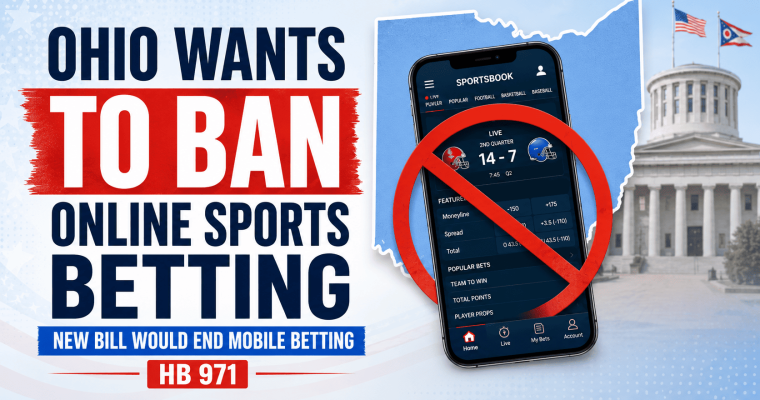
Online sports betting in Ohio is just a little over three years old. Still, some lawmakers want to send it packing from its shores.
House Bill 971 is the new bill that wants this evacuation and has been sponsored by Republican Representatives Jonathan Newman and Beth Lear.
Their deal? Well… they believe sports betting has become too easy, too accessible, and too harmful. Instead of driving to a casino, anyone can place a bet from the comfort of their beds or while standing in line for coffee.
Lawmakers argue that round-the-clock access has made gambling far more addictive and has increased financial harm for some Ohioans.
What would change?
If House Bill 971 becomes law, online sportsbooks would disappear from Ohio.
That means betting apps like FanDuel, DraftKings, BetMGM, Caesars, ESPN BET, Fanatics Sportsbook, and every other licensed mobile operator would no longer be allowed to accept wagers in the state.
Sports betting would not disappear entirely, but it would look very different. The proposal would:
- Ban all online and mobile sports betting.
- Limit legal wagering to in-person bets placed at licensed casinos.
- Cap every wager at $100.
- Ban parlays.
- Ban live in-play betting.
- Ban proposition bets.
- Ban betting on college sports.
In other words, lawmakers want to strip sports betting back to something much closer to its traditional roots.
A big change from just a few years ago
The timing is striking because Ohio only entered the legal sports betting market recently.
Governor Mike DeWine signed the state’s sports betting law in 2021, creating the way for a January 1, 2023, launch. Since then, Ohio has grown into one of the country’s largest regulated betting markets, generating billions of dollars in bets and hundreds of millions in tax revenue.
That rapid growth is exactly what supporters of House Bill 971 say has created the need for tougher rules.
Critics, however, see things very differently.
They believe that banning online sportsbooks would simply push many bettors toward offshore gambling websites that offer none of the consumer protections found in Ohio’s regulated market. They also warn that the state would lose a valuable source of tax revenue while licensed operators would be forced to leave one of the nation’s largest betting markets.
But this is what Newman had to say in concern for tax revenue.
“Monetizing addiction to fund public education is the wrong direction for Ohio. Who wins when predatory gambling preys on the vulnerable? It’s not our schools; that’s for sure! It’s the trillion-dollar big gambling companies who win. How is this good for Ohio?”
Lear further buttressed Newman’s point by arguing that the state has no desire to make revenue at the detriment of the well-being of bettors.
“Gambling is the No. 1 addiction that leads to suicide—online gambling companies are in an aggressive pay-to-play game with the Ohio Legislature, hoping to expand their profits on the backs of Ohioans with the ‘carrot’ of providing extra tax money for the government. This legislation makes it clear: our kids, their physical and mental well-being, are not for sale.”
What happens next?
For now, House Bill 971 is only at the beginning of the legislative process.
The proposal will be assigned to a House committee, where lawmakers will hold hearings, hear testimony from supporters and opponents, and decide whether it should move forward. If approved, it would still need to pass both the Ohio House and Senate before reaching Governor DeWine’s desk.
That is a long road, and there is no guarantee the bill makes it that far.