



 Share
Share 



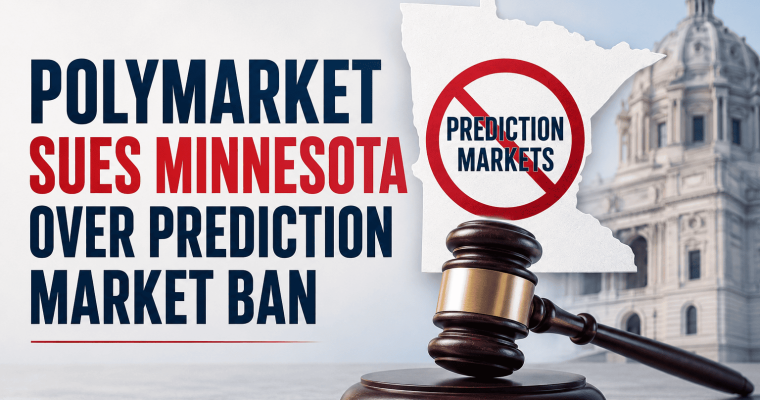
Polymarket has officially filed a lawsuit in federal court against the state of Minnesota.
Why? Well, last month, Minnesota decided to place a ban on prediction market platforms.
Polymarket is now the third body that is officially lawyering up against the state. The Commodity Futures Trading Commission and Kalshi barely waited before the break of dawn after the ban was passed before suing.
What does the ban say?
Senate File 3432 was signed into law by Governor Tim Walz in May. This sweeping public safety package is scheduled to take effect on August 1.
If it goes live, it will make Minnesota the very first state in the country to enact a total legislative blackout on prediction markets.
The new rules mean that operating, facilitating, or even advertising event contracts tied to things like elections, sports, wars, and pop culture would instantly become a felony. The law does not just look at the trading platforms themselves; it also targets the side businesses providing geolocation tools, identity verification, payment processing, and data services.
Polymarket’s constitutional defense
Polymarket has a couple of arguments to explain why this state law simply cannot stand.
First, the company points out that federal law beats state laws. They argue that under the Commodity Exchange Act, Congress gave the federal Commodity Futures Trading Commission total and exclusive authority to oversee these types of markets.
According to this view, a single state cannot just step in and turn federally regulated operations into local crimes overnight.
Polymarket is putting emphasis on the First Amendment. The platform argues that Minnesota is unlawfully criminalizing basic freedom of speech by banning the advertising and marketing of these markets. The lawsuit notes that the state rules heavily interfere with the ability to communicate openly with customers and share critical verification data.
Kalshi is citing the same concern
Before Polymarket entered the fight, Kalshi was already in court.
Court filings show Kalshi initiated its action on or around May 29, 2026, seeking to block enforcement of the law before it takes effect on August 1.
That filing effectively opened the door for other prediction market operators to mount their own constitutional challenges.
Where does this leave all parties?
The urgent focus is August 1.
Polymarket is asking the federal court to prevent enforcement of the ban while the legal challenge proceeds. The CFTC is seeking similar relief through its lawsuit.
For the time being, it’s a game of “may the best man win,” as nothing is known for certain. But if the President’s words count for something, then prediction markets might have an upper hand, as President Donald Trump recently went on a ranting spree, calling out state representatives causing constraints on prediction markets.