



 Share
Share 



Governor Abigail Spanberger just finished a busy week with her red pen, and the results are leaving a lot of people scratching their heads.
She vetoed a set of bills that would have legalized skill game machines and a casino project in Fairfax County.
The skill games dream is dead on arrival
Senate Bill 661 was aimed at bringing back those “skill game” machines you used to see in every corner store and truck stop.
Small business owners were practically begging for this one because those machines helped pay the rent when times were tough.
Spanberger’s reasoning was that the state is not ready to police these machines properly, and she worries they might lead to more crime in quiet neighborhoods. For now, those screens are staying dark, and the only thing people will be winning at the local gas station is a free soda on a scratch-off ticket.
“The absence of a centralized regulatory authority for gaming creates gaps in oversight that threaten the Commonwealth of Virginia’s ability to provide consistent enforcement, prevent illicit activity, and protect all consumers. Right now, legalizing skill gaming and introducing more of these machines into our communities would strain an already fragmented system,” she said.
Fairfax County didn’t get a chance either
While the small shops are mourning their machines, the big developers in Fairfax County are also sulking for the loss of a mouth-watering project that could have been.
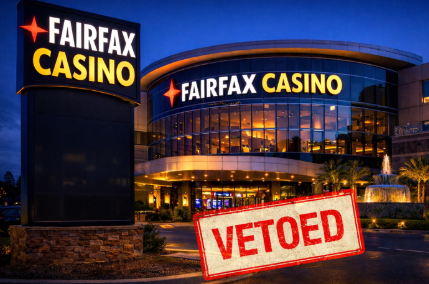
The Governor vetoed Senate Bill 756 on Thursday, bringing a plan that could bring a huge casino right to the heart of Northern Virginia to a halt.
Usually, Virginia lets cities and counties decide if they even want a casino. This bill tried to skip that step by picking the specific spot in the law itself, which the Governor says completely ignores what the local people actually want.
“In no other circumstance has the General Assembly prescribed specifications for a casino’s location,” the governor said in announcing the veto. “This effectively precludes local input and eliminates local decisions. While this legislation specifically affects only Fairfax County, it would set a precedent to bring casino referendums to other localities where the local governing board may similarly oppose such an effort.”
A failed test run
Virginia had a brief fling with these skill game machines during the pandemic as a quick way to raise some extra cash. That experiment ended in 2021.
The governor also pointed out that operators specifically zeroed in on the most vulnerable parts of the state.
She added that data from that temporary period, when thousands of slot machines were in use, backed this up. The numbers suggested the machines were not spread evenly but instead clustered in certain communities.
“The data clearly show that devices were disproportionately located in communities where higher percentages of the population live below the poverty line, communities with lower rates of educational attainment, and communities where higher percentages of the population are Black and Hispanic.
“The data enumerate the millions of dollars in wagers made, resulting in millions of dollars flowing out of these communities, but without an entity in place to evaluate and mitigate social, economic, and public impacts, the Commonwealth is not positioned to expand gaming and legalize electronic skill gaming devices,” she said in the veto statement.
What happens next?
The Virginia General Assembly heads back to Richmond on April 22 for their reconvened session. This is the only chance lawmakers have to push back against the governor’s red pen.
To win, supporters need a two-thirds majority in both the House and the Senate.
Based on the previous votes in March on SB 661, the House originally passed the measure with a 57 to 38 vote, meaning they are roughly ten votes short of the 67 needed for an override. The Senate is in a similar spot, having voted 23 to 15 when they actually need 27 votes to bypass the governor’s veto.
SB 756, on the other hand, saw a 55 to 41 victory in the House and a 25 to 13 finish in the Senate; those numbers still don’t reach the supermajority threshold.