
 Share
Share 



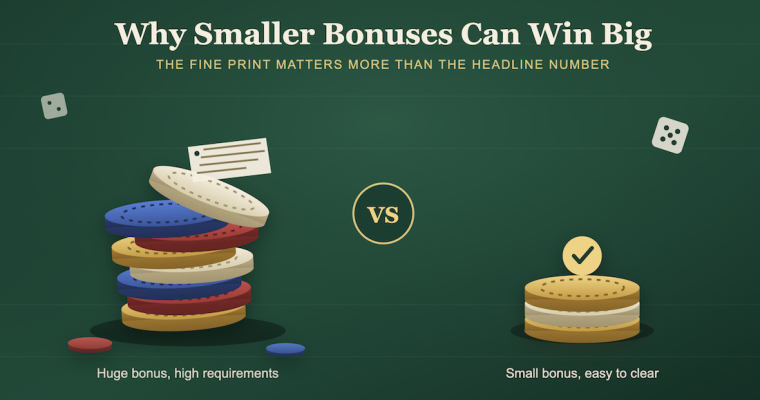
Scroll through any page of online casino bonuses, and the biggest number usually wins your attention. A “300% Match up to $3,000” headline is designed to make a “50% Match up to $200” offer next to it look like an afterthought. But size is the least useful number on that page. The multiplier, the game restrictions, and the fine print underneath the bold text determine whether a bonus is actually worth claiming. And by those measures, the smaller offer often wins.
Here’s why a modest bonus can beat a massive one, and what to check before you decide which is which.
1. Lower Wagering Requirements Mean the Money Is Actually Reachable
Every casino bonus comes attached to a wagering requirement — sometimes called a playthrough or rollover requirement — which dictates how many times you have to bet the bonus amount before any of it (or winnings from it) becomes withdrawable. These requirements typically range from 1x to 25x or more, and the online casinos in legal US states each set their own terms.
Yes, it can be confusing, which is why we made a playthrough requirement calculator.
Here’s where the math flips in favor of the smaller bonus. A $3,000 bonus at 50x wagering requires $150,000 in total bets before you can touch it. A $200 bonus at 10x requires just $2,000. A 300% bonus with 50x playthrough can be worse than a 100% bonus at 20x. The advertised size tells you almost nothing about how reachable the money is.
2. Smaller Bonuses Tend to Come with Friendlier Game Rules
Wagering requirements aren’t applied evenly across every game in the lobby. Slots typically contribute 100% toward the requirement, while table games and live casino often contribute 10% or less, and some games count for nothing at all. That means the same wagering multiplier can play out very differently depending on what you like to play. Splitting a session between slots and live blackjack while clearing a bonus means the blackjack bets move the wagering counter at a fraction of the rate of slots bets.
Casinos generally attach their most generous game contribution rates to smaller, easier-to-clear promotions, since those are designed to get new or casual players playing without friction. The eye-catching four-figure bonuses more often restrict you to slots only, or apply reduced contribution across a longer list of excluded games, simply because the casino has more exposure to manage.
3. Time Limits are Easier to Hit
Bonus funds don’t last forever. Most introductory offers expire between seven and 90 days, and if the wagering requirement isn’t met in that window, the casino revokes the remaining bonus credits, along with any winnings tied to them. A $3,000 bonus at 50x wagering that must clear in seven days requires roughly $21,400 in bets per day to make the deadline. Almost nobody comfortably plays at that volume. A $200 bonus at 10x over the same week needs about $286 a day, a target that’s realistic for an average recreational session. The smaller number isn’t just smaller in total; it’s smaller in the daily pace it demands from you.
4. Lower Max Cashout Caps Sting Less When the Bonus Is Already Small
Many bonuses, particularly no-deposit offers and free spins, cap how much you’re allowed to withdraw regardless of how much you actually win while clearing the wagering requirement. A bonus may allow you to keep up to $100 in winnings after wagering, and that cap is usually stated alongside the wagering requirement. On a small promotion, a cap like that roughly matches what you were going to win anyway, so it barely changes the value of the offer. On a splashy four-figure bonus, a cap can quietly turn a “$1,000 bonus” into a $100 payout ceiling, a detail that’s easy to miss when the headline number is doing all the talking.
5. Smaller Bonuses Lower the Temptation to Overspend
Chasing a giant deposit match means depositing a giant amount to unlock it, and then betting well beyond that amount to clear the wagering requirement. That’s a lot of money in motion for an offer that, per the math above, may never fully convert to cash. A modest bonus tied to a modest deposit keeps the stakes proportional to what you can comfortably risk, which matters more than the marketing size of the offer. Bonuses should support a budget you’ve already set, not expand it.
6. Simpler Terms Mean Fewer Ways to Lose the Whole Bonus
Big bonuses tend to come with a longer list of conditions: deposit-plus-bonus wagering bases (which roughly double what you owe compared with bonus-only wagering), bet-size caps that void the offer if you wager too much on a single hand, and multi-tiered contribution rates across dozens of game categories. Betting above the cap can void everything, and one oversized wager can undo an entire bonus. Smaller, simpler promotions usually carry fewer of these tripwires, which means less chance of doing everything right and still forfeiting the bonus over a technicality you didn’t notice in the terms.
The Bottom Line
None of this means big bonuses are automatically bad, or that small ones are automatically good. A small bonus with a 40x requirement and a $50 cap can still be a poor deal. What it means is that the size of the number in the ad is close to irrelevant on its own. The multiplier and game weighting matter far more than the bonus size operators advertise in bold. Before claiming anything, do the same three-part check regardless of how big the offer looks: what the wagering requirement multiplies (bonus only, or deposit plus bonus), which games count toward it and at what rate, and how long you have to clear it. Whichever number survives that check — not the one in the headline — is the one that tells you what the bonus is actually worth.