


 Share
Share 



While fans have spent the last few weeks arguing over penalty calls and debating between Cristiano Ronaldo and Lionel Messi on who’s the Greatest of All Times, millions of others have been busy doing something else. They have been trading on the outcome of the 2026 World Cup matches.
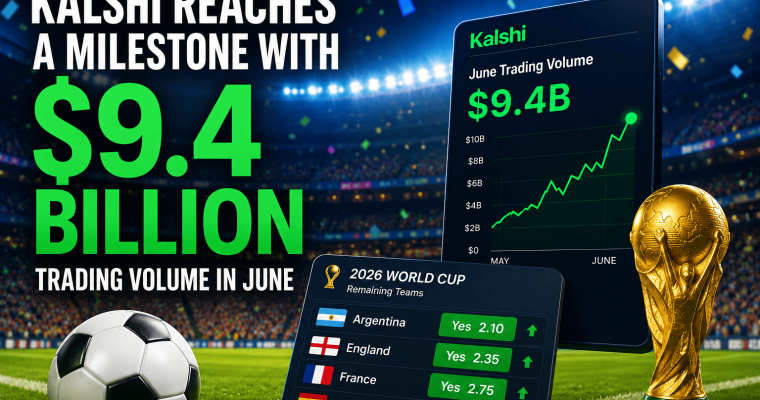
The result? Kalshi has just posted the biggest month in its history, recording more than $9.4 billion in trading volume in June. They did around $5.3 billion in May, which means they practically doubled their entire trading volume in thirty days because everyone suddenly decided that trading soccer contracts was a whole lot more fun than buying regular old stocks.
Turns out, the World Cup is good for business
Nobody expected the world’s biggest football tournament to be quiet. Still, few could have predicted just how much it would move prediction markets.
Every match has become its own little stock exchange. Instead of buying shares in companies, traders are buying contracts on who wins, who loses, and who books the next flight home.
Kalshi’s market for the Round of 16 clash between Canada and Morocco alone got more than $48 million in trading before a ball was even kicked.
Multiply that across dozens of matches every week, and suddenly a record-breaking June starts making perfect sense.
The tournament itself has become the biggest event prediction markets have ever seen. The market estimates suggest World Cup-related contracts have already generated well over $5.4 billion in trading on their own, and there are still matches left to play.
Then came another win nobody saw coming
The best part of the whole story is this crazy brand power list that YouGov just put out. They tracked which companies got the most attention and love during the tournament. Kalshi somehow managed to slide onto the list at number 37.
“With the tournament reaching the business end, YouGov analyzed more than 2,000 brands tracked in YouGov BrandIndex to identify which are gaining most among U.S. consumers interested in the FIFA World Cup.
The ranking shows that official sponsorship still matters, but it is not the only route to impact. Some of the strongest gains are coming from brands that make the tournament part of everyday fan behavior: what people drink, snack on, wear, collect, watch, play and share during the FIFA World Cup,” an article on the YouGov webpage read.
Kalshi became the only prediction market to appear on YouGov’s World Cup brand power rankings.
Even more surprising? It was also the only sports betting-related company to make the cut.
Instead, Kalshi found itself sharing the spotlight with big brands like Coca Cola, Visa, Adidas, Nike, and Pepsi. Even better, they actually ranked higher than Fox, the network that is literally broadcasting the games on television.
That is the kind of guest list most gambling companies would happily frame and hang on the wall.
What’s next on the radar?
The 2026 World Cup has not crowned a champion yet.
Kalshi may not be finished breaking records either. Every knockout match, every upset, every penalty shootout, and every last minute winner gives traders another reason to pile into the market.
The big question now is whether July can do even better.
Data courtesy of Legal Sports Report.