



 Share
Share 



Imagine your love life becoming a predictive market? As Love Is Blind Season 10 winds toward its Ohio finale, viewers aren’t the only ones trying to guess who will actually say “I do.” Increasingly, the most confident predictions aren’t coming from Reddit sleuths or Bachelor‑Nation‑adjacent gossip accounts — they’re emerging from prediction markets, where thousands of traders put real money behind each possible outcome.
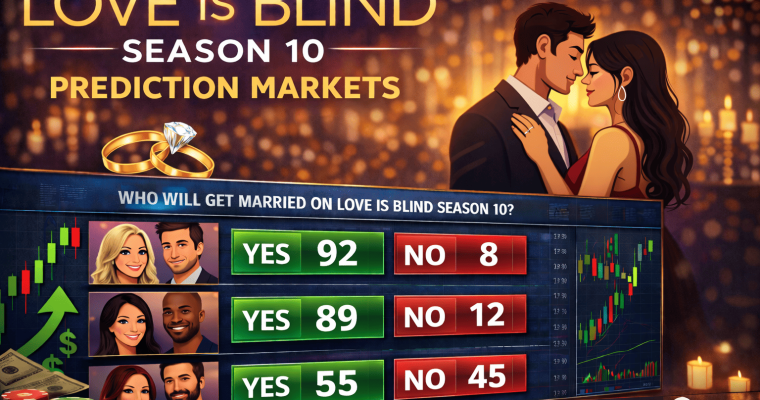
Platforms like Polymarket and Kalshi are shaping that conversation, where an active market—Who Will Get Married on Love Is Blind Season 10?—has turned the series into a high‑stakes emotional stock exchange.
What emerges is a fascinating tension between the narrative Netflix gives us and the probabilities traders believe. In some cases, the market is uncannily accurate; in others, it reveals how spectacle and sentiment can inflate confidence in couples who are destined for a much harder landing.
Where Traders Put Their Money — And What It Says About the Story
At first glance, the Polymarket board reads like a gambler’s cheat sheet for the finale. The highest‑priced outcomes—the “blue chips” of Season 10—belonged to cast members like Victor St. John, Christine Hamilton, Jordan Faeth, and Amber Morrison, with “Yes” shares clustering in the 91–94¢ range.
To a trader, that means one thing: These are the people most likely to walk away married.
But prediction markets reward confidence, not compassion, and sometimes the crowd misreads the emotional signals.
Take Ashley Carpenter, who topped the market with a 94¢ “Yes” price. Traders seemed convinced her story would end in a bridal kiss. Yet everything from early spoilers to the emotional turbulence visible in Netflix previews—where Ashley is seen crying, storming out, and even accusing Alex of lying—suggests her altar moment is anything but secure.
Her sky‑high price reflects something deeper than probability: the allure of a central‑casting love story. Strong edit, big personality, memorable moments. A trader’s bias can inflate optimism where reality may not.
In contrast, the market’s confidence in Victor and Christine wasn’t misplaced at all. Their clean, low‑conflict arc matched up perfectly with public marriage‑license records indicating they actually got married — a case where the trading floor and real‑world documentation aligned seamlessly.
Similarly, Jordan and Amber, another pair priced at 91¢ “Yes,” also did marry—though reporting later confirmed they’ve since split.
For the market, though, the metric is simple: Did they say “I do” on camera? And here, traders were right.
When the Market Gets It Wrong — The Beautiful, Chaotic Middle Tier
The most interesting dynamics appear not in the favorites, but in the middle zone, where price reflects uncertainty and narrative drift.
Consider Emma Betsinger, priced at 92¢. Traders were almost sure she’d marry—but the show itself gives us a cliffhanger: Emma says “yes,” but Mike’s answer doesn’t come. There is a spoiler reporting suggests Mike says no, undermining the market’s optimism.
Here, you can see the blind spot of prediction markets: they can track probability, but they can’t always parse emotional asymmetry. A heartfelt monologue from Emma can move traders more easily than a glimpse of Mike’s hesitation.
And then there’s Connor and Bri, a couple whose Polymarket confidence was completely out of step with what reporting revealed. This is where prediction markets show their limits. Traders priced Connor like a near‑certain groom, even though the couple’s actual story was unraveling under the weight of work schedules, self‑doubt, and resurfacing old connections long before they approached the aisle.
The Market-Dismissed Couples — Where Traders Saw Reality Clearly
Not all mispricings lean optimistic or true to the love is blind message of the show. For pairs like Chris and Jessica, the low trading prices reflect what reporting later confirmed: Chris ended their engagement early, citing lack of attraction (Jessica not being his usual type who does pilates and works out, even though he knew this… yes major eye roll), well before a wedding happened.
What the Prediction Markets Reveal About Season 10
If Season 10 has been about anything, it’s the contrast between idealism and reality. The pod connections were plentiful, even record-setting, with a lot of verbal declarations and promises—but once couples left the pods and re-entered Ohio, real‑world pressure tested those bonds in ways the markets struggled to quantify.
And that’s what makes Kalshi and Polymarket such compelling lenses through which to watch the season:
- It turns love into data.
- It turns chemistry into probability.
- It turns viewer intuition into a tradable commodity.
When traders get it right, the market reflects a clear read of the season’s trajectory. When they miss, it reveals how speculation can diverge from the relationships shown on screen.
Heading into the finale, these markets offer a snapshot of expectation — not certainty. Episode edits, online discussions, and hints from cast behavior all feed into the pricing, but none of it guarantees accuracy. Unscripted emotions can upend even the clearest market trend.
As the finale approaches, one truth becomes clear:
Love may be blind to some, but markets aren’t. Not entirely.
They just see a different kind of truth—one measured not in vows, but in volatility.