



 Share
Share 



Pari-mutuel betting sounds like one of those high-brow terms you nod at in a conversation while praying no one asks you to explain it. But here is the funny part: if you have ever chipped into a winner-take-all office pool, you already get it.
This guide breaks down the “OG” social betting system.
What exactly is pari-mutuel betting?
In short, it is crowdsourced gambling. Instead of betting against a “bookie” or a casino house that sets fixed odds, you are betting against every other person in the pool. Here’s the three-step rule:
- The Pot: All bets on a specific event go into one big shared bucket.
- The “vig”: The operator (the track or the app) takes a small, preset percentage to keep the lights on.
- The Split: The entire remaining pile of cash is divided equally among the winners.
The Math: Imagine 100 friends each bet $10 on a race. The total pool is $1,000. If the operator takes a 10% cut ($100), there is $900 left. If 30 people picked the winning horse, they each get $30. Your payout isn’t fixed; it literally depends on how many people are as smart (or lucky) as you.
How horse betting actually works: A traditional trackside demo
This is an example of what you’ll find at spots like Keeneland.
- Step 1: The Study. You grab a racing program and check the “handicapping” stats.
- Step 2: The Entry. You place a bet on a live horse to “Win, Place, or Show.”
- Step 3: The Market. You watch the “tote board” as odds flicker. If everyone starts betting on your horse, your potential payout drops in real-time.
- Step 4: The Build. There is a 20-minute gap of tension, social drinking, and trash-talking.
- Step 5: The Event. Two minutes of thundering and screaming fans.
- Step 6: The Payoff. The “Official” sign flashes, and winners head to the window.
How pari-mutuel-powered games work: A digital “powered” demo
This is the modern version found on apps like GiddyUp or Horseplay.
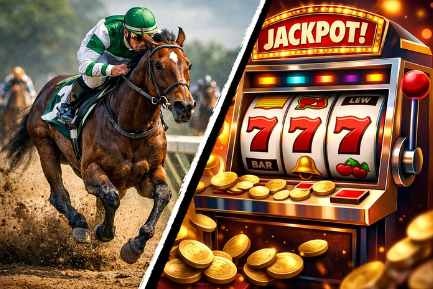
- Step 1: The Interface. You open an app that looks like a video game or slot machine.
- Step 2: The Selection. Instead of horses, you might pick a color, a number, or just hit “Spin.”
- Step 3: The Stealth Bet. Behind the scenes, the app instantly puts your money into a real-life horse racing pool that is closing at that very second.
- Step 4: The Reveal. There is no 20-minute wait. The game uses data to show you the result of a race via a digital animation.
- Step 5: The Loop. The round ends in seconds, and you are ready for the next one.
Comparison: Same math, different rhythm
| Feature | Horse racing (track) | Pari-mutuel games (app) |
| Format | Live physical event | Digital rounds/animations |
| Speed | 1 race every 30 minutes | 1 “race” every 10 seconds |
| Decision Time | Long (analysis invited) | Very short (instinct-based) |
| Visibility | You see the odds shifting | Odds shifts are invisible/instant |
| Complexity | High (requires research) | Low (simple and casual) |
| The Payout | Shared Pool | Shared Pool |
Key similarities: Why they are “siblings”
Despite the different outfits, these two are identical in certain areas.
Neither one uses “fixed odds.” If you bet $10 on a sportsbook, you know exactly what you’ll win.
In both of these worlds, you won’t know your final payout until the betting window closes and the pool is calculated. Both systems also ensure the operator never loses money because they simply take a commission from the total pot.
The “why” behind the innovation
So, what is the “why” behind this digitalization? Honestly, it comes down to the fact that some people absolutely love the chaotic math of a betting pool, but they just don’t have the patience to wait twenty minutes for a bunch of horses to get behind a gate.
The industry basically took the “slow-mo” soul of the racetrack and gave it a high-speed branding for the smartphone era.
Old laws, new tricks: How pari mutuel games stay legal
The regulatory side of pari-mutuel powered games is honestly one of the most interesting parts, because it feels like old rules doing a very modern job. Everything is carried on the Interstate Horse Racing Act of 1978, which was never written with mobile games in mind but somehow still holds everything together.
Instead of answering to gaming boards like regular online casinos, these platforms report to state racing commissions, the same guys who oversee horse tracks. Places like Oregon have become key hubs, quietly acting as the referees, making sure the systems are fair and the numbers add up.
Meanwhile, the “tote” system is the referee for every betting pool. It tracks every single dollar, takes out the operator’s pre-set cut, and then splits the rest among the winners with zero room for funny business or hidden odds tweaking.
Interestingly a piece of every round still goes back into the horse racing community, supporting tracks like Keeneland and everything behind the scenes, from operations to animal care. That connection is the whole reason these games are treated as horse betting, not casino play.
Even if the front end looks like a slot, legally it is still a horse wager. That is why apps like GiddyUp and Horseplay can pop up in states like California, Florida, New York, and Alabama, where traditional online casinos are still off the table.
Same old law. A whole new experience.