



 Share
Share 



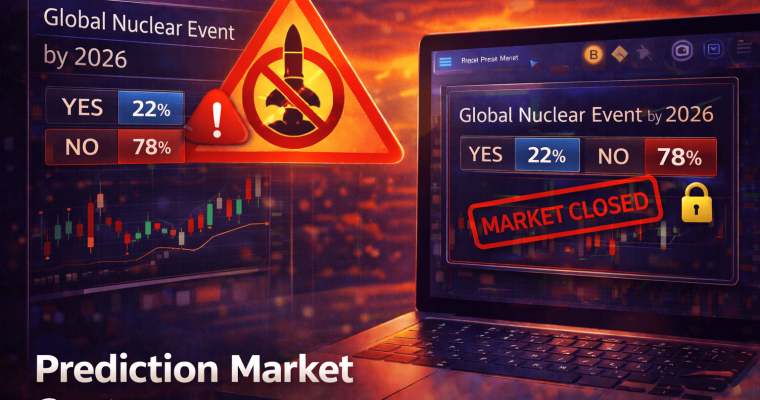
Polymarket, one of the largest crypto‑based prediction market platforms, has quietly taken down a controversial event market that allowed traders to speculate on the likelihood of a nuclear weapon being detonated in 2026. The market, which accumulated more than $847,000 in betting volume, drew swift and widespread criticism given that it went live during escalating real‑world geopolitical tensions.
A Market That Struck a Nerve
The removed event — titled “Nuclear weapon detonation by…?” — offered contracts on three timelines:
- By March 31, 2026
- By June 30, 2026
- Before 2027
Before Polymarket archived the market, the company publicly posted a 22% probability of a nuclear detonation by the end of 2026, an update it later deleted.
As the market gained traction, traffic, and nearly a million dollars in liquidity, users and public figures condemned its premise. Critics argued that monetizing catastrophic global events crossed an ethical line, especially during an active conflict in which hundreds of people had recently died.
Public Outrage and Ethical Concerns
Journalists and social‑media influencers reacted sharply:
- Investigative reporter David Sirota criticized the platform for “monetizing a nuclear attack,” and highlighted concerns that government insiders could exploit privileged information for profit. His post surged past 4.6 million views.
- Commentators expressed disbelief, describing the market as “dystopian” and “effectively incentivizing catastrophe.”
Others raised broader concerns about prediction‑market mechanics themselves — namely, whether financial incentives attached to harmful real‑world outcomes can distort behavior or create perverse motivations.
Polymarket’s Defense Before Removal
Before ultimately pulling the event, Polymarket published a defense on its website. The company argued that prediction markets can provide “accurate, unbiased forecasts” and serve as a valuable tool during crises. According to the statement, users directly affected by the conflict were seeking reliable signals during a period of chaotic, fast‑moving information.
This wasn’t the first time Polymarket faced scrutiny for questionable market topics. In recent years, the platform has confronted accusations of insider trading related to high‑profile events such as the U.S. capture of Venezuelan President Nicolás Maduro and a Super Bowl halftime show controversy.
A Flashpoint in the Prediction‑Market Debate
The removal of the nuclear‑detonation market surfaces deeper questions now facing the rapidly expanding prediction‑market industry:
- Where is the ethical line? Should there be limits on which real‑world events can be “priced” for public speculation?
- Who regulates these platforms — if anyone? Crypto‑based markets often operate outside traditional gambling jurisdictions, creating legal gray areas.
- What happens when markets overlap with geopolitics, military activity, or national‑security concerns?
As prediction markets continue to surge in popularity, incidents like this may accelerate calls for clearer regulatory frameworks — especially as lawmakers already debate how to treat event‑contract trading under gambling, commodities, or financial‑market rules.