



 Share
Share 



With COVID largely in the rearview mirror culturally (at least to some degree), it’s easy to forget the lasting effects of the era’s economic response. As of today (May 20, 2026), every U.S. state still uses some form of federal Covid relief funds to finance their government. Twelve states use these funds to finance recurring services – things like debt payments, government payrolls, and education expenses.
This access to federal money has given states some latitude in their budgets over the past 5 years. Places that were strapped for cash did not have to raise taxes locally to make good on their obligations. On December 31, 2026, the bill for all of it comes due. With billions of dollars in federal money set to leave state coffers in seven months, the time to budget for a future without these resources has begun. In states like Illinois and New York, legalized online casino gaming has been circulated as a viable tax oasis to the inevitable funding desert.
What iGaming Would Replace
Before diving into the iGaming angle specifically, let’s examine how states were receiving this money to begin with. The primary vehicle for COVID relief funding is the State and Local Fiscal Recovery Funds (SLFRF) initiative — an unemployment relief program that was part of the American Rescue Plan Act.
While SLFRF was primarily designed to address unemployment costs during the height of COVID, states generally had the authority to decide how they wanted to spend this money. If states wanted to address multiple parts of their budget, they could.
New York and Illinois did just that, receiving $12.7 billion and $8.127 billion in SLFRF funding, respectively, from the federal government.
What iGaming Could Mean for the Illinois Budget
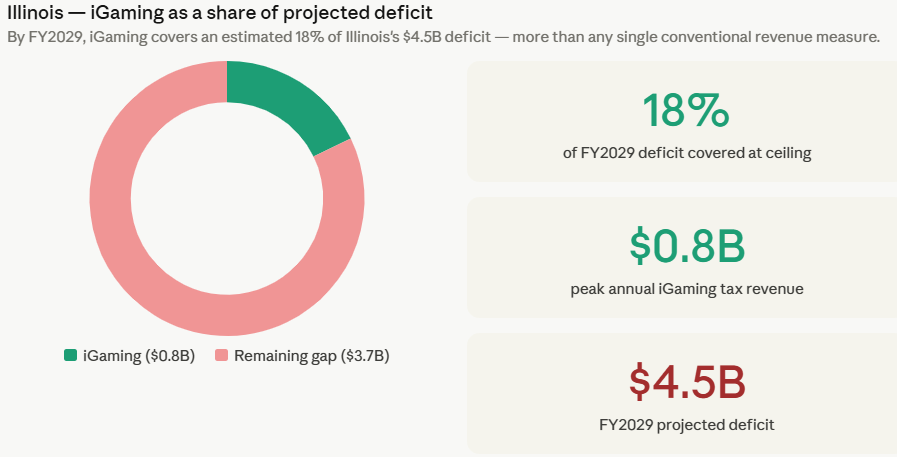
If the state maintains its current revenue rate, it’s on pace to have a $4.2 billion budget deficit by 2029. While the termination of SLFRF funding is not the exclusive reason for this (rising pension obligations largely are), the dependence on federal funds has certainly played a role in making the state dependent on this level of spending. In a world with less federal support, legislators like Edgar Gonzalez jr. – representing Illinois’ 23rd District — maintain there is no better solution than online casino gaming in Illinois.
“The financial boon that legalization portends for the state would help alleviate stress incurred by cuts in federal funding. Money from taxes and licensing can fund infrastructure, education, and state services, provided we regulate it properly.”
In each state where iGaming has been legalized, states have seen significant increases in their tax base. Pennsylvania, which legalized iGaming in 2017 and has a comparable population to Illinois, generated $1.099 billion in state revenue in 2025 alone.
“We have used the $1B figure and depending on whether amendments or other updates change the scope of the bill, that number may vary ie. if the tax rate changes,” said Rep. Gonzalez.
Up to this point, Illinois has understandably struggled to translate iGaming interest into law. Representative Gonzalez has introduced versions of the Internet Gaming Act in each session since 2023, and Senator Cristina Castro has introduced Senate companion bills in parallel — yet neither chamber has brought the legislation to a floor vote.
The primary resistance comes from two entrenched interests: the state’s powerful video gaming terminal industry, which generates $2 billion in annual gross revenue across Illinois, and land-based casino operators like Penn Entertainment, which has invested over $600 million in Illinois properties under the assumption that the gaming landscape would remain stable.
To address this, Gonzalez has maintained his openness to working with the VGT lobby:
“I am willing to discuss options with them; it’s a matter of how long they want to prolong the inevitable. VGT companies can also apply for this licensing; it would supplement their revenue from physical VGTs.”
The time to address the inevitable may be here fairly soon. With Illinois’ deficit trajectory worsening, the window for iGaming revenue to meaningfully offset the state’s fiscal cliff is narrowing. The 2026 session is arguably the most consequential – and perhaps the most optimistic – for the bill’s prospects.
What iGaming Could Mean For the New York Budget
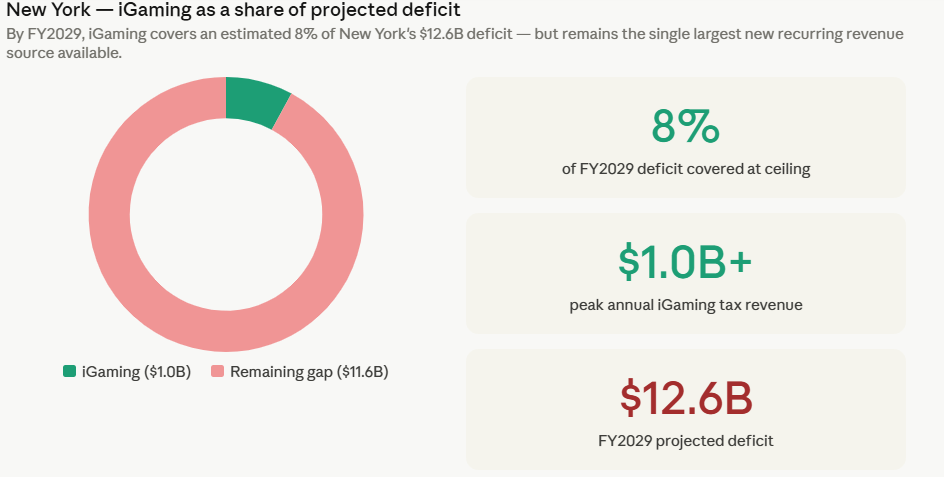
New York entered 2026 with a slightly more favorable financial situation than Illinois, amassing a $2.4 billion surplus on the back of strong Wall Street tax receipts. When SLFRF expires, that cushion evaporates almost immediately.
Legislators in the Empire State have a long history of kicking around the idea of using online casino gaming to address budget concerns. On this topic, no one has been a bigger evangelist than Senator Joseph Addabbo. As Chairman of the Committee on Racing, Gaming, and Wagering, Addabbo has repeatedly introduced legislation — most recently Senate Bill S2614 — to legalize online slots and table games, viewing it as the natural evolution of New York’s highly successful mobile sports betting market.
“We are leaving billions of dollars on the table,” Addabbo has argued, pointing to neighboring New Jersey, which has generated billions in tax revenue since legalizing iGaming in 2013.
The financial projections for the Empire State are massive. Proponents estimate that a mature New York iGaming market could generate between $1 billion and $4 billion annually in gross gaming revenue. At a proposed tax rate of around 30.5%, that translates to a massive, recurring influx of cash directly into the state’s education and infrastructure funds — safely bridging the gap left by the departing SLFRF federal dollars.
A Tactical Bridge
From a practical legislative standpoint, iGaming is not being positioned as a sweeping cure-all for deep-seated fiscal structural imbalances at the state level. What some legislators in these states do see is an opportunity to shore up the specific funding gaps — none bigger (at least in the short term) than the expiration of SLFRF on December 31, 2026.
The “funding desert” is arriving, and while iGaming may not turn it into a fertile paradise, legislators like Gonzalez Jr. and Addabbo believe it could provide just enough water to keep services afloat.