



 Share
Share 



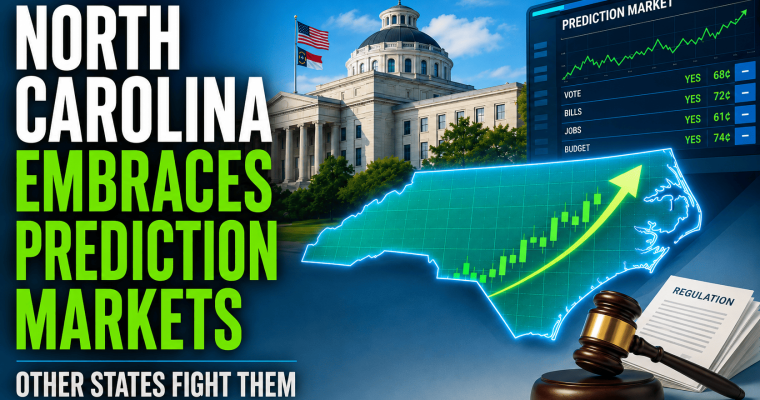
As states across the country battle prediction market operators over sports event contracts, North Carolina is heading in the opposite direction.
Governor Josh Stein recently signed Senate Bill 257, a budget measure that formally recognizes the Commodity Futures Trading Commission’s (CFTC) authority over federally regulated prediction markets such as Kalshi and Polymarket. The law also establishes a new tax framework for these platforms, making North Carolina one of the few states to publicly embrace prediction markets while others pursue lawsuits and enforcement actions.
The move highlights the growing divide among states over one of the gambling industry’s most contentious issues: whether sports prediction markets should be treated as financial products, sports betting, or something entirely different.
What North Carolina’s New Law Does
Under the new legislation, prediction markets registered and licensed by the CFTC may legally operate within North Carolina. The law specifically acknowledges the federal agency’s “exclusive federal regulatory authority” over such platforms under the Commodity Exchange Act.
The state isn’t simply stepping aside, however.
Beginning January 1, 2027, prediction market operators will be subject to a 6% tax on net trading fee revenue generated from North Carolina residents. Notably, the law does not require these platforms to obtain a separate state license or comply with additional state-level registration requirements.
That approach stands in stark contrast to North Carolina’s treatment of traditional sportsbooks. At the same time lawmakers approved the prediction market framework, they increased the state’s sports betting tax rate from 18% to 23% of gross wagering revenue.
A Different Approach From Other States
North Carolina’s position makes it something of an outlier.
Over the past year, prediction market operators have faced mounting resistance from gaming regulators who argue that sports event contracts look and function much like traditional sports wagers. Multiple states have issued cease-and-desist letters or pursued legal action aimed at restricting sports-related prediction contracts.
Just this week, a federal judge denied Kalshi’s request to block New York regulators from enforcing state gambling laws against the company’s sports event contracts. New York officials have argued that the products constitute unlicensed sports betting and should be regulated accordingly.
Michigan has also intensified its efforts against Kalshi, with regulators securing a temporary restraining order against the platform’s sports contracts and arguing that prediction markets operate outside the responsible gaming safeguards imposed on licensed sportsbooks.
North Carolina, by contrast, appears willing to recognize the federal framework governing these platforms rather than challenge it.
Why Prediction Markets Matter
Prediction markets have become one of the fastest-growing sectors adjacent to sports betting.
Platforms such as Kalshi and Polymarket allow users to trade contracts tied to future events, including economic indicators, political outcomes, and sporting events. Supporters argue these contracts function as financial instruments governed by federal commodities law rather than state gambling statutes.
Critics see it differently.
Many regulators and gaming industry stakeholders argue that sports-related prediction contracts closely resemble conventional sports wagers. Unlike operators such as FanDuel, DraftKings, BetMGM, and Caesars, prediction market platforms generally do not operate under state sportsbook licensing regimes.
That distinction has fueled an ongoing legal and regulatory battle over who should oversee the products and whether existing gambling laws apply to them.
Could More States Follow?
North Carolina’s decision could provide a glimpse into how some states may eventually handle prediction markets.
Rather than attempting to block federally regulated operators, lawmakers created a framework that allows the platforms to operate while generating tax revenue for the state. The approach effectively acknowledges the presence of prediction markets and seeks to benefit from their growth rather than challenge their legality.
Whether other states adopt a similar model remains uncertain.
Several jurisdictions continue to argue that sports event contracts fall squarely within state gambling authority, while prediction market operators maintain that federal law governs their activities. Courts have already issued conflicting decisions, and many observers expect the dispute to continue through appeals and additional litigation.
What Happens Next?
For now, North Carolina has become one of the clearest examples of a state willing to coexist with prediction markets rather than fight them.
As New York, Michigan, and other states continue challenging sports event contracts, North Carolina is betting on a different strategy—one that recognizes federal oversight while still creating a path for state tax revenue.
The decision may not settle the broader debate, but it adds a new dimension to one of the most important regulatory battles in American gambling. As prediction markets continue expanding into sports-related offerings, more states will likely be forced to decide whether to embrace them, regulate them, or attempt to shut them down altogether.