



 Share
Share 



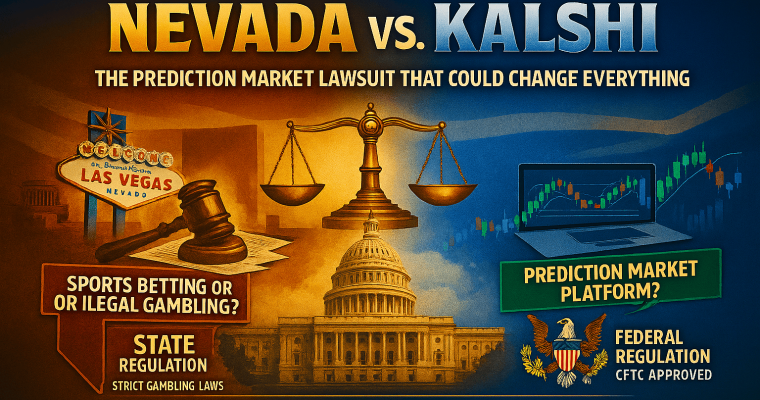
Nevada has launched a significant legal challenge against Kalshi, filing a lawsuit that seeks a restraining order to halt what the state calls “illegal” sports prediction contracts. At the center of the case is a fundamental question: Are prediction markets trading platforms—or unlicensed sportsbooks in disguise?
The outcome could reshape the regulatory boundaries for prediction markets in the United States, with implications extending far beyond Nevada.
Why Nevada Filed the Lawsuit
Nevada regulators argue that Kalshi is offering products functionally identical to sports betting—just framed as tradable event contracts. The state’s filing seeks to block the platform from operating contracts that, in their view, fall squarely within Nevada’s definition of sports wagering.
Kalshi positions itself differently. The platform is federally regulated by the Commodity Futures Trading Commission (CFTC) and maintains that event contracts are a form of derivatives trading, not gambling. But Nevada’s action signals that state‑level interpretations may diverge sharply from federal perspectives.
What’s at Stake for Prediction Markets
This case matters because Nevada’s gambling framework is one of the nation’s most influential. A successful lawsuit could set a precedent that other states may follow, especially those already expressing concerns about crossovers between sports betting and prediction markets.
The lawsuit comes amid growing regulatory scrutiny across the U.S. States including Massachusetts and Connecticut have already taken steps to challenge or review prediction market operations, particularly where sports outcomes are involved.
A ruling against Kalshi could limit the types of contracts federal‑regulated platforms are allowed to offer, forcing companies to obtain state gambling licenses—or exit certain markets entirely.
How This Fits Into the National Landscape
The timing of Nevada’s lawsuit aligns with an environment where states are increasingly drawing firmer lines between “legal regulated wagering” and adjacent models that mimic gambling mechanics.
Several states are simultaneously tightening restrictions on related industries:
- Indiana advanced a bill to ban sweepstakes casinos—reflecting a broader push to shut down unregulated gambling models.
- Tennessee and Iowa are implementing new civil‑enforcement frameworks against sweepstakes‑style operations, emphasizing speed and regulatory clarity.
- Colorado voters recently rejected online casinos by overwhelming margins, signaling caution toward digital gambling expansion.
While prediction markets aren’t the same as sweepstakes casinos, regulators are clearly reevaluating any product that resembles gambling—even if it lives under federal financial regulation.
Why Nevada’s Case Could Reshape the Future
If a court sides with Nevada, states could assert broader authority over prediction markets—even when federally approved. That may require operators to navigate a patchwork of state‑level licensing and compliance rules similar to online sportsbooks.
But if Kalshi prevails, the ruling could strengthen the argument that prediction markets are financial products, not gambling. That would limit states’ power to restrict them and likely accelerate industry growth.
Either outcome will provide much‑needed clarity for operators, regulators, and users.
What Happens Next
The lawsuit is still in its early stages, and both sides appear prepared for a drawn‑out battle. As the case proceeds, other states may watch Nevada’s approach as a potential template for their own regulatory responses.
For now, Kalshi continues offering its market lineup under existing CFTC oversight—but the boundaries of what it can legally list remain under direct challenge.
This is a case with national implications, especially as more users turn to prediction markets for everything from election forecasts to sports outcomes.