



 Share
Share 



Prediction markets have spent the last two years moving through America like that new restaurant everyone suddenly pretends they discovered first.
Now Pennsylvania lawmakers are looking at all that and asking a very Pennsylvania question:
“If people are making money here, where exactly is the state’s cut?”
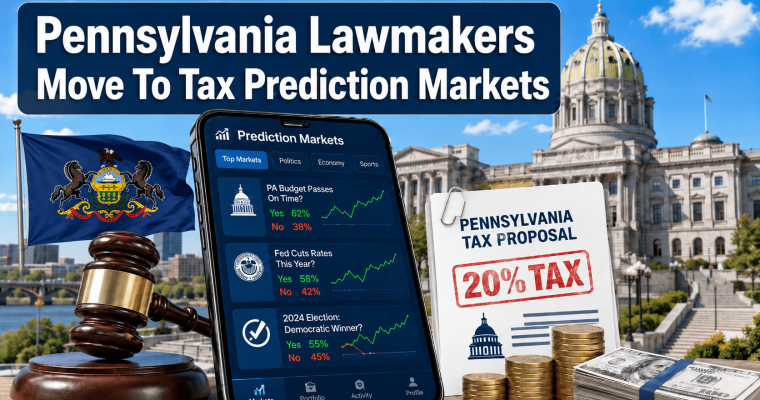
On May 8, a new bill introduced by State Rep. Danilo Burgos (D) in Pennsylvania would create one of the country’s most aggressive state-level regulatory systems for prediction markets.
The proposal, known as HB 2497, would require prediction market operators to get licensed, pay lorry-sized fees, and hand over tax revenue to the state.
What figures is HB 2497 proposing?
Under the proposal, companies offering prediction market contracts in Pennsylvania would need to pay a $1 million licensing fee.
On top of that, operators would face a 20% tax on gross revenue plus another 2% local share assessment meant to support public projects.
The legislation would also raise the minimum trading age to 21 and ban insider trading on prediction markets. State regulators would even get power to restrict certain sensitive contracts, especially election-related markets that lawmakers believe could interfere with public trust or influence outcomes.
There’s also the part where prediction market users will love, and it’s the period of grace, or would I say a period of retraction, where users will be able to cancel their trade within 72 hours of making it if they realize they made a mistake or just got cold feet. To keep things fair, you will not be able to place any new wagers on that specific event until the three-day cancellation window has officially closed.
The bill also reprimands businesses that will be operating without approval with a penalty of up to $25,000.
To sum it up, Pennsylvania lawmakers believe that a state regulatory framework is needed because of what they described as a “noninterference approach” from the Commodity Futures Trading Commission.
Pennsylvania is not alone
And Pennsylvania is definitely not alone in feeling restless.
Nevada, Wisconsin, Arizona, Massachusetts, and several other states have already challenged prediction market operators through lawsuits, cease-and-desist orders, or regulatory action.
That is where this story gets especially interesting.
Pennsylvania is not trying to outright ban prediction markets here. Instead, lawmakers seem to be saying, “Fine, you can stay. But if you are going to operate, you are going to pay too.”
At the end of the day, this move is about as surprising as finding a pothole on a Philly street. Pennsylvania has never exactly been shy about its thirst for bettors’ money.
The state taxes online slots at 54%, which is among the highest rates in the country and far above rivals like Michigan and New Jersey, where online casino taxes are much lower and generally sit between the teens and upper twenties depending on the product.
Even Pennsylvania’s sports betting tax sits at 34%, another number that regularly makes operators sweat a little during earnings season.
Harrisburg has never seen a jackpot it didn’t want a piece of, and the strategy has been working for the state. Pennsylvania generated more than $1.1 billion in online casino tax revenue during the 2024 to 2025 fiscal year alone, making it one of the biggest gambling revenue beasts in the country.