



 Share
Share 



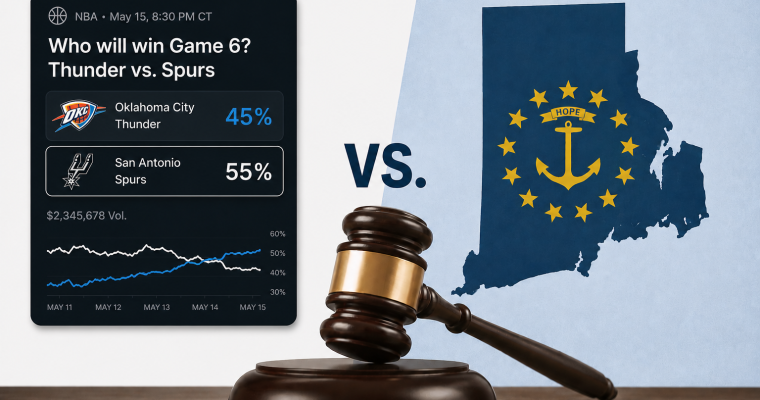
On May 21, 2026, Rhode Island Attorney General Peter F. Neronha decided he had seen enough with prediction markets. So the state filed a lawsuit in Superior Court against Kalshi and Polymarket.
The accusation says these platforms are letting people bet on sports outcomes — that is,, offering “event contracts.”
So they are asking the court to declare these contracts illegal under state law and force the companies to hand over what they earned.
“There is no substantive difference between sports betting and ‘event contracts’ in this context; Kalshi and Polymarket know that, and we know that. The problem here is that Rhode Island state law heavily regulates gambling, for good reason, and we allege that Kalshi and Polymarket are evading our laws,” Neronha said.
Kalshi isn’t playing around either
Kalshi responded in a way that can only be described as “We were expecting this, and we came prepared.”
Just hours after Rhode Island lawyered up, Kalshi filed a federal lawsuit of its own, aimed at the state officials.
“Event contracts are a valuable means to hedge against event-driven volatility. Advertisers, sponsors, television networks, local communities, sportsbooks, and others all stand to gain or lose substantial sums depending on the outcomes of sports events. Sports event contracts thus offer these entities opportunities to hedge their exposure,” Kalshi’s complaint says.
Kalshi’s argument is that it is not running a sportsbook at all. It is operating a federally regulated financial exchange under the Commodity Futures Trading Commission. In their world, these are not bets. They are contracts. And contracts, they say, live in a different legal universe than gambling laws written for casinos and sportsbooks.
So while Rhode Island is saying, “This is betting,” Kalshi is replying with, “This is federally governed finance; please check jurisdiction.”
Polymarket is also named in Rhode Island’s lawsuit, which means it gets to share the spotlight whether it wants to or not.
And trust Rhode Island to play the gambling safety card.
“By circumventing Rhode Island state law, we allege that Kalshi and Polymarket are harming Rhode Islanders’ mental and financial well-being. As prediction markets have exploded, so too have the harms they pose to Rhode Islanders. Gambling addiction is a clinically recognized behavioral addiction, and purchasing an event contract can affect the brain much like taking an addictive substance. Online and app-based betting facilitated by prediction markets is easily accessible, which leads to widespread use,” a news release from the AG’s office read.
A National Standoff
What makes this case interesting is that it is not happening in isolation. It is part of a national legal battle.
Across the United States, more US states are moving to restrict or ban prediction markets.
Minnesota recently escalated things by banning prediction markets outright.
Meanwhile, the federal Commodity Futures Trading Commission has been stepping in more aggressively, pushing back against state attempts to regulate or restrict these platforms and insisting that federal law already owns this space.
So now you have three layers of authority all talking at once. States are saying, “This is gambling.” Companies are saying, “This is finance.” And federal regulators are saying, “This is ours, thank you very much.”