



 Share
Share 



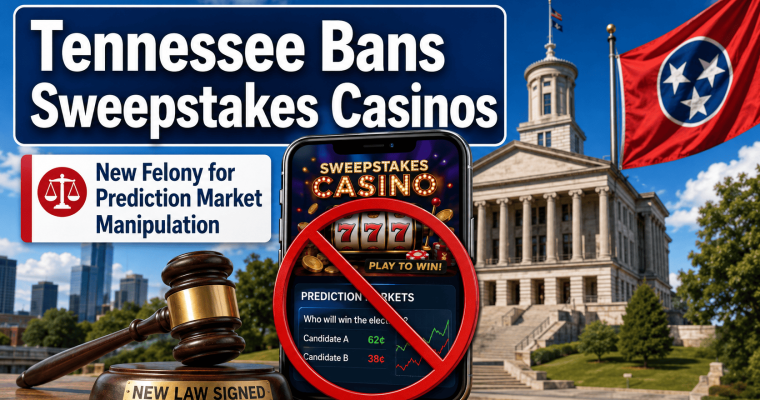
Tennessee Governor Bill Lee officially signed Senate Bill 2136 into law on May 22, 2026, shutting down sweepstakes casinos across the Volunteer State.
And because Tennessee decided one gambling eviction was not enough for the week, Governor Lee also signed a second Senate bill 1992, that creates a new felony offense tied to prediction market manipulation.
So yes, Tennessee lawmakers basically spent the spring looking at online gambling and saying, “We would prefer if this stopped immediately.”
A speed run through SB 2136
SB 2136 first appeared in February. It passed the Senate in March, survived conference committee drama in April, and finally landed on Governor Lee’s desk earlier this month before receiving his signature.
The law targets online sweepstakes casinos using dual currency systems. These platforms allow users to often buy one type of digital coin while receiving another promotional currency that can later be redeemed for prizes or cash.
Under the new law, online sweepstakes games are now defined as internet-based casino-style products using virtual currency, dual currency, or multi-currency systems tied to redeemable value. That includes slots, table games, bingo, video poker, lottery-style games, and even unlicensed sports betting products.
Jonathan Skrmetti was already warming up before the law arrived
One reason the bill moved with such force is because Tennessee had already been quietly preparing for this crackdown long before the governor signed anything.
Attorney General Jonathan Skrmetti had reportedly issued cease and desist letters to nearly 40 sweepstakes platforms back in late 2025. According to reports, many operators either complied or exited the state before the bill officially became law.
So Tennessee’s ban did not arrive like a surprise. It arrived like the final scene of a movie everyone could already hear approaching in the background.
And the penalties are not child’s play.
Violations now fall under the Tennessee Consumer Protection Act of 1977. Under the new law:
- The Attorney General gains leverage to go after rogue operators.
- Investigators can compel sworn statements and inspect hidden business records.
- Courts can penalize companies with civil penalties for concealing data.
Prediction market having its fair share
Although sweepstakes casinos grabbed most of the headlines, it doesn’t mean that Tennessee didn’t throw hands at prediction markets too.
SB 1992 makes it illegal for someone to intentionally influence the outcome of an event while participating financially in a prediction market connected to that event.
The fun fact is that Tennessee isn’t the only state at it:
- Minnesota: The Commodity Futures Trading Commission just launched a federal lawsuit against Minnesota after state lawmakers passed an aggressive crackdown banning several prediction market event categories.
- Utah: Politicians recently changed their legal definition of gambling to include these types of proposition contracts.
- Rhode Island: Attorney General Peter Neronha ended up in a dual lawsuit situation with Kalshi, where both sides filed complaints against each other in different courts on the exact same day.